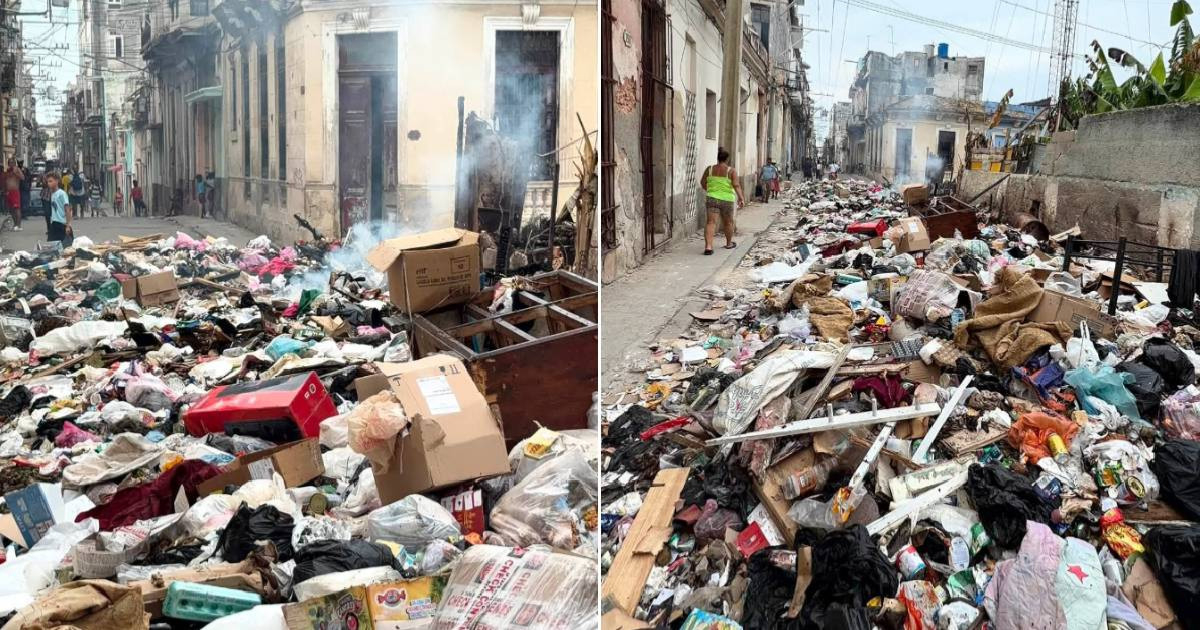
Images shared on social media this Thursday show the corner of Lealtad and Maloja, in the Los Sitios neighborhood in Central Havana, completely blocked by a mountain of waste that occupies nearly an entire block, with visible columns of smoke from the open-air burning of refuse.
The photographs, published by the user DisA on their Facebook profile, show plastic bags, cardboard boxes, clothing, wood, containers, and decomposing organic waste.
People walk along the narrow walkable strips of the sidewalks, surrounded by colonial buildings with crumbling facades.
One of the people who commented on the post confirmed the exact location: "That's at Lealtad and Maloja, how horrible." Another user summarized the extent of the problem beyond the capital: "It's not just Havana; that's how all of Cuba is."
Citizen outrage was immediate. "The government thinks they can force the people to be their trash cans too," wrote one user.
Another was more direct: "We are alive by miracle." A third comment pointed to state responsibility: "It is mandatory for governments to take care of garbage collection; it is like that in all countries around the world."
The scene at Lealtad and Maloja is neither an isolated nor a new occurrence. That same corner was the site of a makeshift dump fire in April, during a nighttime blackout.
The Los Sitios neighborhood has experienced similar incidents throughout this year. A waste fire occurred at the intersection of Sitios and División in May, while complaints about the accumulation of trash around the Church of San Judas Tadeo and San Nicolás have been recurring.
In June, a mountain of garbage blocked the intersection of San José and Escobar, also in Centro Habana.
In August, one of the sides in Trillo Park, in the neighboring area of Cayo Hueso, was overflowing with waste and worms, while the deputy director of the Office of the Historian, Perla Rosales, admitted that Old Havana can’t stay clean for even two hours after a cleaning effort.
The government attempted to alleviate the crisis with a pilot experiment of electric tricycles in the Rampa Popular Council, but the project failed in August.
The president of the Popular Council located in Vedado acknowledged that "unfortunately, the initial idea and the goal with which the collection of solid waste was designed using electric tricycles has not been realized."
The health consequences are severe. Cuba closed 2025 with at least 81,909 official cases of dengue and chikungunya and 65 fatalities, a outbreak that The New York Times directly linked to the garbage crisis.
More than 500,000 residents of Havana were without regular access to drinking water in July, significantly increasing the epidemiological risk in neighborhoods like Los Sitios, one of the most densely populated areas of the capital.
The root of the problem is structural. At the beginning of the year, it was revealed that out of the 106 garbage collection trucks in Havana, only 44 were operational, paralyzed due to a lack of fuel and mechanical deterioration.
The city generates between 24,000 and 30,000 cubic meters of solid waste per day, but up to 23,814 cubic meters remain uncollected each day. The shortage of containers exacerbates the situation, as the capital has about 10,000 when it would need between 20,000 and 30,000.
Related videos:
Filed under: