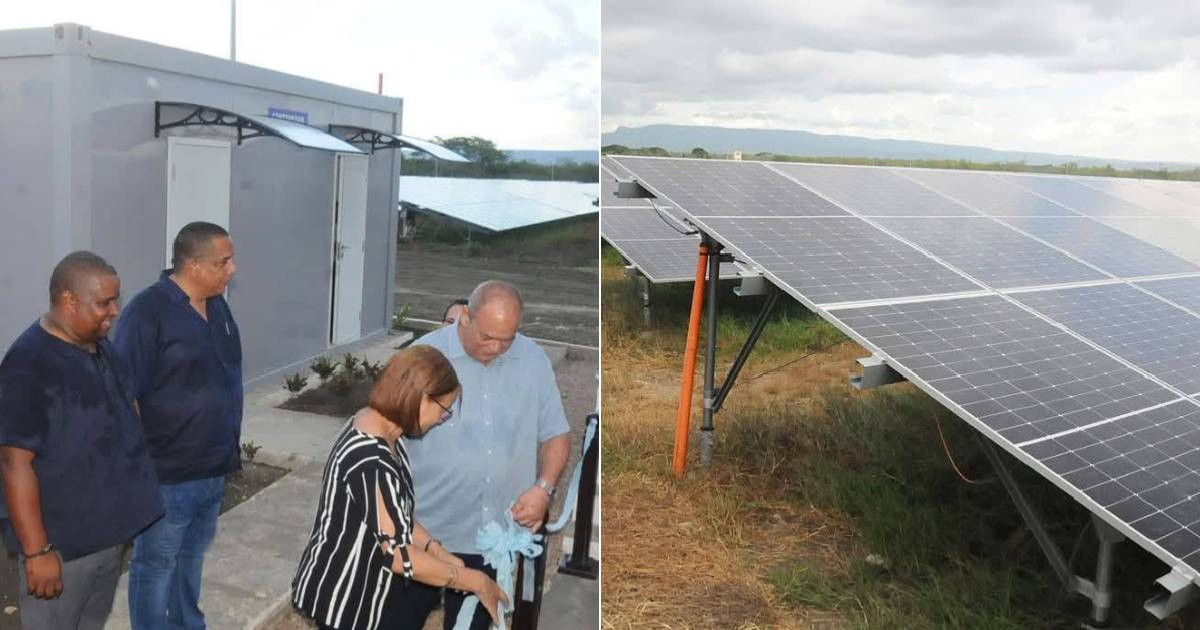
The Minister of Energy and Mines, Vicente de la O Levy, led the official opening this Saturday of the El Algarrobo photovoltaic solar park in the province of Guantánamo, a facility with a capacity of 21.8 megawatts that officials presented as the first of its kind synchronized with the National Electric System (SEN) with exclusively Cuban participation.
The park is located at kilometer 10 of the road to the popular council of Paraguay and required an investment of over 1.4 billion Cuban pesos, specified a report from Radio Guantánamo.
The work was carried out by the Electric Company, the Ministry of Construction, and other entities in the industrial sector, although its history was marked by setbacks.
It was supposed to be ready by the end of 2025, but it has faced delays that the government attributes to restrictions resulting from the U.S. embargo.
The most notable incident occurred in August, when the foreign investors involved in the project unexpectedly withdrew and the official press did not provide an explanation for the reasons, which led a team of around 10 Cuban technicians to take on the synchronization themselves.
Authorities estimate that El Algarrobo will be able to meet 25% of the province's daily electricity demand when operating at full capacity, which should reduce blackouts during daylight hours.
The inauguration ceremony also featured the presence of Yoel Pérez García, the first secretary of the Communist Party in the province, and Alis Azahares Torreblanca, the governor of the territory.
Guantánamo is the most energy-vulnerable province in the country, as it relies on a single 110 kV transmission line from Santiago de Cuba to connect to the national electrical system.
When that line fails, the entire province is left in the dark. This happened in June, when a fault in that line left the whole province without electricity.
Before this inauguration, the territory already had about 80 megawatts generated through photovoltaic parks in La Yaya, the substation in the capital, Santa Teresa, Los Ciguatos, and Punta de Maisí.
As part of the same distributed generation strategy, a state charging center installed in an old microdump was inaugurated in the provincial capital recently, the third of its kind in the city, featuring 15 kilowatts of solar panels and 12 kilowatts of storage.
The official goal is for the eastern region to increase its renewable energy generation from the current 15% to 37% by 2030, as part of a national program aiming for 92 solar parks and 2,000 megawatts installed nationwide by 2028.
Related videos:
Filed under: