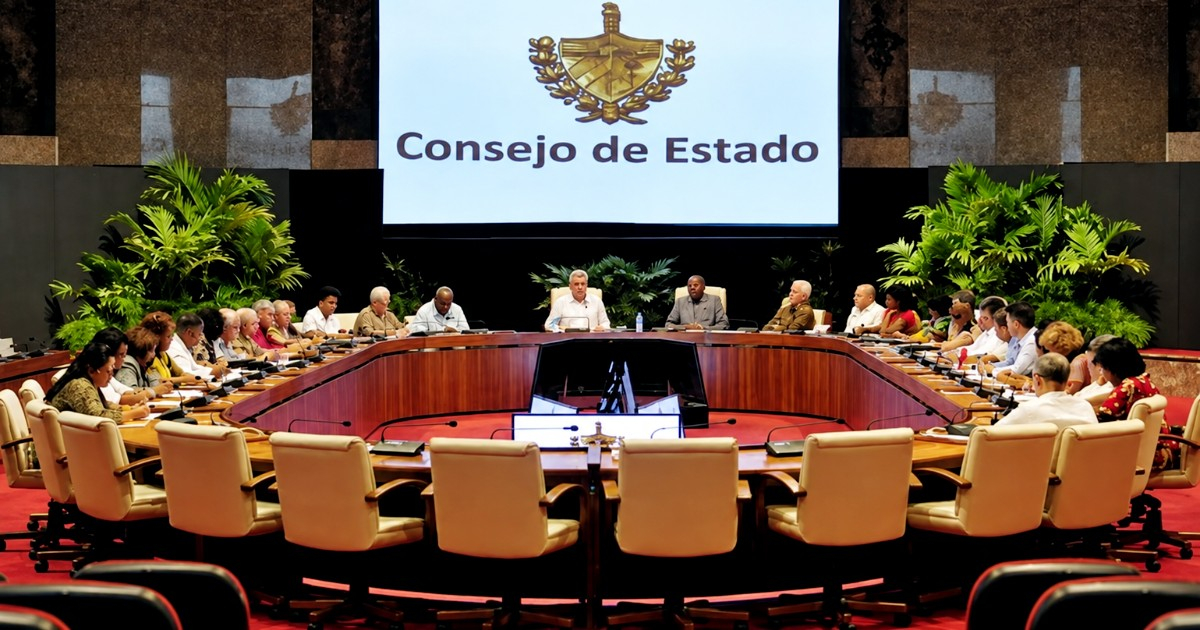
The Council of State of Cuba approved three new decree-laws on Wednesday in an extraordinary session presided over by Esteban Lazo Hernández: "On Strengthening Social Work," "On the Recruitment of Workers to Carry Out Administrative, Technical, or Service Tasks for Foreign Representations," and "On Oil and Gas," as reported by the state media Cubadebate.
The three regulations are part of the legislative development stemming from the 176 economic and social transformations approved by the National Assembly of People's Power on June 18 and 19, 2026, marking the largest package of structural reforms for the Cuban economic model in decades, grouped into 23 thematic axes.
Implementing this package requires a large-scale regulatory reform: the regime acknowledged that more than 148 legal provisions must be modified or repealed, and 32 new higher regulations must be approved, including 10 laws, 14 statutory decrees, and eight decrees.
The three decree-laws approved on Wednesday are not the first of this process. On July 16, the Council of State had already approved two similar regulations—regarding the State Business System and Agricultural Cooperatives—and, at the end of July, the National Assembly enacted five structural laws, including the new Labor Code, published as Law 189 on August 14, which replaces Law 116 of 2013.
New legal framework for social work
The decree-law on social work, presented by Minister Jesús Otamendiz Campos, aims to provide this profession with its own legal framework that has not existed until now: its regulation relied on administrative provisions and political programs, without a generally applicable standard.
The new provision establishes principles, organizational structures, functions, and procedures to prioritize the work of social workers and their impact on the design and evaluation of public policies, with an emphasis on the municipality, the popular council, and the constituency.
Direct contracting for foreign representations
Regarding the hiring of Cuban workers for foreign representations, one of the most significant changes announced is the possibility of bypassing the mandatory mediation of a state employer entity.
The , which currently regulates this matter, establishes that Cuban workers must be hired to provide services in foreign representations through employers authorized by the State.
According to the information released about the new regulations, the approved decree-law opens the possibility for direct contracting, while also maintaining the option to resort to intermediary entities.
The change provides regulatory support for an opening that the regime had announced since the end of 2025, but which at that time lacked a legal instrument to implement it.
In December of that year, the Deputy Prime Minister and Minister of Foreign Trade and Foreign Investment, Óscar Pérez-Oliva Fraga, stated that foreign investors could choose to hire Cuban workers directly or turn to a state employment entity.
CiberCuba then pointed out that the announcement was not accompanied by any decree, resolution, or operational mechanism that would allow for the direct hiring, while the regulations imposing state mediation remained in effect.
The approval of the new decree-law, therefore, represents a shift from a political announcement to its formal legal establishment. However, the exact scope of the change, its conditions, and the timing of its implementation will depend on the text that is published in the Official Gazette and its entry into force.
New rules for oil and gas
The third decree-law, "On Oil and Gas," establishes a comprehensive legal framework for the entire cycle of activities in the sector—exploration, extraction, refining, transportation, storage, and marketing—both in national territory and within the continental shelf and Exclusive Economic Zone.
This framework updates legislation that was based on the Mining Law of 1995 and complements the , approved in July, which had already opened the extraction of crude oil and natural gas to private and foreign actors under a concession regime.
The regime also reported during the session on the overall progress of the legislative process related to the 176 measures, which additionally includes the repeal of Decree-Law 155 on confiscation, approved at the end of August.
The three approved regulations will be published in the Official Gazette of the Republic, a necessary step to understand their full content, scope, and the dates set for their entry into force.
Related videos:
Filed under: