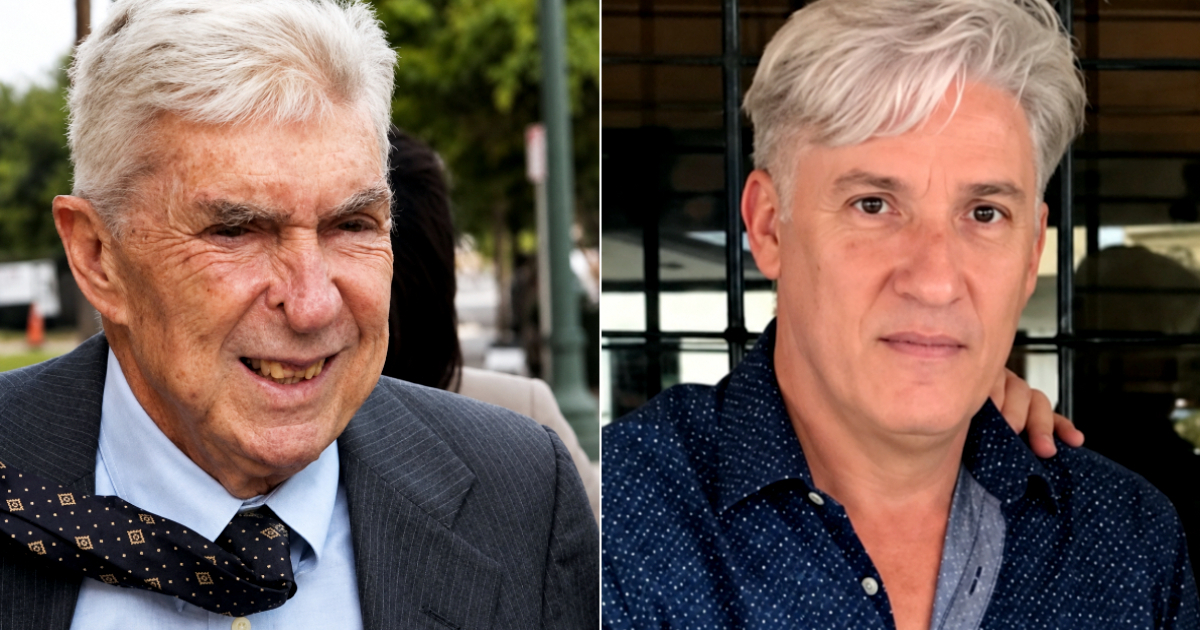
In April 2008, the Cuban government made a strong accusation against the United States: Washington, the Ministry of Foreign Affairs (MINREX) stated at that time, was allowing Luis Posada Carriles to enjoy a "peaceful life" in Miami while preventing him from being tried as a terrorist.
The accusation was not exceptional. For decades, the Cuban regime turned Posada into one of the principal figures of its narrative on terrorism against Cuba and repeatedly used his presence in the United States to accuse Washington of harboring and protecting individuals responsible for violent actions against the island.
Eighteen years after that statement from MINREX, a revelation introduces an uncomfortable paradox into that narrative.
While Havana publicly denounced the alleged U.S. protection of Posada, Cuban intelligence had apparently managed to place one of its assets within the innermost circle of the anti-Castro militant.
The man was Fernando Armando Valdés Pérez.
The U.S. Immigration and Customs Enforcement (ICE) asserts that Valdés was an asset of Cuban intelligence tasked since at least the 1990s with infiltrating exile organizations.
And an investigation by journalist Nora Gámez Torres for the Miami Herald has unveiled the extent of that infiltration.
Valdés was not just an acquaintance of Posada.
He accompanied him to medical appointments and events, took care of his medications, and practically acted as his representative and caregiver. Orlando González, a close friend of Posada, described him as a kind of "devoted son".
The relationship reached such a level of trust that Posada stayed hidden for more than a year in a house owned by Valdés in Guatemala. Later, when some of his associates tried to prevent Valdés from accompanying him on a transfer to Mexico due to the suspicions he was already generating, Posada refused to leave without him.
That is to say, while the Cuban government publicly denounced Posada's impunity, a man now identified by U.S. authorities as a Havana operative had extraordinary access to his private life, his movements, and his surroundings.
Inn as a symbol of Cuban narrative
Luis Posada Carriles was one of the most well-known and controversial figures of the anti-Castro exile community.
A veteran of the Bay of Pigs and a former collaborator of the CIA, he dedicated a good part of his life to fighting the regime of Fidel Castro.
Cuba and Venezuela held him responsible for the attack on Cubana de Aviación Flight 455, which occurred on October 6, 1976, off the coast of Barbados and resulted in the deaths of 73 people.
Havana also accused him of being behind the attacks on Cuban hotels in 1997 and of participating in a plot to kill Castro in Panama in 2000.
Posada was never convicted of terrorism in the United States.
The Barbados crime has, over the years, become a fundamental piece of the regime's political narrative regarding the violence stemming from exile and the alleged responsibility of Washington for allowing its perpetrators to operate or reside in U.S. territory.
Posada's presence in Miami provided Havana with a particularly effective argument.
When a U.S. judge dismissed the immigration charges against him in 2007, the regime intensified its accusations.
"The peaceful life" of Posada in Miami, stated MINREX in April 2008, would add to the "humiliations, violations, and atrocities" for which, according to Havana, the administration of George W. Bush would be remembered.
The Cuban regime then claimed that the United States was deliberately preventing Posada from being prosecuted as a terrorist and presented the case as evidence of Washington's double standards in its fight against terrorism.
The mysteries of Barbados
The political use of the Barbados attack does not diminish the seriousness of the crime nor the longstanding suspicions surrounding Posada Carriles.
But that doesn't mean that all the questions surrounding the attack have been answered.
An investigation by journalist Carlos Cabrera Pérez published by CiberCuba in 2021, marking the 45th anniversary of the crime, gathered testimonies, documents, and contradictory accounts that challenge aspects of the established narrative regarding its intellectual authorship.
Among them is the testimony of Ricardo Morales Navarrete, known as "El Mono," who testified under oath in a Florida court in 1982 that he had been part of the conspiracy, but exonerated Orlando Bosch from the attack.
Other sources cited in that investigation also exonerated Posada and Bosch, while some accounts suggested the possibility that agents linked to Cuban intelligence may have had prior knowledge of the operation or even intervened in it.
None of those hypotheses allow us to assert that the Cuban regime organized the Barbados attack.
The former officer of the Cuban General Intelligence Directorate, Enrique García Díaz, mentioned by CiberCuba in that investigation, acknowledged that he did not have evidence to hold the regime accountable, although he voiced his doubts about whether the Cuban services could have been completely unaware of what was happening, given their extensive infiltration of exile groups.
The case remains shrouded in contradictory accounts and historical controversies.
In addition, the infiltration activity attributed by ICE to Valdés begins, at least according to publicly available information, in the 1990s, nearly two decades after Barbados. Therefore, there is no known element that links him to the 1976 attack.
What did Havana really know about Posada?
The revelations about Valdés Pérez raise a different question.
If U.S. authorities are correct and he was indeed an asset of Cuban intelligence, Havana gained an exceptional position to monitor the movements of one of the men it publicly portrayed as a serious threat to Cuba.
The question is no longer what the regime knew about Barbados in 1976, but what it knew about Posada during the following years when one of its alleged assets was practically by his side.
What information did Valdés provide to his superiors? What did Cuban intelligence know about Posada's contacts, movements, and activities? How far did that operation actually go?
And why was it more valuable to maintain an asset so close to Posada for years than to interrupt that relationship?
There are no public answers to those questions.
There is no evidence that Valdés had instructions to attack, kidnap, or cause physical harm to Posada. The purpose of an undercover agent may precisely be to stay close to a target for as long as possible to gather information about them, their contacts, and the organizations in their environment.
Therefore, it would be incorrect to conclude that the Cuban regime "protected" Posada Carriles simply because his alleged asset stayed with him for years.
But the political contradiction remains.
The paradox of the "peaceful life"
For years, Havana pointed to Posada's presence in Miami as evidence that the United States was protecting a man whom the regime blamed for terrorism.
It is now known that, during part of that same period, the Cuban intelligence apparently had an asset with privileged access to Posada himself.
The paradox is even greater because some of his close associates claim that they suspected Valdés many years before the United States took action against him.
Orlando González told the Miami Herald that he warned the FBI around 2006 about his suspicions that Valdés might be linked to Cuban intelligence.
González also claims that he later confronted Valdés in person and informed him that he had spoken with federal authorities. According to his account, Valdés responded that if he had truly been a Cuban spy, he could have killed both Posada and González himself.
The sentence does not reveal what his true orders were or what the objectives of the operation were. However, Valdés's identification by ICE sheds new light on those years.
The "peaceful life" of Posada that the regime denounced from Havana may not have been as disconnected from the Cuban services as its public discourse suggested at the time.
While accusing Washington of allowing one of its biggest enemies to live peacefully in Miami, its own intelligence had apparently achieved something that any espionage service would consider extraordinarily valuable: having a trusted man next to the target.
Related videos:
Filed under: