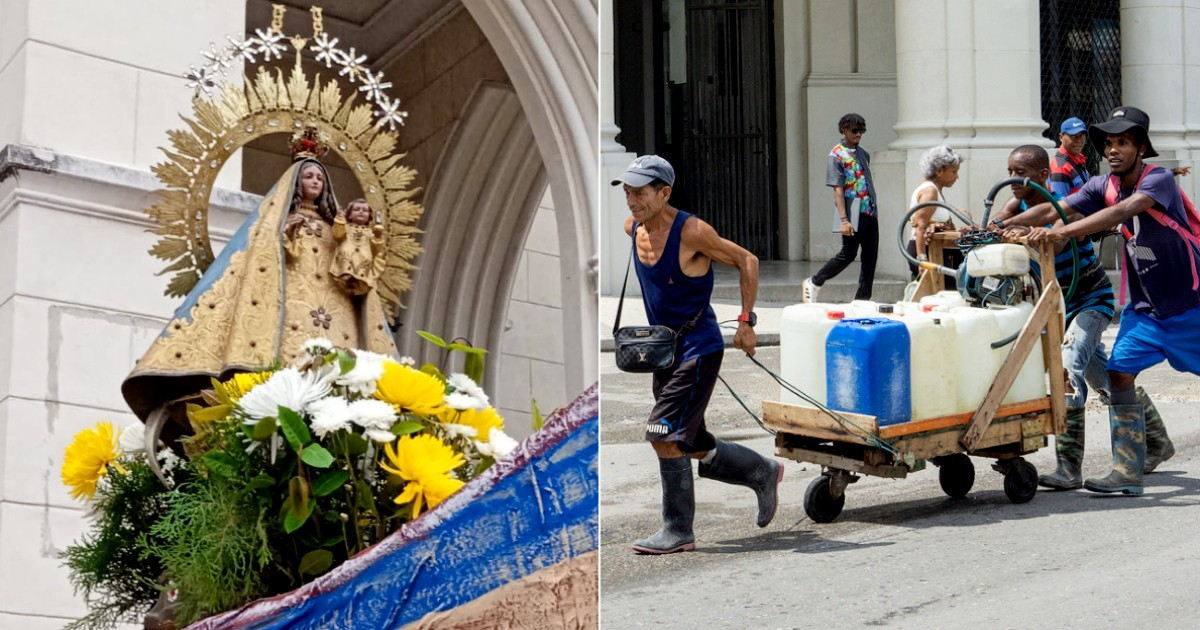
With the image of the Virgin of Charity of El Cobre on a platform surrounded by yellow and white flowers, dozens of faithful walked through the streets of Vedado in Havana in a procession organized by the Sacred Heart of Jesus parish to celebrate the patroness of Cuba on September 7 and 8.
The images of the procession, captured by photographer Pedro Luis García and shared on social media by journalist Magdiel Jorge Castro, depict the Marian figure on a carriage adorned in front of the neo-Gothic facade of the Vedado church.
The celebration in Havana joined those that took place simultaneously in other parts of the island and the diaspora.
In El Cobre, Santiago de Cuba, the Sanctuary remained open continuously from Monday afternoon until midnight on Tuesday, with masses at midnight, 9:30 in the morning, and 8 in the evening. The main procession in Santiago departed from the Archbishop's headquarters to the Cathedral under the motto "Charity unites us."
In Miami, among other celebrations and spontaneous displays of devotion, the exiled community held a solemn mass at the Miami-Dade Fair & Expo Center, presided over by Archbishop Thomas Wenski, preceded by a rosary and procession from apostolic movements.
Cuban devotion in that city dates back to the arrival of the image in 1961, and the Ermita de la Caridad, built between 1967 and 1973, remains the main sanctuary of that religious and patriotic memory.
This year's celebration carries a particular symbolic weight. Cuba is experiencing one of its worst energy crises: blackouts affected 72% of the territory in August, and the electric deficit exceeded 2,060 megawatts in the first days of September.
Since more than 80% of water pumping systems rely on electricity, the crisis has resulted directly in water shortages for millions of people.
That context adds an additional meaning to the popular cry for the Virgin of Charity.
In Santería, the patroness of Cuba is syncretized with Oshún, orisha of love and fresh waters, divine sister of Yemayá —orisha of the sea—, who together represent the entirety of water in Yoruba mythology.
In a country where water does not flow from the taps and electricity is absent for hours, the prayer to these female figures of water resonates with an urgency that goes beyond the spiritual.
The Cuban Catholic Church has openly linked faith with the country's situation. The Archbishop of Santiago de Cuba, Dionisio García Ibáñez, stated that “the only way to face life is by placing ourselves in God's hands,” while the Archdiocese proclaimed that “faith is what saves Cuba.”
From the Vatican, Bishop Osmany Massó Cuesta declared: “I have prayed for our diocese and all our people,” before the image of the patroness.
The Virgin of Charity of El Cobre was proclaimed the patroness of Cuba by Pope Benedict XV on May 10, 1916, at the request of veterans of the wars of independence, and her veneration dates back to around 1612, when, according to tradition, three young fishermen found her image floating in Nipe Bay.
More than four centuries later, Cubans continue to turn to her to ask for what the regime cannot provide: water, food, and electricity.
Related videos:
Filed under: