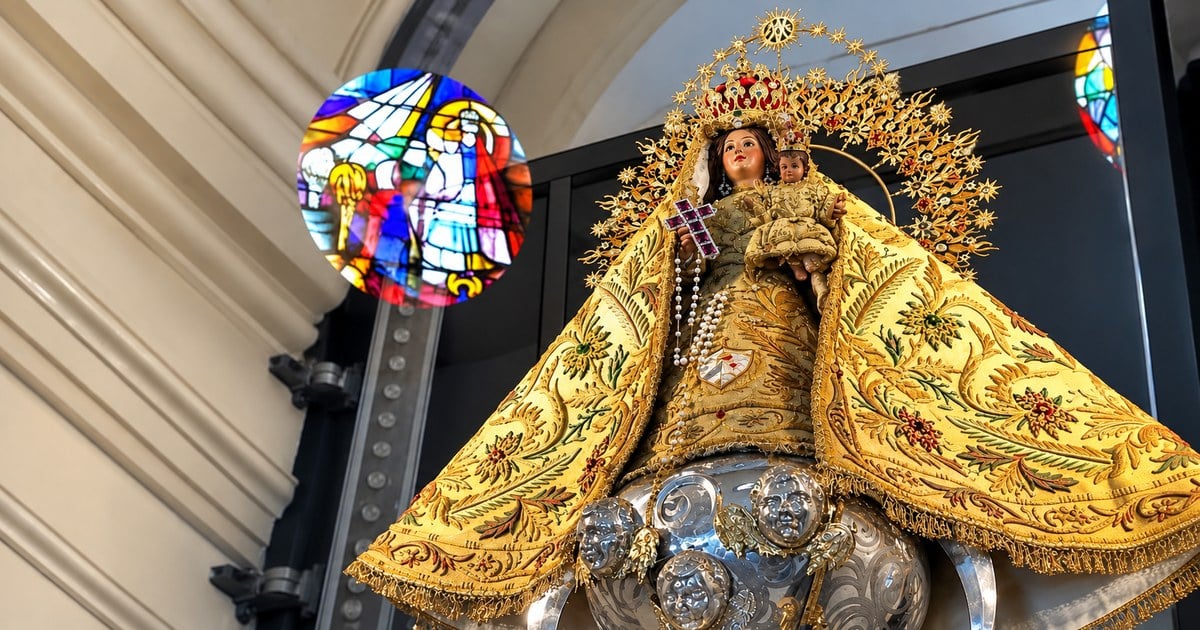
The story of the Virgin of Charity of El Cobre is intertwined with the very history of Cuba. According to the testimony provided by Juan Moreno in 1687, around 1612 he, as a child, was sailing with the indigenous brothers Juan and Rodrigo de Hoyos through the Bay of Nipe, in eastern Cuba, in search of salt. After a storm, they spotted on the waters a small image of the Virgin with the Child Jesus, placed on a board that read: "I am the Virgin of Charity." They took her to the estate of Barajagua, and over time, the image became venerated in the mining area of El Cobre, near Santiago de Cuba, where her sanctuary was built.
The devotion soon transcended the strictly religious. During the wars of independence, Charity became known as the "Mambisa Virgin." The fighters of the Liberation Army entrusted themselves to her and wore medals and the so-called “measure” of her image on their chests. In 1898, the troops of General Calixto García went to El Cobre in thanksgiving. On September 24, 1915, more than two thousand Mambi veterans, led by Generals Jesús Rabí and Agustín Cebreco, requested Pope Benedict XV to declare her the Patroness of Cuba. The pontiff agreed on May 10, 1916.
Decades later, the Virgin was still present among the Cubans fighting against the dictatorship of Fulgencio Batista. Historical research describes fighters from the Rebel Army in the Sierra Maestra carrying rosaries, crucifixes, images of the Virgin of Charity, medals, and religious necklaces. Even the priest Guillermo Sardiñas served as a chaplain among the guerrillas. This popular religiosity coexisted with the various political currents within the revolutionary movement.
After 1959, however, the power led by Fidel Castro came into direct conflict with the Catholic Church. In 1961, private schools, including Catholic ones, were nationalized; numerous priests and nuns left Cuba, and about 130 priests were expelled in September. Religious holidays disappeared from the official calendar, and the public presence of the Church was severely restricted. That very September, the authorities prevented a traditional procession of the Virgin in Havana; tensions escalated, and soon after, the major expulsion of clergy took place. For years, processions and public demonstrations of faith were practically suppressed.
But Cachita could not be expelled from the hearts of Cubans. She remained in homes, in hidden prayer cards, medals, candles, and the prayers of mothers and grandmothers. She survived decades of official atheism and state hostility.
A decisive moment arrived with Saint John Paul II. On January 24, 1998, in Santiago de Cuba, he solemnly crowned the image of the Virgin and reminded the nation of her connection with Céspedes, the Mambi fighters, and independence. He referred to her as the Queen and Mother of all Cubans, without distinction of political options or ideologies. The next day, he entrusted the Patroness with the "dreams and hopes" of the Cuban people.
The other great house of Cachita is in Miami. The venerated image at the Hermita de la Caridad arrived from Cuba on September 8, 1961, and that same night presided over a mass attended by about 30,000 exiles at the Miami Stadium. In 1966, Archbishop Coleman Carroll promoted the construction of the sanctuary; the first stone was laid in 1967, and the Hermita was dedicated in 1973. Facing Biscayne Bay, it became the spiritual home of the exile community and a permanent place of prayer for Cuba.
Today, September 8, 2026, the tradition remains alive on both sides of the Florida Straits. Pilgrims arrive at the Sanctuary of El Cobre for masses, processions, and prayers, while in Miami, thousands of Cubans gather once again around the Virgin.
To Cachita come the sick, the mother who fears for her son, the prisoner and his family, the exile who dreams of returning, and those who wait and fight for a free, democratic, reconciled, prosperous, and just Cuba.
Today, Cuba is experiencing a crisis that millions feel is the worst and most prolonged in its contemporary history: hunger, blackouts, migration, divided families, and despair. For this reason, from the Island and from exile, a single plea rises once again: Virgen de la Caridad del Cobre, Mother of all Cubans, protect your people. Cachita, be with us and help us bring an end, once and for all, to this lengthy Stations of the Cross that has brought us so much pain and suffering.
Related videos:
Filed under:
Opinion Article: Las declaraciones y opiniones expresadas en este artículo son de exclusiva responsabilidad de su autor y no representan necesariamente el punto de vista de CiberCuba.