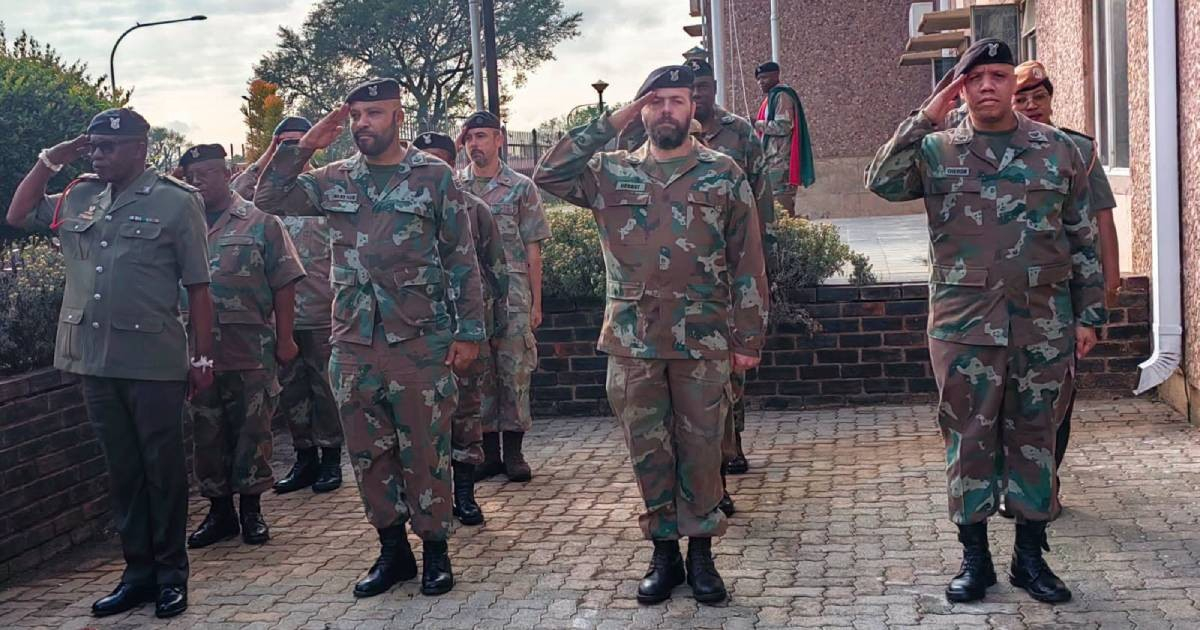
The South African National Defence Forces (SANDF) denied on Tuesday that 38 officers sent to Cuba as part of a military exchange program were pressured to give part of their assignments to "needy Cubans", although the union representing the military maintains its doubts and demands an independent investigation.
The military institution thus rejected the accusations published by South African media, as reported by the specialized portal DefenceWeb.
According to those reports, shortly after the arrival of the 38 officers in Havana, a superior is said to have suggested that they contribute money to assist Cubans, citing Cuba's historical support for the African National Congress (ANC) in its fight against apartheid.
A list would also have been circulated where the military personnel were required to write down their names and the amounts contributed.
The SANDF were adamant in responding to the accusations.
"At no time were members participating in education and training programs in the Republic of Cuba required to make donations to Cuban citizens. Therefore, none of our students made such contributions to any social assistance program or to needy Cuban citizens," stated the institution.
The South African armed forces acknowledged that they received a preliminary report on the case and indicated that they expect a complete report before providing further details. Additionally, they described the accusations as "irresponsible and misleading" and warned that they could harm public trust and the relations between South Africa and Cuba.
However, the South African National Defence Union (SANDU) maintains its questions.
Its national secretary, Pikkie Greeff, demanded the establishment of an independent investigation tribunal and reminded that "soldiers' salaries are not a discretionary fund."
According to reports cited by the union, the amounts involved would exceed 15,000 rands—approximately 938 dollars—in the case of senior officers and 3,000 rands for junior officers.
Greeff stated that these amounts are part of the remuneration for military personnel and cannot be considered simple subsidies. He also claimed that those who provided money were promised a reimbursement in December, without any official documentation to support that commitment.
"Rating volunteer payments does not solve the problem. In a military hierarchy, soliciting money from a subordinate carries inherent pressure. No soldier should feel obligated to forgo part of their pay to avoid being labeled as disloyal, uncooperative, or problematic," he stated.
SANDU also considers the alleged existence of a list containing the names of military personnel and the amounts contributed to be particularly concerning.
The union demands clarification on who authorized the collection, who received the money, what its destination was, and what legal basis the initiative had.
"Even if the entire plan had good intentions, it would still represent an improper and inappropriate use of the armed forces and their personnel for purposes that are not military at all," Greeff questioned.
The controversy once again brings the military cooperation between South Africa and Cuba under scrutiny, formalized through a defense agreement in 2012.
Among its background is the Thusano Project, through which Cuban technicians participated in the maintenance of South African military vehicles and which, according to parliamentary data, cost over 1.1 billion rands in four years.
In July 2025, the spending of 34 million rands on a charter flight to transport more than 212 South African soldiers to Cuba also generated criticism.
"If this agreement was legal, let the evidence prove it. Otherwise, those responsible will have to be held accountable," concluded Greeff.
Related videos:
Filed under: