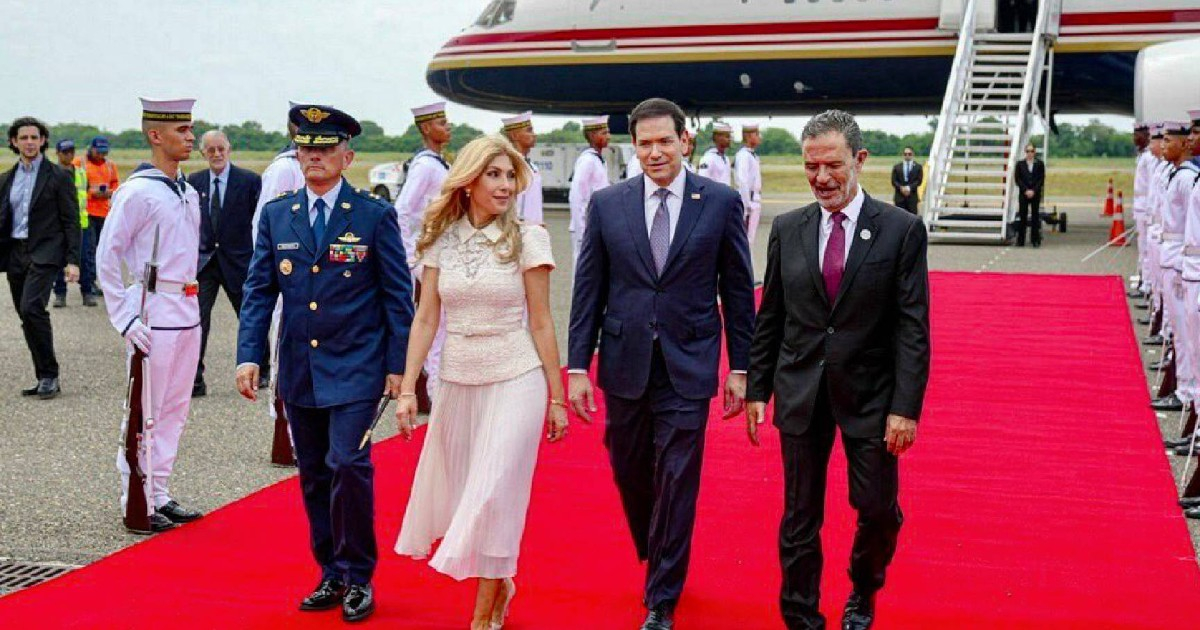
The United States Secretary of State, Marco Rubio, met this Tuesday with the Colombian president Abelardo De la Espriella in Barranquilla to seal the so-called Barranquilla Agreements, a package of security and investment measures that marks the formal relaunch of the bilateral relationship between the two countries after years of tension during the Gustavo Petro era.
It was the first high-level visit that De la Espriella received since he took office on August 7, and he chose to welcome it in his hometown.
The meeting took place in a warm atmosphere that included a personal touch: Rubio recalled, with laughter, that they have known each other since before entering politics.
“Two and a half years ago, we were at the same table at a wedding in South Florida,” said the Secretary of State, who spoke in Spanish during the joint press conference, which did not take questions.
Rubio also highlighted the strategic significance of the meeting: "The opportunities that exist between Colombia and the United States go far beyond mere security."
De la Espriella summarized the agreed objectives into three main areas: "rebuild the homeland, restore the economy, and secure the hemisphere."
The first aims at the recovery of the areas devastated by the magnitude 7.4 earthquake on August 10, centered in San José del Palmar, Chocó, which left at least 294 dead, 320 missing, and over 115,000 people affected, with American capital serving as a lever for reconstruction.
The second axis aims to attract US investment in infrastructure, housing, and energy, in exchange for fiscal discipline and improvements in legal security.
The third one, perhaps the most substantial in concrete commitments, revolves around the fight against drug trafficking.
De la Espriella confirmed that Colombia is now part of the Shield of the Americas, the anti-drug coalition founded by Trump in March 2026 that includes 18 countries, and that a working headquarters will be established in Medellín.
The president also unveiled his "21st Century Patriot Plan" to modernize radars, drones, and military intelligence with support from Washington.
"Colombia will contribute its own resources, [but] we need the support from the United States. We will work in the fight against narcotics. We will carry out fumigation. We will go after the armed organizations," he stated.
His message about criminal groups was even more direct: "A bandit who does not surrender will be eliminated. It's either prison or a grave."
In economic matters, Rubio and the Colombian Foreign Minister Omar Bula signed two memoranda of understanding: one concerning critical minerals and rare earths —aimed at positioning Colombia as a partner in clean technology, battery, and electric infrastructure supply chains, without granting exploitation rights to the U.S.— and another about civil nuclear energy, which opens a space for technical and gradual dialogue.
Both agreements are part of Washington's strategy to reduce its dependence on China for strategic materials.
On migration, De la Espriella aligned his position with that of the Trump administration: "Our principle is simple: legal, safe, and orderly migration. We are against illegal migration."
Two pending issues were left out of the agreements: the Colombian request to suspend the 12.5% tariffs that the U.S. imposes on its products—a demand that business groups were hoping to see resolved—and the reopening of the U.S. consulate in Barranquilla, which has been closed for over 30 years, a request that De la Espriella made personally: "It’s a matter that touches my heart, and I said that to the Secretary."
At the end of the conference, the Colombian president described the meeting with a phrase that encapsulated the tone of the day: "It was a frank, deep, strategic, and cordial conversation."
Rubio will continue his Latin American tour this Wednesday in Ecuador, where he will meet with President Daniel Noboa, and on Thursday in Peru with President Keiko Fujimori.
Related videos:
Filed under: