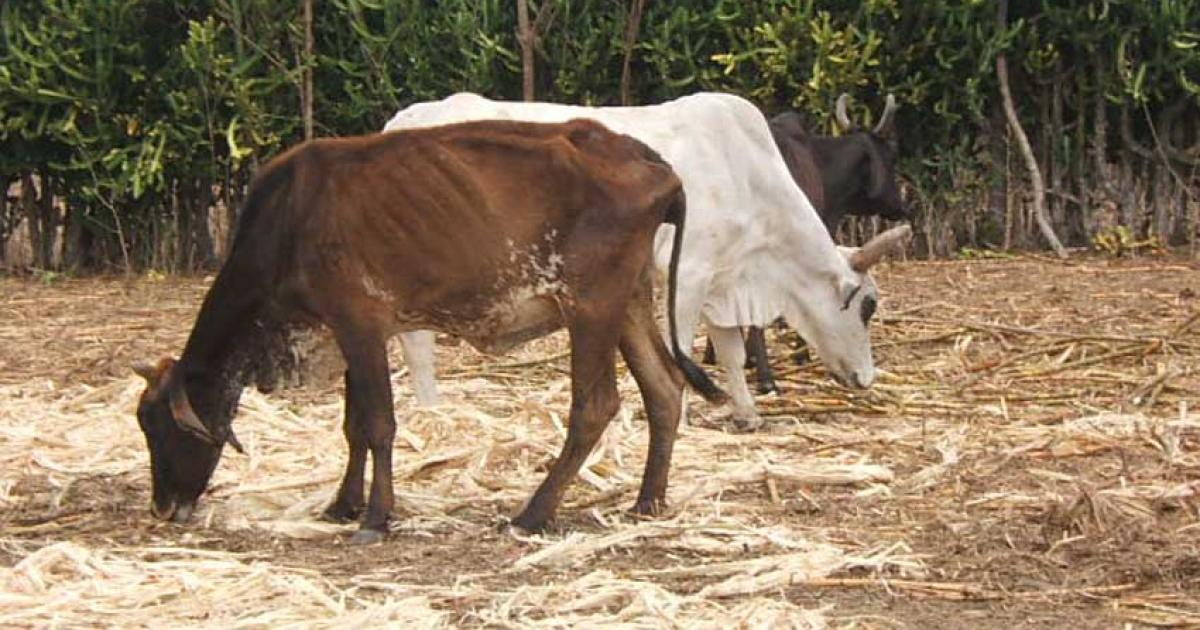
The Cuban government approved new regulations for the slaughter, consumption, and marketing of cattle and equine meat by agricultural producers. This legislation modifies the framework established in 2021 and even allows individuals without land to engage in the fattening of certain animals.
The Ministry of Agriculture published in Official Gazette No. 75 Ordinary the , which establishes the new procedure and will come into effect 30 days after its publication.
The regulation applies to both individuals and legal entities that own cattle and equines and are interested in slaughtering their animals for commercial purposes or consumption. Among its stated objectives are to encourage breeding, recognize rights related to livestock ownership, and expand producers' access to various markets.
One of the significant changes is that individuals who meet the requirements to fatten males in the categories of calves and yearlings will be able to do so without the need to own land.
In such cases, they must register the animal in the corresponding Livestock Registry and request a health permit from the competent authority.
New requirements for slaughtering livestock
To legally access the sacrifice, owners must be registered in the Land Registry and the Livestock Control Registry, as applicable; comply with animal health regulations; and adhere to the established categories and minimum weights.
In the case of cattle, the resolution states:
Bulls: 100% of the animals with a minimum weight of 370 kilograms.
Stickers: 40%, with at least 300 kilograms.
Heifers not suitable for reproduction: 5%, weighing 290 kilograms.
Cows unsuitable for reproduction: 6%, weighing 345 kilograms.
Cull cattle and stallions: extraction rate of 10%, with 450 kilograms.
For buffaloes, percentages and weights are established according to categories, while for equines, slaughter can be carried out without an extraction fee and at the producer's discretion.
Adult horses must weigh at least 280 kilograms, and females that are not suitable for breeding must weigh 250 kilograms.
Once the potential for meat production is determined, producers will define during the contract negotiations with the municipal balancer the deliveries to the approved destinations and what they will allocate for self-consumption, with prices and quantities agreed upon by mutual consent.
How will the sacrifice and sale take place?
The producer must request a slaughter certificate from the veterinary authority and subsequently go to the Livestock Registry to obtain a transit pass to an authorized slaughterhouse or slaughter slab.
These facilities must have veterinary inspection to medically certify the meat obtained.
The cost of slaughter and processing will be agreed upon between the producer and the slaughterhouse. Additionally, the owner may claim the by-products of their animals, including meat, blood, leather, entrails, and other edible and non-edible by-products.
Owners will be able to consume the meat or sell it at authorized destinations, provided they meet the requirements for quality, safety, and other current health regulations.
The government has lifted some of the conditions imposed in 2021
The new regulation expressly repeals the , with which the Cuban government allowed producers to slaughter and market cattle under numerous conditions.
At that time, livestock farmers had to fulfill state commitments for the delivery of milk and meat, ensure the growth of their herds, and not report any missing animals, among other requirements. The procedure also included applications to the municipal authorities and the approval of the Commission on Agrarian Affairs and Livestock.
One of the most restrictive rules stated that once the contracted plan was fulfilled, the producer could only sacrifice one animal for every three that were added to the herd. The Minister of Agriculture, Ydael Jesús Pérez Brito, explained the formula explicitly: if the herd increased by three animals, they could sacrifice one; if it grew by six, two.
The 2021 relaxation was introduced as part of a package of measures to stimulate agricultural production in response to food shortages. Shortly after, the first legal livestock slaughters began under these new rules: in June of that year, ten producers from a cooperative in Sancti Spíritus started to slaughter and legally sell beef to the public.
Five years later, the government is once again modifying the system in the midst of a prolonged food crisis, while beef remains a product that is difficult to access for a large portion of the Cuban population.
Related videos:
Filed under: