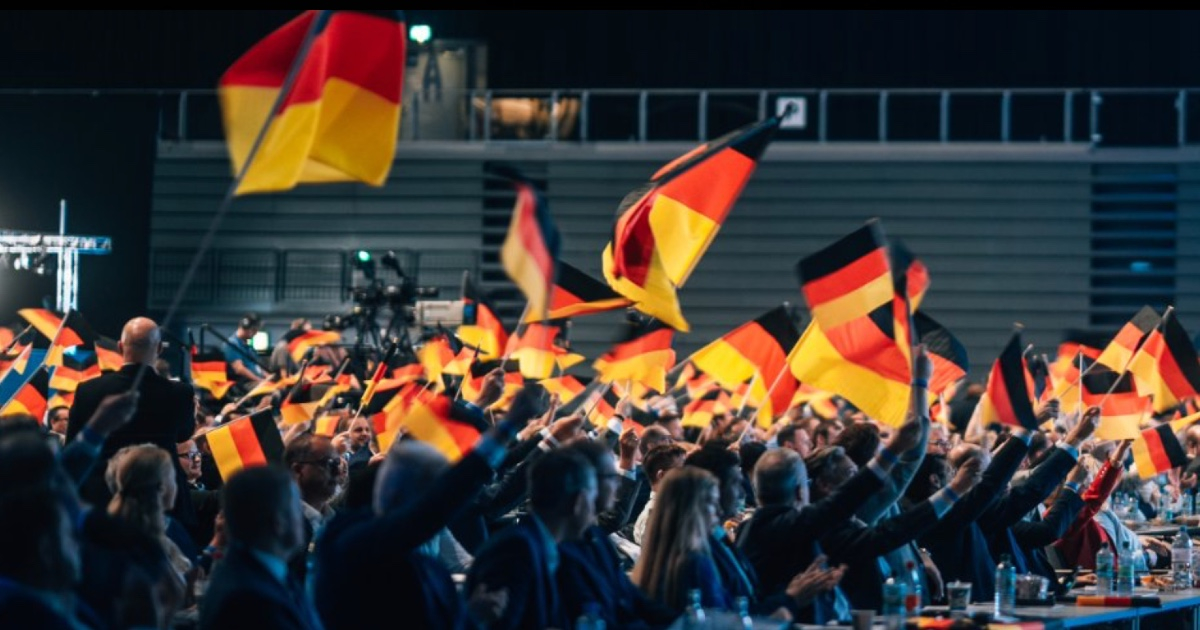
Germany is undergoing a political transformation much deeper than what its seemingly stable institutions suggest. The country is still governed by a coalition between the Christian Democratic Union of Germany and the Christian Social Union of Bavaria, CDU/CSU, a center-right alliance, and the Social Democratic Party (SPD), under Chancellor Friedrich Merz. However, the force that currently dominates much of the political conversation is Alternative für Deutschland (AfD), which has transitioned from being a marginal party to leading national polls and recently achieved a historic result in Saxony-Anhalt.
The Bundestag, the Federal Parliament of Germany, currently has 630 seats. The CDU/CSU holds the largest parliamentary group with 208 deputies; AfD has 150; the SPD, 120; the Greens, 85; Die Linke (The Left), 64; and there are three deputies not affiliated with these groups.
The CDU, led by Friedrich Merz, and its Bavarian sister party, the CSU, headed by Markus Söder, represent the German Christian democratic and conservative tradition: social market economy, support for private enterprise, European integration, the Atlantic alliance, and a currently much more restrictive immigration policy compared to the era of Angela Merkel. Merz governs alongside the SPD, directed by Bärbel Bas and Lars Klingbeil, the latter also serving as vice chancellor and finance minister. The SPD maintains its social democratic orientation: protection of the welfare state, labor rights, redistribution, and a strongly integrated Europe.
The Greens, positioned between the center-left and the left, make energy transition, climate issues, Europeanism, and liberal social policies their main banners. Die Linke, to the left of the SPD, advocates for higher taxes on wealth, rent controls, and a significant expansion of social spending. German politics also includes the liberals from the FDP and the populist BSW, although currently neither has a federal parliamentary group.
And then there is AfD. Founded in 2013 as primarily a Euro-skeptical force, Alternative für Deutschland evolved into a national-conservative and right-wing populist party, with much harsher positions on immigration, asylum, national identity, and multiculturalism. Its co-chairs are Alice Weidel and Tino Chrupalla, re-elected in July 2026. Among its most influential figures is also Björn Höcke, leader of Thuringia and representative of the party's more radical sector.
The AfD proposes to drastically reduce immigration and asylum concessions, implement broader deportations, regain national competencies in relation to Brussels, fundamentally modify German climate policy, and restore closer economic relations with Russia. It also rejects a significant portion of German military aid to Ukraine. Some of these positions, along with statements and actions from certain leaders, have led German domestic intelligence services to subject the AfD and several of its regional organizations to surveillance for right-wing extremism.
In the European context, AfD can be partially compared to Marine Le Pen's Rassemblement National in France, the Austrian FPÖ, Geert Wilders' PVV in the Netherlands, or segments of the European nationalist right. However, AfD has its own peculiarities and significantly more radicalized factions; it is also not equivalent in all aspects to Giorgia Meloni's Brothers of Italy, which currently maintains a much more clearly Atlanticist orientation.
The electoral geography explains a significant part of the phenomenon. Germany is divided into 16 Länder, or federal states. In the federal elections of 2025, AfD emerged as the leading party in the five large Länder of former East Germany: Brandenburg, Mecklenburg-Vorpommern, Saxony, Saxony-Anhalt, and Thuringia. The CDU dominated Baden-Württemberg, Hesse, Lower Saxony, North Rhine-Westphalia, Rhineland-Palatinate, Saarland, and Schleswig-Holstein; the CSU won in Bavaria; the SPD was first in Bremen and Hamburg, while Die Linke led in Berlin.
But the 2025 data already seems outdated in light of the current progress. On September 6, 2026, AfD received approximately 43.8% in Saxony-Anhalt, compared to just around 17% for the CDU. This is the best regional result in AfD's history and puts their candidate Ulrich Siegmund close to being able to attempt to form the first regional government led by this party.
The problem for AfD continues to be the so-called Brandmauer, or "firewall": the CDU, SPD, Greens, and other traditional forces adhere to the principle of not forming coalitions with them. As a result, AfD can win elections and still not govern.
The situation for Friedrich Merz is particularly delicate. The latest ARD-DeutschlandTrend survey, conducted between August 31 and September 2, recorded a mere 13% satisfaction with his management. The AfD ranked first with 27%, followed by CDU/CSU with only 21%, the Greens with 15%, SPD with 13%, and Die Linke with 12%. Following the elections in Saxony-Anhalt, another poll found that only 14% believed Merz could lead the country effectively in facing its challenges, while 82% were skeptical of his ability.
The concerns driving this rift are quite clear: economy and industrial competitiveness, immigration, security, energy costs, pensions, infrastructure deterioration, and distrust towards the government. The AfD has also managed to gain credibility among certain segments of the electorate, particularly in matters of immigration and asylum: the DeutschlandTrend attributes greater public trust in this area to them than to any other party.
The next ordinary federal elections are to be held between January and March 2029, unless there is an early election. It would be unwise to claim who will win: there are over two and a half years remaining. However, if the vote were to take place now, the answer is indeed significant: AfD would start as the leading force according to several recent polls.
And there lies the German paradox. AfD is still politically isolated, but electorally it is becoming less so. The question is no longer simply whether it can continue to grow, but rather how long a system can sustain itself where the party that receives the most votes from a growing segment of the country remains permanently excluded from any coalition. Germany appears to be heading toward a political confrontation that will not only shape its future but possibly that of Europe as well.
In relation to the Cuban regime, AfD and CDU/CSU are the most critical forces, directly denouncing repression, political prisoners, and the lack of freedoms. The Greens also question the Cuban system, although they reject broad economic sanctions. The SPD maintains a critical yet more conciliatory stance, advocating for dialogue and cooperation. At the opposite end, Die Linke is the party most favorable to Havana: it supports the Cuban socialist path and calls for the lifting of U.S. sanctions.
Related videos:
Filed under:
Opinion article: Las declaraciones y opiniones expresadas en este artículo son de exclusiva responsabilidad de su autor y no representan necesariamente el punto de vista de CiberCuba.