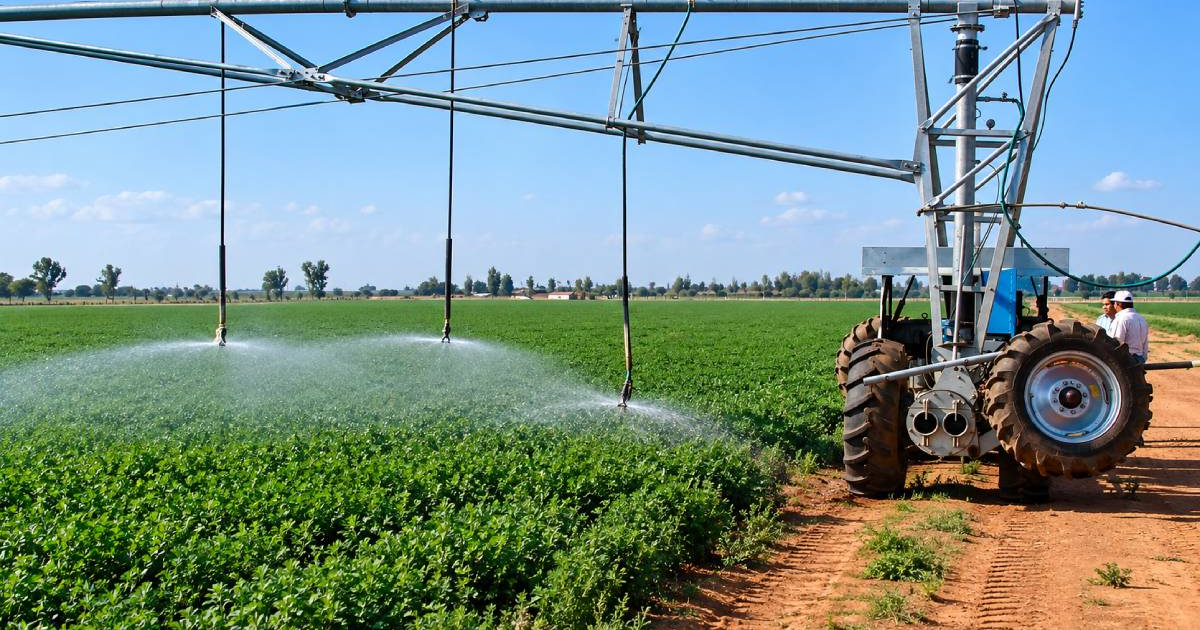
The Council of State of Cuba approved the , which modifies the current regulatory framework regarding mechanization, irrigation, agricultural drainage, and water supply for animals. The aim is to encourage the recovery of national agricultural production.
The regulation was published on Wednesday in the , and specifically amends 21 articles of Decree-Law 2 of 2019, which until now served as the foundational framework for these activities.
The text warns that "the approved Economic and Social Transformations aimed at encouraging agricultural recovery involve the modification of the regulations contained in the aforementioned Decree-Law 2 of 2019 regarding mechanization, irrigation, agricultural drainage, and the supply of water to animals, making their update appropriate."
The Ministry of Agriculture (MINAG), headed by Ydael Jesús Pérez Brito, serves as the governing body with the function to "formulate, implement, and direct policies for mechanization, irrigation, agricultural drainage, and water supply for animals."
Among the most significant changes, the regulation explicitly recognizes as agricultural equipment single-axle tractors—referred to as tillers, motor hoes, and two-axle mini tractors with up to 20 HP of power—a category that was not defined with such precision in the previous legislation.
The provision of machinery and irrigation services may be carried out by both natural and legal persons. Agricultural producers will be able to acquire agricultural equipment in accordance with the procedure established by the Regulation.
For investments in the non-state sector, state testing and equipment validation will be optional and at the express request of the client. In all cases, a technical report from the Institute of Agricultural Engineering Research will be required.
Agricultural motor vehicles must be registered at the municipal office of the Registry of Tractors and Self-Propelled Harvesters. The system ensures that by taking this step, they are decentralizing a process that previously required procedures at other levels.
The MINAG must also coordinate with the National Institute of Hydraulic Resources (INRH) the activities related to agricultural irrigation and the supply of water to livestock, and promote comprehensive agricultural engineering systems that integrate irrigation technologies, drainage, mechanization, energy, post-harvest, and environmental conservation.
The Decree-Law 125 is the second significant modification of Decree-Law 2/2019, which had already been amended in September 2023 through the .
This regulation is part of a broader regulatory framework published in the same Gazette No. 75, which contains 19 provisions, including the Law 185 on the ownership and use of agricultural and forestry land, and is part of the package of 176 economic and social transformations announced by the regime in 2026.
The context in which this regulatory update arrives is one of severe agricultural crisis. An example of this is the rice production, which fell in Cuba from 304,000 tons in 2018 to 111,000 tons in 2025, according to official data.
The agricultural mechanization is facing a paralysis due to shortages of fuel, spare parts, and operational machinery, which has necessitated the use of animal traction, windmills, and solar pumps for some tasks.
Related videos:
Filed under: