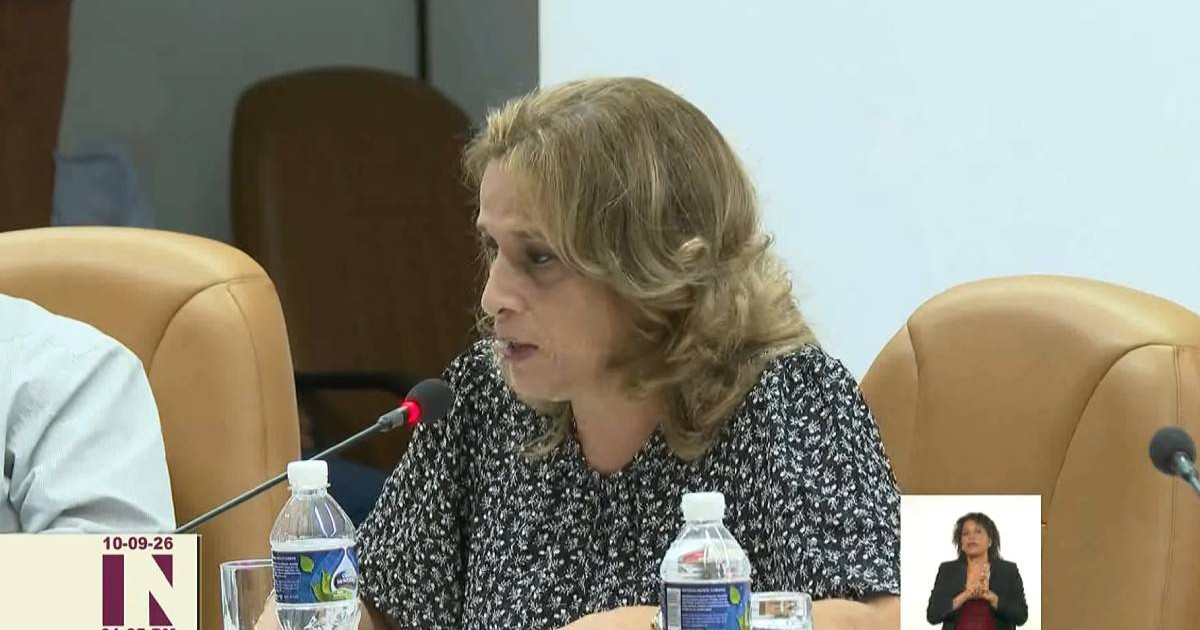
The Minister of Domestic Trade, Betsy Díaz Velázquez, characterized the new legal framework regulating trade in Cuba as a "modern policy" this Thursday, during a training seminar on economic transformations held with executives from state entities, local governments, and business groups.
The meeting, led by Prime Minister Manuel Marrero Cruz along with the President of the National Assembly, Esteban Lazo Hernández, and Vice President Salvador Valdés Mesa —all members of the Political Bureau— aimed to update officials on the implementation of reforms in trade, agriculture, and municipal autonomy.
Díaz Velázquez referred to Decree 167/2026, approved by the Council of Ministers on August 7 and published in the Official Gazette at the end of that month, as the central instrument of the changes in his sector.
"It is a modern policy that, for once, encompasses in a single legal provision everything related to commerce. It defines what wholesale and retail trade is. It establishes a framework for violations and institutional competencies," he stated.
Among the new features of the decree, the minister emphasized that as a mode of sale.
All existing forms of commercialization are also regulated in a single text: regulated sales, controlled sales, standardized sales, sales of gifts, and garage sales, the latter limited to weekends and, exceptionally, to holidays at the discretion of each territory.
However, the official herself acknowledged that the adjustments to the subsidies for individuals instead of products are still pending implementation, which is one of the changes the public has been eagerly awaiting.
In agricultural matters, the Deputy Minister of Agriculture, Tels Abdel González Morera, presented the scope of the Land Law (Law 185) and its regulations.
The regulation allows for the granting of land in usufruct to individuals, legal entities, state and private entities, as well as to micro, small, and medium-sized enterprises, regardless of their corporate purpose.
"The delivery of land for usufruct without limit corresponds to what the individual requesting it can demonstrate with the project they present," explained the deputy minister.
The official also emphasized that the law recognizes the property rights of the usufructuaries over improvements and housing, and that the terms of usufruct are extendable by mutual agreement between the parties.
Marrero Cruz, for his part, addressed the interpretations that see these reforms as a departure from the state model.
"All the decision-making we are implementing based on the transformations, where there is greater participation from all non-state actors, let's call them private entities, in no way signifies that the state, the government is disengaging," said the Prime Minister.
The seminar also addressed municipal autonomy. The director of local government attention for the Popular Power, Nancy Acosta Hernández, warned that decentralizing responsibilities to municipalities cannot mean turning one's back on them: “The agency or institution that decentralizes a municipality or a responsibility does not simply transfer it and then ignore it; there needs to be follow-up and support for the municipality.”
The global reform package, announced in June 2026 before the National Assembly, includes 176 transformations organized into 23 strategic axes. At the close of the seminar, 155 of these already had approved legal norms, and another 17 must be implemented before the end of September.
Related videos:
Filed under: