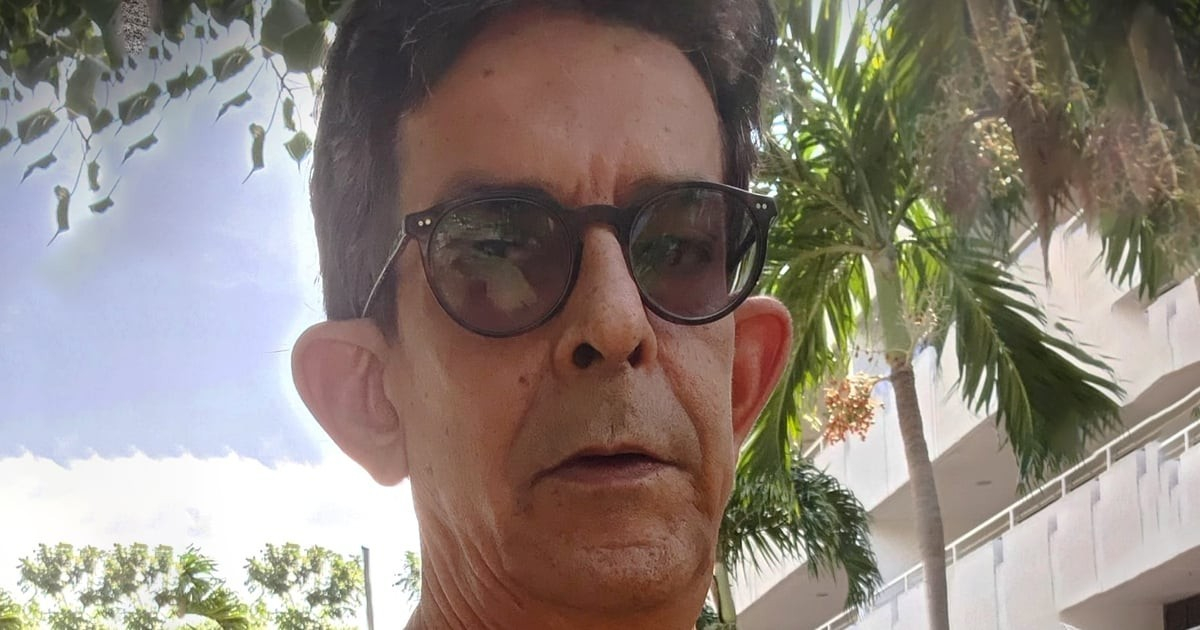
The Cuban comedian and actor Ulises Toirac warned this Thursday that Cuba's electrical crisis will not be resolved as long as the current economic model persists, and he expressed this with a phrase that encapsulates his main thesis:
The comment, published on his own Facebook profile, arose in response to the debate generated by reports from the Miami Herald regarding an alleged secret agreement between the Trump administration and the Cuban regime, in which Washington supposedly offered oil in exchange for the privatization of CUPET —the state fuel company— and the departure of Miguel Díaz-Canel from power.
Toirac neither dismissed nor endorsed the agreement, but noted that the proposal to privatize CUPET "must keep more than one person awake over here," and he went straight to the heart of the issue: the owner of the National Electric Power System (SEN) —"our fierce people," he wrote ironically— cannot pay for fuel at market prices because electricity is charged at subsidized rates in pesos to the residential sector and to a large part of the state sector.
"The problem is quite simple: how does the owner of the thermoelectric plants acquire the fuel for the operation of the plants? Because bear in mind: that operation, which supplies electricity, charges for its service at... prices that are still subsidized today," he wrote.
The actor also ruled out the possibility of the SEN falling into private hands: "The electricity of a country belongs to the country. It is too strategic to be left adrift by others," he argued, citing the example that Canada keeps several U.S. states in a position of energy dependency.
The full post garnered over 1,218 reactions and 230 comments, with responses ranging from agreement to dark humor. One user, Tony Ex-Flaco, joked: "Maybe they'll privatize it in some crustacean's pincers..."
The diagnosis from Toirac is not new, but it is increasingly compelling. In July, he attributed the energy collapse to "six decades of poor economic decisions", mentioning the closure of sugar mills, the failed bet on the Juraguá nuclear plant, the use of heavy national crude oil, and the neglect of maintenance.
Days later, he declared that he no longer sees "the light at the end of the tunnel" because "there is no tunnel".
At the beginning of September, he referred to the blackouts as a "crime" due to their human impact, denouncing that his circuit in Havana had been without electricity for days, experiencing restorations of less than twenty minutes. On August 30, he had compared them to a form of "torture" because of the psychological damage they inflict.
The context surrounding their words is one of sustained collapse. This Thursday, the SEN operated with only 1,220 MW available against a forecasted demand of 3,350 MW, a deficit of more than 2,100 MW.
So far in 2026, Cuba has experienced at least seven complete blackouts of the national electrical system.
Toirac closed his publication with a biblical phrase that sums up his skepticism towards any announced solution: "Although, as the Bible says: 'they will be seen...'"
Related videos:
Filed under: