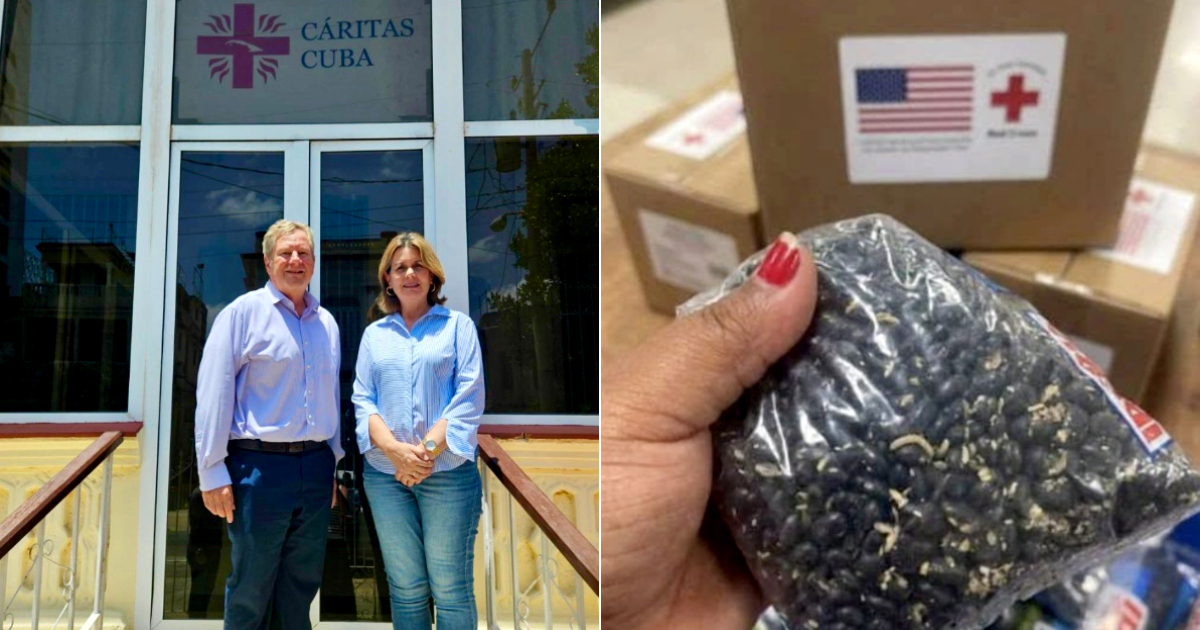
A new discrediting campaign against Mike Hammer, head of the U.S. diplomatic mission in Cuba, is circulating on social media coinciding with his visit to Villa Clara and with the distribution of U.S. humanitarian aid intended for vulnerable families.
The Cuban activist Magdiel Jorge Castro raised an alert about the offensive and denounced that profiles linked to the government are spreading hostile messages against Hammer and content that presents what are claimed to be contaminated packages of beans with worms, supposedly originating from the United States.
"An ongoing defamation campaign against Mike Hammer for his visit to Villa Clara," Castro warned on the social network X.
According to their complaint, accounts with a history of pro-regime propaganda began to disseminate the version that "wormy beans" had arrived in Villa Clara as part of the aid coming from the United States.
The images examined by CiberCuba show at least two Facebook posts that convey almost the same message: "Worm-infested beans are arriving in Villa Clara, Cuba, from the USA."
The messages also use similar photographs: packages of black beans that apparently show insects or larvae, boxes with labels that include an American flag and the symbol of the Red Cross, a church, and scenes of unloading and distributing supplies.
However, the images released do not independently prove that the photographed beans belong to the shipment of humanitarian aid sent by the United States. CiberCuba has not been able to independently verify the origin of these photographs nor establish that the alleged packages were included in the supplies distributed in Villa Clara.
The nearly identical repetition of content from different profiles does indeed indicate an amplification of the same narrative on social media.
Another of the reviewed publications shows a direct political attack against Hammer under the headline "Villa Clara Does Not Kneel: Response to the Diplomatic Provocation from the US."
The author accuses the diplomat of seeking "provocations," contacting alleged "mercenaries," and catering to the interests of Washington. The message also employs typical expressions from Cuban official propaganda, such as "imperial proconsuls," "criminal blockade," and "Florida mafia."
The activist reported that these contents have also been reproduced in buy-sell groups and other spaces on Facebook, and he believed they correspond to the pattern of smear campaigns promoted by the regime's propaganda apparatus.
The offensive occurs while the United States is developing a $100 million humanitarian assistance program for the Cuban people, announced by Secretary of State Marco Rubio.
The plan calls for 60 million dollars channeled through the Catholic Church, with participation from Catholic Relief Services (CRS) and Cáritas Cuba, and an additional 40 million through trusted non-governmental organizations. The stated objective by Washington is to directly deliver the resources to citizens without them falling under the regime's control.
The first phase began in July with a shipment of approximately 18 tons, which included 700 food modules and 700 hygiene kits, initially intended for about 700 families.
Among the foods that have been documented as delivered are rice, beans, sugar, oil, sardines, and tuna, as well as hygiene products and other essential items.
Hammer has personally traveled to different locations to verify how the distribution is carried out.
In August, he visited Alquízar, Artemisa, where beneficiaries confirmed receiving food and hygiene products. One of them pointed out that the boxes had arrived sealed and emphasized the organization of the process.
The distribution is part of a much larger program that Washington intends to progressively extend to tens of thousands of Cuban families.
A campaign against Hammer that has deep roots
The attacks in Villa Clara these days do not represent an isolated incident.
Since Hammer took over as head of the U.S. mission in Havana in November 2024, his policy of touring the island and directly engaging with citizens, religious leaders, opponents, activists, and families of political prisoners has triggered a series of reactions from the regime.
In March 2025, state media accused him of being “weaving an anti-Cuban agenda” and presented him as a supposed “agent of destabilization.” Two months later, the offensive intensified with publications labeling him as an “imperial emissary” and attributing to his meetings with civil society a supposed strategy of “hybrid warfare.”
The MINREX also escalated the accusations. In May of that year, it summoned the diplomat and delivered a Note Verbale of protest, accusing him of engaging in "provocative and irresponsible" behavior and allegedly inciting citizens to act against the constitutional order.
Days later, Johana Tablada de la Torre, then a senior official in charge of U.S. affairs at the Ministry of Foreign Affairs, issued a public warning against Hammer, stating that no one should confuse Cuba's "patience" with "weakness".
The campaign transcended the official narrative.
In June 2025, Hammer was confronted during a trip on the Regla boat in an episode that CiberCuba reported as a repudiation act organized with the participation of State Security agents in civilian clothes. Subsequently, pro-government profiles spread the incident as if it were a spontaneous reaction from citizens.
Weeks later, a similar scene occurred in Varadero, where individuals introduced as revolutionary citizens confronted the diplomat. The images were amplified by profiles associated with official structures.
The harassment continued in 2026 and also affected the Cubans who were trying to meet with him.
In February, the United States Embassy reported that citizens were detained or intimidated before receiving Hammer in their homes during a visit to Las Tunas. An activist had previously reported that State Security threatened her with “serious problems” if she hosted the diplomat.
Washington ultimately made a public denunciation of the harassment. The Undersecretary of State Christopher Landau stated that Cuban agents were targeting the mission chief during his travels across the country and assured that the United States had identified those involved and would assess consequences, including visa restrictions.
The recent emergence in Villa Clara of publications linking American humanitarian assistance to allegedly spoiled food adds a new element to a campaign of discredit and harassment against Hammer that has been documented for over a year, this time also targeting one of Washington's most visible projects in Cuba: the direct distribution of aid to families affected by the economic crisis and shortages.
Related videos:
Filed under: