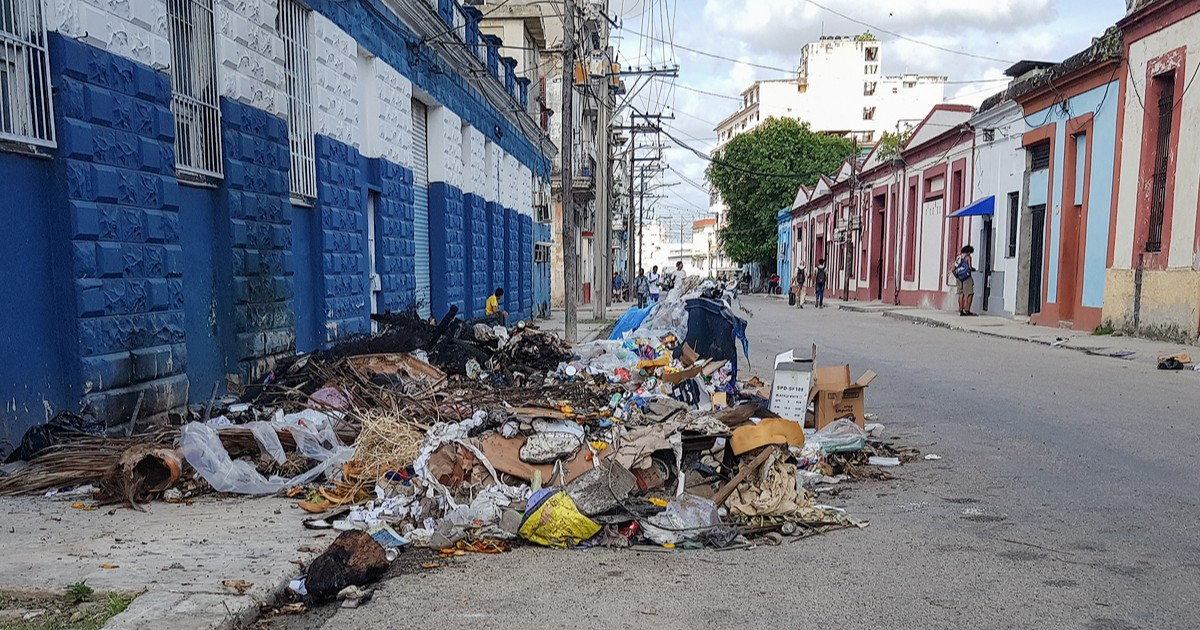
While 94% of Cubans live in extreme poverty and blackouts extend over 20 hours daily in some areas of the country, the regime has its priorities well defined: next Tuesday and Wednesday, Havana will host the 26th edition of the Cultural Research Symposium at the Pabellón Cuba, as announced by the state agency ACN.
The event, organized by the Provincial Directorate of Culture of Havana and the Félix Varela y Morales Center for Cultural Development, is dedicated —as expected— to the centenary of the birth of Fidel Castro (1926-2016), the 507th anniversary of the founding of the Villa of San Cristóbal de La Habana, the 50th anniversary of the Ministry of Culture, and the 40th anniversary of the Hermanos Saíz Association (AHS), the source indicated.
Among the stated objectives of the symposium is, with all seriousness, "to promote reflection and debate on the fundamental problems currently faced by the capital's culture," the report elaborated. Let no one be alarmed: it is unlikely that the deep-rooted causes of the blackouts that prevent watching a movie will be discussed, nor the massive exodus of artists and intellectuals abroad, nor the impossibility of purchasing a paintbrush or a ream of paper. The "reflection" has its well-defined ideological limits.
The agenda is as tight as it is lacking in real answers. On Tuesday the 15th, Dr. Ignacio Turcios Lima Tamayo from the Fidel Castro Ruz Center will give a keynote lecture titled "Fidel Castro Ruz and the Cultural Traditions of Guanabacoa." The following day, Wednesday the 16th, a tribute panel in the Salón de Mayo will feature Yasel Toledo Garnache, president of the AHS; representatives from the UNEAC and the Ministry of Culture; and M. Sc. María Eugenia Ascuy Rodríguez from the Provincial Directorate of Culture.
Each session will take place from 10:00 a.m. to 2:00 p.m., with work in three committees: cultural needs, history and identity, and artistic education alongside environment, architecture, and urban planning. At the end, the judges will distribute research awards. Because in Cuba, when there are no solutions, there are always diplomas.
The symposium is not an isolated event, but rather another piece of the systematic pattern of the regime living from event to event to project a non-existent normality. The official calendar for 2026 features dozens of institutional activities. In August, Díaz-Canel inaugurated the 24th International Meeting of Communist and Workers' Parties with over 100 delegates from 48 organizations, and the colloquium “Fidel: Legacy and Future” brought together more than 1,500 delegates from 63 countries.
In June, the XXII Congress of the CTC brought together 759 delegates — 561 of whom participated via videoconference — under an organizational principle of "maximum austerity," a formula that, at the very least, has the merit of unintentional honesty.
The backdrop of such cultural celebration is devastating. The CEPAL projects a contraction of the Cuban GDP of -10.3% for 2026, the worst economic decline in Latin America and the Caribbean. Year-on-year official inflation reached 20.70% in July, and the State Budget Law set a maximum fiscal deficit of 74.5 billion Cuban pesos for this year. All of this occurs in a country whose effective population has decreased to about 9.4 million inhabitants, according to official data, and where, according to the Cuban Observatory of Human Rights, 94% of the population lives in extreme poverty.
So, while researchers debate "development strategies from a cultural dimension" and pay tribute to Castro's legacy, ordinary Cubans will continue to stand in line for food, calculating how many hours of electricity they'll have tonight, and wondering if there will be any commission to study when this will end.
Related videos:
Filed under: