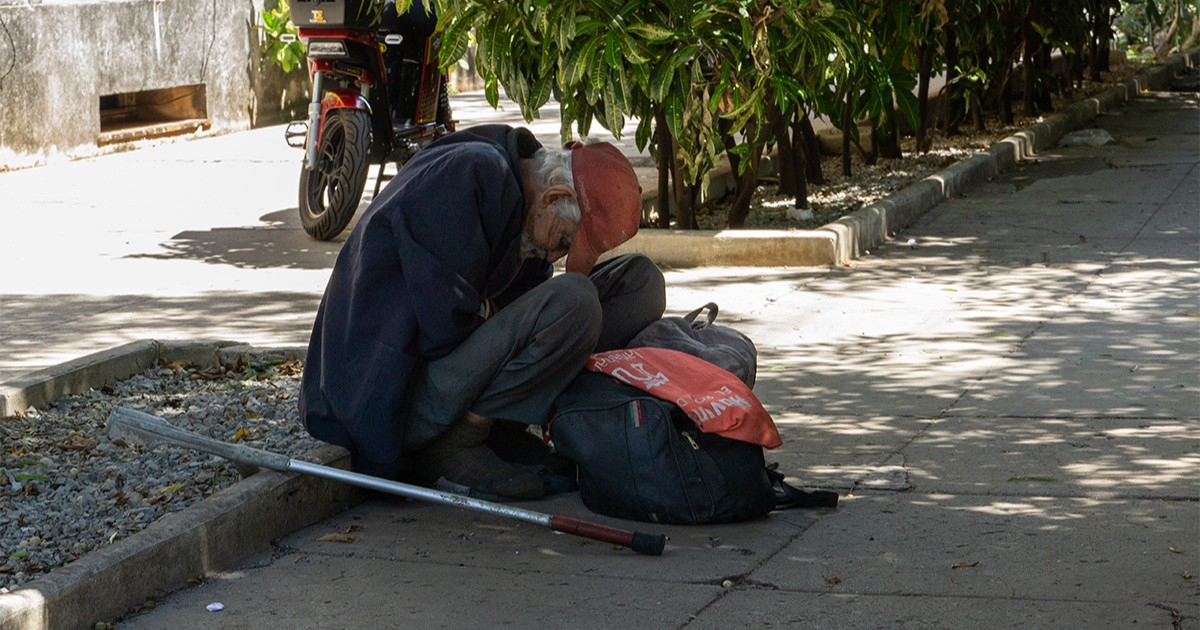
The sociologist Elaine Acosta warned this Sunday that Cuba is not prepared for the rapid aging of its population and that this process will create deep inequalities among the elderly themselves, in a country where the pension system is already in crisis and state coverage is shrinking without real alternatives for the majority.
In statements to Martí Noticias, Acosta emphasized that the issue is not aging itself, but the lack of institutional response: "The problem is not in this accelerated aging, which could actually be good news, but in how unprepared Cuban society is to face the challenges posed by such a defining change in the population structure of society."
The projections from the National Office of Statistics and Information (ONEI) indicate that 36% of the Cuban population will be over 60 years old by 2040. By 2026, this percentage will already reach 26.7%, compared to the 24.4% recorded at the end of 2023, reflecting an acceleration driven by three combined factors: the sustained decline in birth rates—with a fertility rate of 1.29 children per woman in 2025, well below the replacement level—the increase in deaths, and the mass emigration of young Cubans, with nearly 50% of emigrants being under 35 years old.
In 2025, Cuba recorded twice as many deaths as births: 134,354 deaths compared to 68,051 births, and the total population dropped to around 9.43 million inhabitants.
Acosta warned that if the trend is not reversed, the consequences will be structural: "We will see entire communities organized logistically around the care of elderly people with an unbearable burden. Amid the humanitarian crisis currently being experienced, it is very likely that if we do not adequately address the conditions of precariousness in life, we will not be able to organize or reorganize care in a manner that a graying society deserves."
The expert identified an emerging social fracture within the group of older adults. While those receiving remittances from abroad can access private residences —which charge from 1,080 dollars per month— the vast majority rely on overwhelmed families or pensions that do not cover basic needs. The minimum pension was raised to 4,000 Cuban pesos in September 2025, but this amounts to less than 10 dollars at the informal exchange rate.
"What is likely to occur is an increasing gap in income and class, particularly among the elderly who have limited access to care services, with a large majority relying on families or becoming overwhelmed... This also alters economic security dynamics, because in the current scenario, we are already facing a crisis in the sustainability of the pension system," Acosta clarified.
The burden of care disproportionately falls on women in a context of extreme scarcity. The regime implicitly acknowledged this reality in July 2026, when it announced that up to 10 years spent on caring for family members will count as work time for retirement.
Acosta also noted that aging demands a transformation that the regime is not implementing: "The aging of a society transforms urban spaces, institutions; in other words, a whole structural transformation is required, which, unfortunately, is not taking place. Collective demands focused on issues such as food security, pensions, and social inclusion should be at the forefront."
The public system has only 156 nursing homes with 12,697 beds nationwide, and 51 municipalities lack any elderly care services, according to data from August 2026.
Related videos:
Filed under: