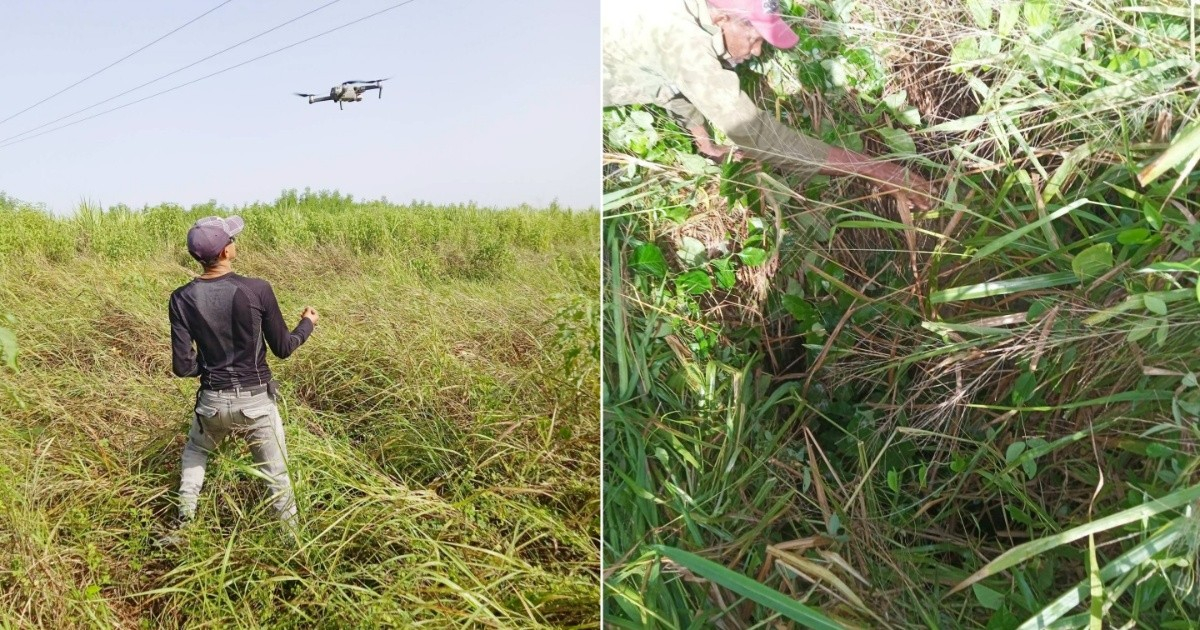
The body of Alexander Pantoja Bertot, a young power line engineer at the Electric Company of Santiago de Cuba, was found this Sunday at 12:15 PM in a rural area of the municipality of Contramaestre, after three days of intensive searching, as detailed Aris Arias Batalla on Facebook.
The body was found in the area known to locals as El Palmar, about 1.5 kilometers from the road, sitting on a rock and leaning against a tree, stated Batalla, provincial chief of Operations and Relief for the Red Cross in Santiago de Cuba.
The body showed advanced signs of decomposition, a result of the days that had passed since its disappearance on Thursday, September 10, when his colleagues left him conducting inspections on an electrical line that supplies the Gota Blanca reservoir, between the municipalities of Palma Soriano and Contramaestre.
According to the report, the body showed no visible signs of physical aggression and retained all of its personal belongings and backpack intact.
Alexander's wife confirmed that he did not suffer from any known illness, which leaves the cause of death in the hands of forensic specialists, who will conduct the autopsy after the body is transferred to the cemetery in Contramaestre.
The search this Sunday was the most extensive of the three days of operations. A multisectoral team from GEOCUBA, consisting of Yaimir Rodríguez and Ernesto Roja López, deployed drones equipped with thermal measurement technology and specialized equipment since the early hours of the morning.
The operations were led by the Provincial Delegate General and the Second-in-Command —holding the rank of Colonel— from the MININT Headquarters, alongside officers from the municipalities of Palma Soriano, Contramaestre, and Santiago, as well as members of the Forest Rangers Corps.
The conditions during the search were extreme: intense sunlight and suffocating heat that, according to the chronicler of the discovery, posed a risk of severe fatigue, dehydration, and exhaustion for both the search teams and potentially for Alexander himself.
Her sister Yaima Bertot, the family's public voice throughout the process, had explained before the discovery that Alexander's work dynamic was not unusual: "He often worked like this. They leave him in one place, he does his job, and then he either leaves on his own or his colleagues pick him up. What he did that day was nothing out of the ordinary."
Yaima also pointed out that her brother knew the area well, having worked there since his years in Contramaestre, and that he only carried his mobile phone with him as a valuable item.
The operation that resulted in the discovery involved more than 50 electrical workers from Palma Soriano, Contramaestre, and Tercer Frente, canine brigades, members of the National Revolutionary Police, rescuers, forest rangers, local farmers, as well as organizations such as ETECSA and the Cuban Red Cross.
Before the outcome was revealed, Yaima had expressed suspicions that third parties might be involved, based on the fact that the dogs were losing the trail. After her brother's death was confirmed, the sister demanded that "the full weight of the law" be placed on those responsible, without specifying who she was referring to.
The official cause of death will be determined once the forensic specialists complete the autopsy, the results of which were not available at the time this information was finalized.
Related videos:
Filed under: