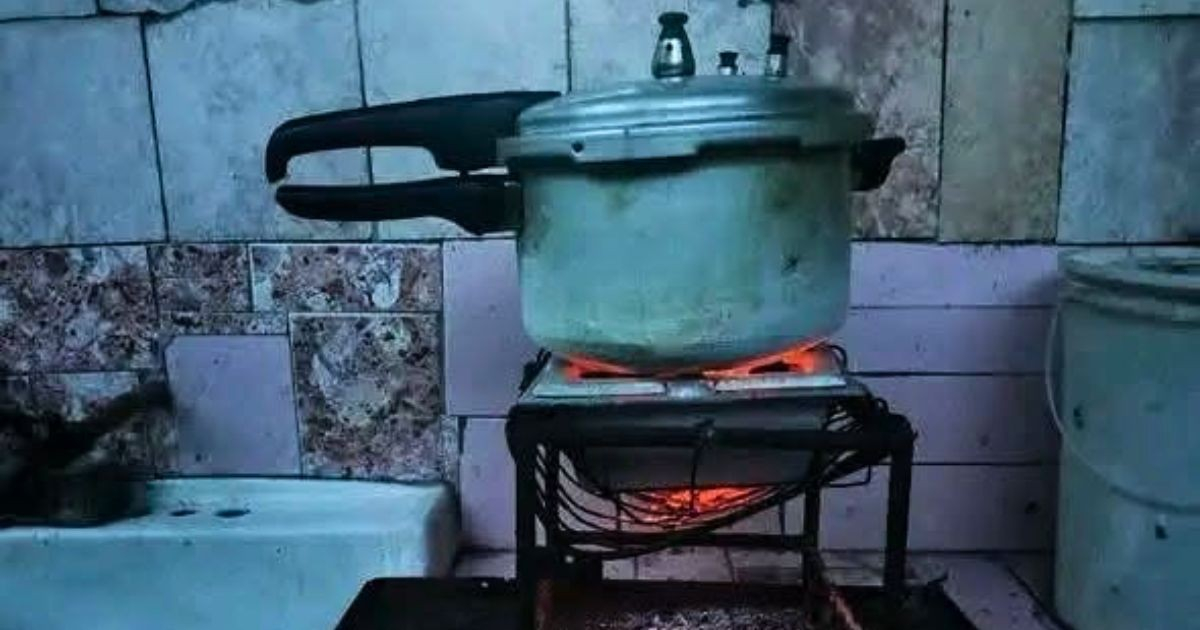
The Holguin writer José Poveda Cruz published a text on Facebook this Sunday titled “Manual for Lighting Charcoal”, in which he turns the act of lighting a fire into a metaphor for the civilizational regression that Cuba is experiencing.
The trigger was an article from a national Cuban newspaper that seriously addressed the process of making a fire with charcoal. Poveda quotes it with barely contained irony: "The journalist analyzes it as if discovering a new discipline of survival." That a state media outlet in the 21st century dedicates space to explaining how to light a fire speaks, perhaps, more about the state of the country than any official statistic.
The writer describes the ritual with surgical precision and a painful humor: “Lighting charcoal, in these times, requires one to become a sort of magician, alchemist, or digital conjurer. First comes the match, if it exists. Then the matchbox, if it works. Next the little piece of paper, the nail, some scrap of cardboard rescued from who knows where, and finally that tiny flame that one gazes at with an unreasonable hope: that it survives.”
Poveda acknowledges that there is a hierarchy even within misery: "The more fortunate still have gas and can buy it one way or another." For the rest, the question that dictates the day is not what to cook, but whether there will be anything to cook with: "If the charcoal doesn’t light, there’s no lunch. And if there’s no lunch, it doesn’t matter much whether one has a pot, a bit of rice, some root vegetables, or any of those meager foods that have somehow made it to the kitchen. Domestic technology can then be reduced to a primitive question: Will there be fire?"
The context surrounding the text is devastating. The state-owned company CUPET indefinitely suspended the distribution of liquefied gas in Santiago de Cuba and the eastern provinces as of January 2026. Frequent blackouts often exceed 20 consecutive hours in many areas of the country, and in August there was a record generation deficit impact, exceeding 2,400 megawatts.
The price of charcoal, a de facto household fuel for millions of families, soared from between 900 and 1,400 pesos per bag at the end of 2024 to between 3,200 and 5,000 pesos in various provinces by 2026; meanwhile, the average monthly salary of a Cuban is just over 7,000 pesos. The structural paradox is that Cuba exported charcoal worth 61.8 million dollars in 2023 —the ninth largest exporter globally— while its population struggles to light their stoves.
The scarcity has led to the emergence of an entire informal industry of survival tutorials on social media. At the beginning of this month, creator Suramia Castro went viral with a video on how to reuse charcoal by soaking it in water to extinguish it and then drying it in the sun, which has garnered over 537,000 views.
Meanwhile, the authorities have responded by seizing the production from artisanal charcoal producers: in August, a forestry worker in Camagüey reported that agents accompanied by police confiscated all his production, leaving him without a livelihood.
Poveda, who back in July had stated that in Cuba, “even the most basic needs seem like luxury items”, turns to Homer to conclude his text: the heroes of antiquity crossed seas and faced monsters, but no one wrote an epic about making the coal ignite. “Perhaps because for them, fire was still a certainty. For us, it has become a conquest.”
Its final synthesis could very well serve as the epitaph for six decades of dictatorship: "first we discovered fire; then we invented progress; and now we are learning again how to ignite it."
Related videos:
Filed under: