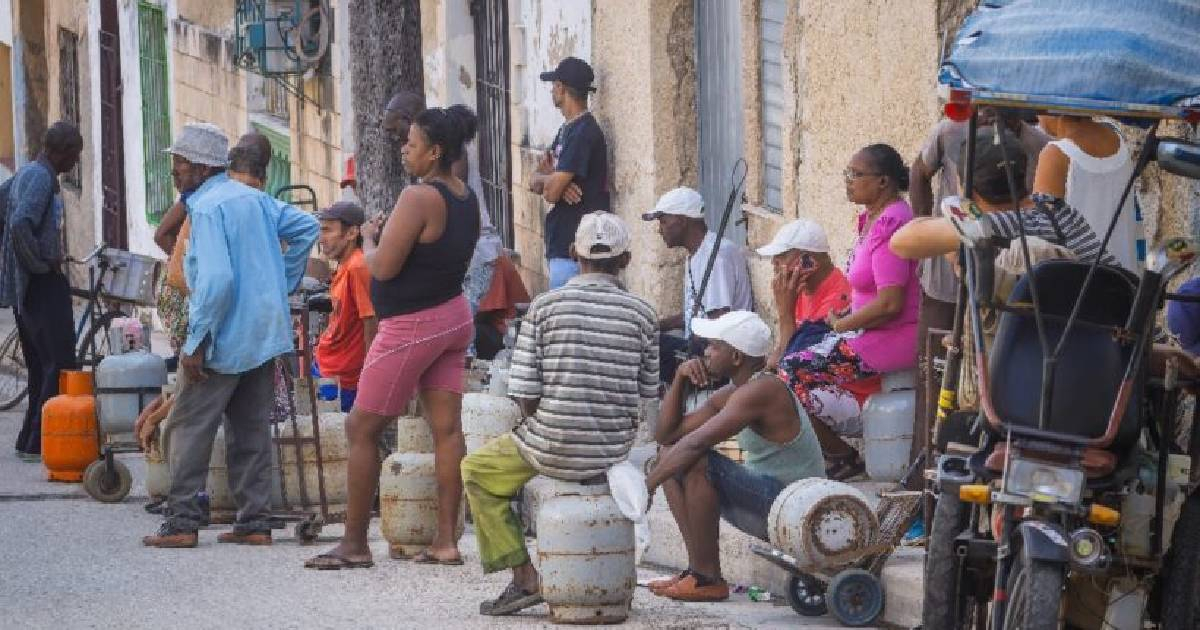
The Holguin writer José Poveda Cruz published a reflection on Facebook this Sunday that began as a philosophical exercise and ended up being a harsh chronicle of present-day Cuba: in a country where cooking or eating rice and beans has become an unattainable privilege.
The catalyst was a phrase circulating on social media: "It is not the rich who have the most, but the one who needs the least." Poveda Cruz acknowledged its beauty but pointed out that this wisdom clashes head-on with the Cuban reality. "The problem arises when one decides to move to today's Cuba. Then philosophy stumbles upon the accounting," he wrote.
Poveda Cruz, residing in Holguín, detailed the costs of a life without luxury with precision.
To cook, you need charcoal, "that fuel that has survived the centuries and, by some irony of fate, has ended up becoming a luxury item." Each bag costs around 2,500 pesos, and in a month, four or five are needed, so just the kitchen fire consumes about 13,000 pesos monthly.
Then comes the food. The writer clarified that he doesn’t even talk about meat, which “has long ceased to belong to the realm of customs to enter the realm of legends.” Rice costs 400 pesos per pound and beans another 400. “I could almost say that I am vegetarian by conviction... or by budget,” he wrote with bitter irony. If we add a liter of oil—priced around 2,200 pesos—“the math ultimately defeats any treatise on philosophy.”
The contrast with actual incomes is striking. Poveda Cruz took a salary of 4,000 pesos as a reference and concluded that “survival demands several times that amount.” The minimum wage in Cuba was set at 3,210 pesos from July 1, 2026, and the average state salary hovers around 6,930 pesos, while meeting the basic needs of an individual estimated requires 96,060 pesos monthly, about 14 times that average salary.
The most striking scene in the text is not about the prices, but rather about a retired friend who returned home “fainting from hunger” and accepted a plate of food “with a mix of gratitude and shame.” The man has a son who is also struggling to support his own family. “Neither of them asks for luxuries; they barely try to survive until the next day. What should we call them? Poor? Impoverished? Survivors? Perhaps no word suffices,” reflected the writer.
That scene portrays a crisis that the data confirms. The Cuban minimum pension was raised to 4,000 pesos in September 2025, equivalent to just between seven and nine dollars on the informal exchange. 99% of retirees affirm that this amount does not cover food, housing, or medications, and 79% of those over 70 years old are unable to have three meals a day.
Poveda Cruz closed his text with the image of the nightly blackout that awaits at the end of each day in Holguín. "Tonight the blackout will return. The darkness, as punctual as an exemplary official, will fill the house," he wrote. The province has operated with barely 70 MW of electrical capacity against a demand of between 225 and 240 MW, with outages in some neighborhoods lasting more than 50 consecutive hours.
The philosophical phrase that sparked his reflection, in Cuba, "where even the most basic needs seem like luxury items," takes on a different meaning. Because there are places where needing little is still too much. And this, more than a philosophical paradox, is the daily chronicle of a country that still promises a bright future… while the twilight continues to ignite reality," concluded Poveda Cruz.
Related videos:
Filed under: