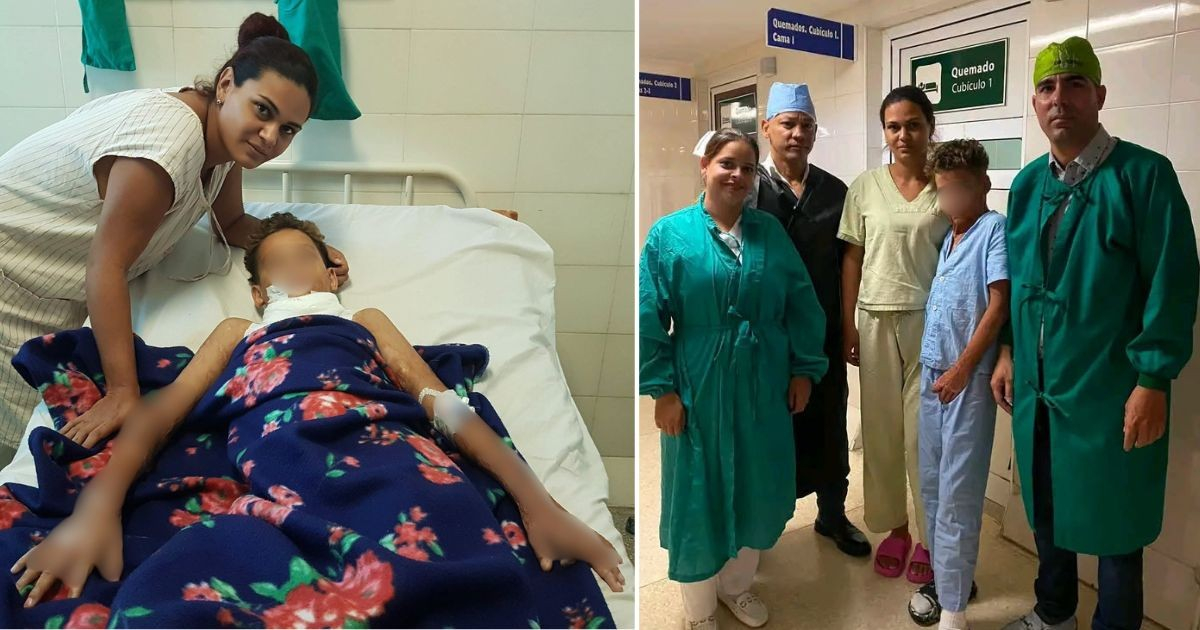
At a young age, Leandro Gamboa Pelegrín has had to fight more than one battle: first, he survived an electric shock of more than 30,000 volts after the kite he was flying came into contact with a high-voltage line, an accident that caused burns to 60% of his body; then he faced the serious consequences those injuries left on his skin and mobility for almost three years.
Now, at just 11 years old, she has just undergone four reconstructive procedures performed in a single day in Camagüey, in a process that also progressed thanks to a widespread show of solidarity from Cubans both on and off the island, who helped raise awareness of the case and provided resources, supplies, transportation, and support for her recovery.
Radio Cadena Agramonte reported this Tuesday that the intervention was carried out by a multidisciplinary team from the Eduardo Agramonte Piña Pediatric Hospital and the Manuel Ascunce Domenech Clinical Surgical Teaching Hospital, both located in Camagüey.
According to the publication, the minor underwent surgery to address the aftermath of the severe burns caused by an electrical shock and has already been discharged to continue his recovery.
But Leandro's arrival in the operating room was preceded by weeks of efforts and citizen solidarity that are not reflected in the institutional information.
The journalist and activist Guillermo Rodríguez Sánchez, who along with doctor Verona Bonce and a community of supporters brought attention to the case, stated that the child's mother had been trying for months to find a solution for the aftermath her son was experiencing.
In a live broadcast on Facebook, Rodríguez stated this Tuesday that the mother had been trying to contact him and Bonce for about six months before they decided to take on the case and start mobilizing help.
The activist clearly distinguished that phase of the initial care that Leandro received after the accident.
He recognized that the specialists from Ciego de Ávila did a decisive job to save his life and to treat the burns during the first weeks.
Thanks to a divine miracle and their efforts, they saved that child, he stated, while also highlighting the recent work of the surgical teams in Camagüey.
His criticisms focus on the subsequent period: after overcoming the most severe phase, Leandro spent about three years with significant aftereffects while his mother tried to ensure he received further interventions and proper rehabilitation.
The activist claims that during that time, the minor attended consultations without resolving the problems caused by the skin retraction, which worsened as he grew.
According to what was explained, the scars had caused a strong tension in Leandro's neck and also issues in the groin area that made it difficult for him to move.
The intervention recently carried out in Camagüey included four surgical procedures in a single day: two on both sides of the neck and two others aimed at releasing retracted tissue in the lower part of the body.
Rodríguez stated that the operations resulted in approximately 90 stitches, about 60 in the neck and another 30 in the groin area.
He also noted that the child progressed without infection or immediate complications and surprised the staff with his resilience during the subsequent dressings.
Leandro's resilience is supernatural, the activist had stated while describing how the boy faced the procedures and the post-operative period.
One of the specialists who participated in the intervention was the burn surgeon Orlando Gazmuri.
Days before the operation, Rodríguez had explained that the dermatology services from Las Tunas, Santiago de Cuba, Holguín, Guantánamo, and Havana had also offered to attend to the minor.
Finally, the mother chose Camagüey: “The decision to have the surgery in Camagüey was made by the one who had to, Leandro's mother,” explained the activist who dedicated several follow-up posts to this case.
The mobilization surrounding the case also included significant material assistance. In his latest broadcast, the activist stated that he bought and sent from Mexico about 800 dollars in medical supplies for the surgery and the subsequent stages of recovery.
Among those resources, he mentioned ointments, gauze, antibiotics, neck braces, special bandages, and other materials intended for treatments.
According to what was explained, part of the supplies sent for the procedure ultimately did not have to be used because the hospital had the materials, so they were available for the minor's subsequent treatment.
Leandro's transportation from Santana, in Ciego de Ávila, to Camagüey was covered thanks to the generosity of an old neighbor of the child who currently resides in the United States and anonymously paid for an air-conditioned private car to take him both to the consultation and subsequently to the hospital admission.
The support network remained active after the operation: a woman offered her home in Camagüey for free so that Leandro and his mother can stay there for about 15 to 20 days, or as long as necessary, while continuing treatments and waiting for the removal of the stitches.
Rodríguez also noted that more than 10 people offered housing to accommodate them, and others provided cars, bicycles, and electric tricycles for the family's needs, thus demonstrating something that the activist has pointed out on other occasions: that the actions he is able to carry out are thanks to a large community of supportive Cubans.
Rodríguez declined to personally take credit for that mobilization: “I have been fortunate to be the catalyst, the connection, let's say, the coordinator,” he stated during the livestream, emphasizing that many people have contributed from both Cuba and abroad behind the case.
His questioning arose after several institutional publications and official press presented the operation as solely the result of sustained coordination within the health system, when the reality hidden by the regime is that it was also thanks to many supportive individuals.
At the same time, he excluded the specialists who performed the operation from his criticisms and expressly acknowledged their work.
I am infinitely grateful to the doctors because what they have done with this child, and having four surgeries on the same day without any complications, is undoubtedly a superlative achievement, she stated.
The case of Leandro became publicly known in January 2024 when it was reported that specialists from Ciego de Ávila had managed to save his life after suffering burns over 60% of his body.
At that time, he was identified as Leandro Daniel Gamboa Pelegrín, then eight years old, and it was reported that he had been admitted on December 16, 2023, to the Dr. Antonio Luaces Iraola Provincial General Teaching Hospital in Ciego de Ávila.
Initially, he remained in the Pediatric Intensive Care Unit for several hours until he reached hemodynamic stability. Then, he required multidisciplinary care to address the severe injuries.
The Frank País Hospital in Havana sent temporary skin coverage for the affected areas, while his own mother donated skin for a homograft.
Almost three years later, the story once again brings to the forefront, above all else, the resilience of a child who first survived an extremely severe injury, then learned to live with its consequences, and now has just endured four procedures aimed at recovering some of the lost mobility and improving his quality of life.
However, the process is not yet over. Rodríguez stated that Leandro will need physical therapy, specialized follow-up, and possibly further interventions as he continues to grow.
For now, he remains in Camagüey with his mother, recovering from the surgeries under medical supervision and also supported by a network of solidarity that helped bring his story out of anonymity and continues to address many of his daily recovery needs.
Related videos:
Filed under: