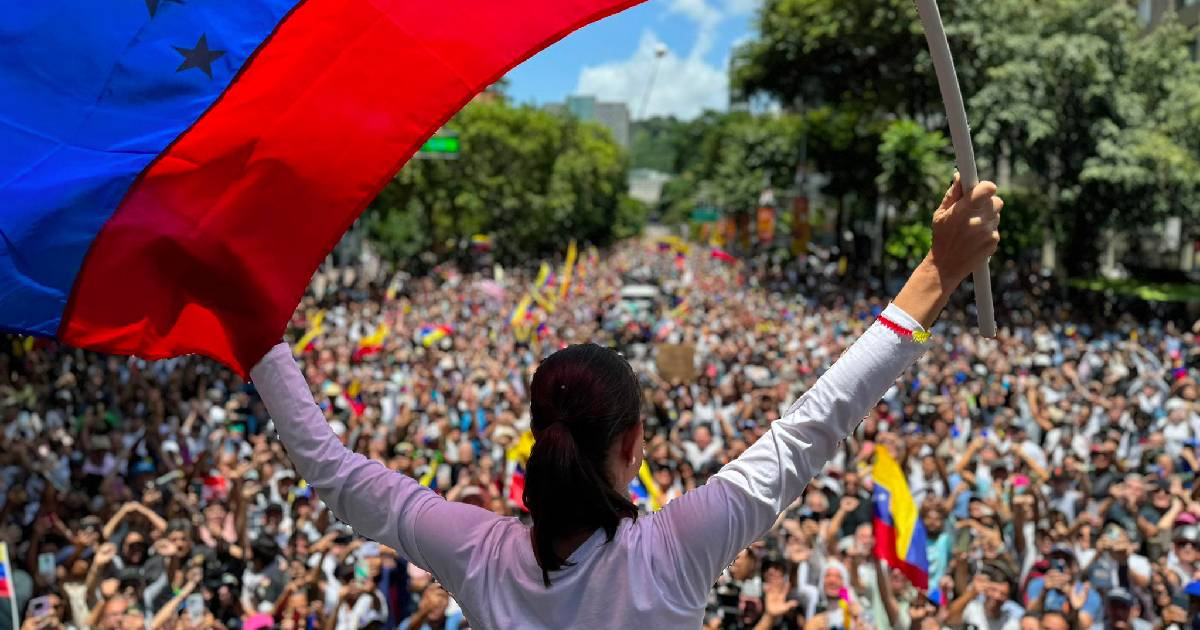
María Corina Machado reaffirmed her decision to return to Venezuela despite the daily threats she receives, in an exclusive interview granted to Democrats Review published on September 4, 2026, in which she warned that the democratic transition in the country remains "incomplete" and that Venezuelan society demands her presence.
The 2025 Nobel Peace Prize winner has been in hiding for over a year and separated from her family for nearly 18 months, primarily residing in Panama without a valid passport — which Venezuelan authorities refuse to renew.
Her return to Caracas, announced multiple times since January 2026, has not materialized: in March, she promised to return "in a few weeks", and her party repeated the announcement days later without providing an exact date.
In the interview, Machado was straightforward about the dangers she faces: "I receive daily threats from members of Delcy Rodríguez's Executive, and this state of terror obviously affects all our family and friends."
Nonetheless, the opposition leader was unequivocal about her intention: "That is the decision I have made: to return to Venezuela to stand by my people, ensuring that this popular and democratic energy is channeled in a civic manner, that it grows, and ultimately achieves the right to a genuine democratic electoral process."
The announcement comes at a particularly complex time. On September 7, media outlets citing journalist David Alandete reported that the White House reportedly asked Machado to visit Washington before returning to Venezuela, which adds a new layer of political pressure to his return.
Machado emphasized that the repressive apparatus inherited from Maduro's government has not disappeared: "The repressive and criminal organization that led it continues to operate in Venezuela." Of the 1,200 political prisoners that existed, 700 have been released, but around 500 remain detained, and there are still torture centers, as he reported.
Regarding the process driven by Washington, it was explained that Secretary of State Marco Rubio outlined three phases —stabilization, recovery, and democratic transition— and that, according to the U.S. administration, the first phase has already been completed.
Investments in the energy sector anticipated for the second stage, however, have not materialized, partly because Venezuela ranks last worldwide in adherence to the rule of law.
The statement contrasts, however, with the extensive energy agreement promoted by the Trump administration with the interim Venezuelan authorities, which includes the marketing of up to 50 million barrels of crude oil under U.S. supervision and the entry of major international companies into the sector.
Trump has promoted investments of around 100 billion dollars to rebuild the industry, although the plan has sparked controversy over its viability, Washington's control over sales and oil revenues, while companies like ExxonMobil have warned about the lack of legal guarantees for making large investments.
In a different context, Machado expressed his confidence in tangible signals: "There are ongoing discussions with the State Department that lead us to believe that, before the year ends, a new National Electoral Council will be appointed, along with a new Supreme Court of Justice."
The earthquake on June 24—which left more than 6,500 dead according to reports from August—exacerbated the crisis and, in Machado's opinion, revealed the regime's ineptitude: "Seventy-two hours after the quake, not a single action had been recorded from the regime in support or aid of the population." He described images of soldiers stealing personal belongings from the debris while people were still trapped.
A survey by Meganálisis attributes over 80% of the votes to him in a hypothetical electoral showdown against Rodríguez, and 65% of Venezuelan exiles in the United States have expressed a willingness to return if a genuine democratic transition is promoted.
"This is a decisive moment. We would be mistaken if we think we can somehow ease the pressure on the regime in Caracas," warned Machado, who declared in July that she had not requested protection to facilitate her return to the country.
Related videos:
Filed under: