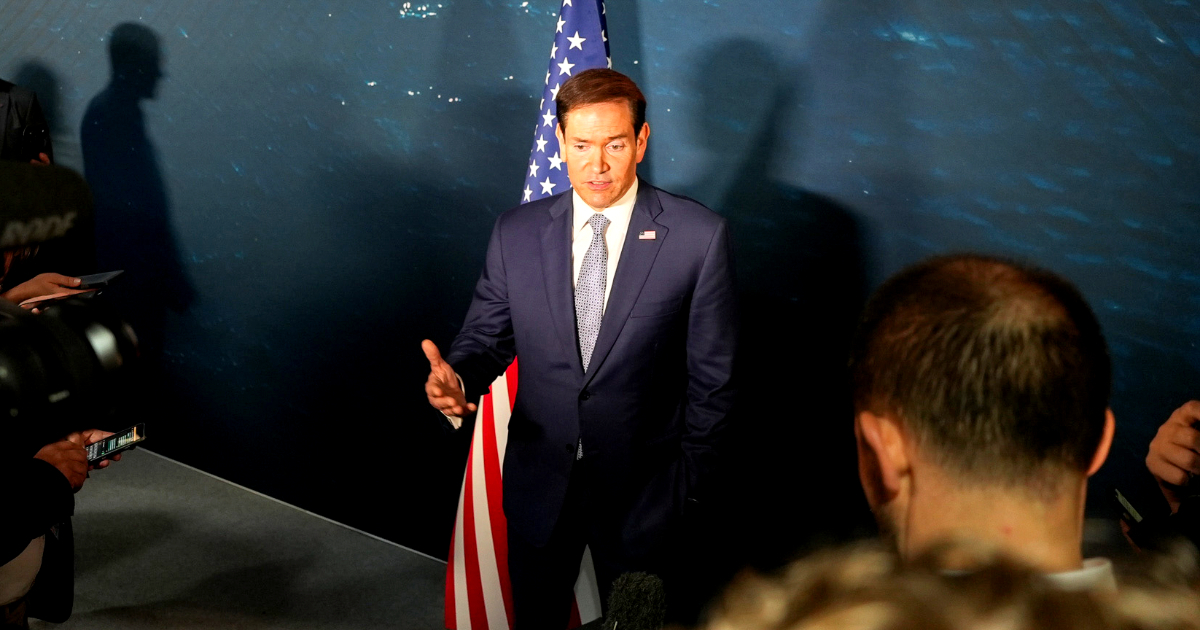
The United States Secretary of State, Marco Rubio, outlined the conditions that Washington deems necessary to complete the democratic transition in Venezuela, ranging from holding free elections to the safe return of exiled leaders and the political participation of the millions of Venezuelans living abroad.
During an interview with journalist Sergio Novelli, Rubio made it clear that the interim government led by Delcy Rodríguez is viewed by Washington as a temporary structure and not the final outcome of the process initiated following the capture of Nicolás Maduro.
“Our desire and our goal here is not to create a permanent system, but for the current system to become the permanent system”, he stated during an interview.
In the end, there will come a time when Venezuela must be governed by a democratically elected government, he added.
The statements are particularly significant following the new oil agreement announced by the administration of Donald Trump, which considerably deepens the economic ties between the United States and Venezuela, and which Rubio presents as a crucial component for achieving the necessary recovery towards a democratic stage.
Recovering the economy before completing the transition
The strategy designed by Washington following Maduro's downfall was presented by Rubio at the beginning of the year in three main phases: stabilization, economic recovery, and political transition.
The logic behind that sequence is that the democratically elected future government does not inherit a completely collapsed state. "We don't want them to inherit an economic disaster, a disaster of a country," Rubio explained in the interview.
Oil plays a central role in that strategy. The recent agreement with North American Blue Energy Partners (NABEP) involves the exploitation of 17 Venezuelan oil fields and significant investments to enhance their production capacity.
According to Rubio, the recovery of the sector must generate revenue for the State and create the economic conditions that will subsequently support a stable democratic system.
The secretary denounced that during the chavismo era, a significant portion of the oil wealth ended up benefiting leaders connected to the government and international allies. He specifically mentioned Cuba, Russia, and China, and stated that the new model must ensure that resources return to the state and are used for the benefit of Venezuelans.
Rubio also explained that, in the short term, the United States can monitor the money generated under the new scheme through KPMG audits. In the long term, however, he maintained that those resources should be entrusted to a legitimate government that emerges from the polls.
The approach directly links economic recovery with Washington's political objective: to attract investment, rebuild the capacity of the state, and subsequently transfer that apparatus to democratically elected authorities.
The oil agreement, however, introduces a new tension in that process. The United States is building a lasting economic relationship with the interim authorities while the ultimate goal of democratic elections remains pending.
Washington argues that stabilization and recovery are necessary to reach that point. The challenge will be ensuring that these economic advancements do not end up solidifying a government initially conceived as transitional into a permanent one.
Elections "as soon as possible," but not immediately
Rubio stated that the elections should be held "as soon as possible," although he refrained from setting a date.
"Everyone understands that this has to happen, because at the end of the day, Venezuela cannot reach where it needs to go without having a legitimate government," he stated.
The secretary warned, however, that holding elections immediately using the structures inherited from Chavismo would not ensure a democratic process.
“If there are elections in Venezuela tomorrow, they will use the existing machinery. Of course, that machinery will not provide you with a system. There are many things to clean up,” he stated.
Among the essential conditions mentioned were that the opposition parties have the time, space, and resources to organize and campaign; that there is a free press where all candidates can express themselves; a National Electoral Council recognized as legitimate; a reliable voting system and international observation.
It also demanded assurances of safety for those participating in the political process.
The statement aligns with the position expressed by Trump in July, when he asserted that Venezuela is still "not really ready" to hold elections, although he emphasized the progress made since Maduro's departure.
"We do not want" another Nicaragua here
Rubio referenced the case of Nicaragua to explain why Washington believes that quickly organizing elections and concluding the transition is not sufficient.
He recalled that the Nicaraguan opposition electorally defeated sandinismo in 1990, but Daniel Ortega later returned to power and ended up rebuilding an authoritarian system.
"A few years later, Sandinismo returned and took control of the country, and they lost their freedom. We don't want that here," he stated. The goal, he explained, is to build "a democracy and a permanent republic for the future of Venezuela."
The priority, therefore, would not solely be to set an electoral date, but rather to change the institutional conditions that allowed chavismo to control public powers for decades.
This process has already begun. In August, a negotiation table was formally set up between representatives of the interim government and the National Assembly elected in 2015, which has been recognized for years by Washington as the legitimate representation of Venezuela.
The first round of negotiations resulted in an agreement to completely renew the Supreme Court of Justice, one of the steps aimed at rebuilding the institutions before the upcoming elections.
Rubio mentioned in the interview that representatives of the 2015 National Assembly will meet again next month. “These negotiations are up to the Venezuelans. But we will do everything possible to continue facilitating and insisting,” he affirmed.
María Corina Machado has the right to return
Another element that Rubio considers essential for a legitimate transition is the return of political leaders forced to leave Venezuela.
Specifically asked about María Corina Machado and her intention to return to the country, she stated that the opposition leader does not need authorization from Washington.
María Corina Machado is a Venezuelan citizen who has every right to enter her country whenever she wants to return, he responded.
Rubio stated that the United States has expressed concern for her safety and believes it is necessary to ensure it. "She has every right to return. She is a citizen of Venezuela", he insisted.
The secretary also expressed his admiration for Machado, but he expanded the discussion to other opposition leaders who remain outside the country.
It is important that all those elements, if they wish, can return and participate in the political life of Venezuela in a way that poses no danger to them and that they are given the necessary space to participate, he noted.
The issue is particularly significant because Machado and Edmundo González Urrutia are not part of the core of the negotiations currently held by the interim government and the opposition sector represented by the 2015 National Assembly.
Both have conditioned their support for the process on the production of concrete results, including the release of political prisoners, the recovery of democratic institutions, and the establishment of a path toward presidential elections.
The diaspora must also participate
Rubio extended political guarantees to the millions of Venezuelans who left the country over the past decades.
He specifically mentioned those living in the United States, Spain, and Panama, and defended their right to intervene in Venezuela's political future, regardless of whether they decide to return permanently.
Some will return, others will not. But they want to participate, they want, for example, to vote from abroad, he stated.
According to Rubio, the more than seven or eight million Venezuelans who left the country due to economic, political, or both circumstances must play "a key role" in its future.
The roadmap outlined by Washington seeks to connect two processes that are advancing simultaneously: rebuilding a devastated economy and dismantling the institutional structures that enabled the permanence of chavismo in power.
The new oil agreement could significantly expedite the first one. The real challenge for the Trump administration will be ensuring that this economic stability is utilized to achieve the second objective rather than postponing it.
Rubio made it clear in the interview what he believes should be the end goal: a stabilized country, with institutions capable of sustaining themselves regardless of who is in power, and a government legitimized through free elections.
For Washington, according to its stance, the transition does not end when Venezuela resumes wealth production, but rather when the Venezuelans themselves can democratically choose who manages that wealth and under what institutions.
Related videos:
Filed under: