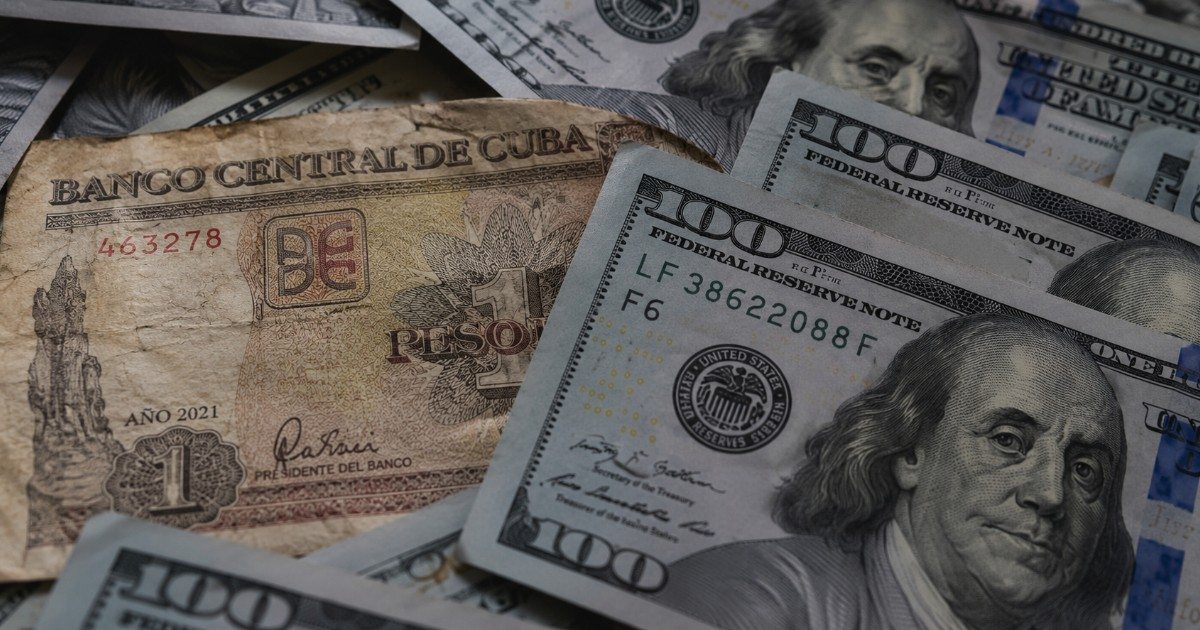
The Cuban economy is once again moving towards a greater presence of the dollar and other currencies, but a total dollarization is not yet inevitable.
The economist Pavel Vidal believes that the future of the peso will depend on whether the country can stabilize its accounts, restore confidence in the national currency, and correct an exchange system characterized by multiple rates and a large informal market.
In an analysis published this Monday by elTOQUE, Vidal examined the consequences of the new regulations approved by the Cuban government to expand operations in foreign currencies and posed a question that is gaining significance again in light of the island's economic reality: Will Cuba eventually become fully dollarized?
The latest official decisions, according to the economist, represent another step in reversing the de-dollarization process that started in 2004 and also stray from the stated objective during the Monetary Ordering of 2021 to re-establish the Cuban peso as the sole currency in the economy.
The most recent change came on September 10, when new regulations were published that relax the opening and operation of foreign currency bank accounts.
Resolution 102/2026 of the Central Bank of Cuba allows opening accounts in foreign currencies without the prior authorization of that institution and expands the operations that natural persons, legal entities, and non-state economic actors can perform from these accounts.
At the same time, the new regulations allow private businesses to receive cash payments in dollars, euros, or other foreign currencies and deposit that money directly into foreign currency accounts.
They can also use those funds for imports, transfers, and other authorized operations.
For Vidal, these provisions particularly expand the dollarization of transactions between businesses and wholesale trade.
In those spaces, foreign currency can be used by mutual agreement between the parties, while in retail, efforts are made to maintain the Cuban peso as the general denomination currency, although accepting cash in foreign currencies is also permitted.
The dollarization, the economist reminds us, is not a new phenomenon in Cuba.
Between 1993 and 2004, the peso coexisted with the dollar in banks, businesses, and much of the consumer market, until the authorities later initiated a process to reduce the use of the U.S. currency.
Now, however, Vidal identifies forces that could push back in the opposite direction.
An eventual economic recovery and a greater international reintegration of Cuba would likely imply, according to your analysis, a strengthening of the ties in trade, finance, and investment with the United States and the Cuban diaspora in Florida.
More remittances, travel, investments, trade, and financing from the United States would mean a greater influx of dollars.
Companies and investors linked to those flows would also have incentives to maintain part of their operations and balances in that same currency, thereby reducing their exposure to the exchange rate risk of the Cuban peso.
In these circumstances, greater dollarization seems to Vidal as a likely trend, but the economist warns that this does not necessarily mean that Cuba should completely abandon its currency.
Among the advantages of partial dollarization, it is noted that it can provide stability in an economy affected by inflation, depreciation, and loss of confidence in the banking system.
During a stabilization phase, allowing dollarized operations could also facilitate the inflow of capital and financing while the peso regains some of its functionality.
The problem arises when this process lasts too long. Vidal warns that dollarization can widen the gap between those who have access to foreign currency and those who rely solely on income in pesos, especially when there is no full convertibility and multiple exchange rates coexist.
A full dollarization would also have greater consequences for economic policy: Cuba would lose tools to manage the money supply, interest rates, and bank credit.
Although the dollar may provide monetary stability, the country would have fewer tools to respond to internal or external crises, the analysis explains.
Vidal considers, however, that there are still conditions to try to save the peso.
In this regard, he emphasized that Cuba has not entered a hyperinflationary scenario and, despite its significant depreciation, the national currency continues to function as a means of payment in most internal markets.
Among the measures proposed to avoid excessive dollarization are continuing to reduce the fiscal deficit, progressively unifying official exchange rates, formalizing and expanding the currency market, strengthening the Central Bank's reserves, and raising interest rates to encourage saving in pesos.
It also later proposes a greater institutional autonomy for the Central Bank.
The conclusion of Vidal leaves two paths open. If dollarization progresses without macroeconomic stabilization, control of the fiscal deficit, and monetary and exchange rate reforms, it will be very difficult to prevent it from becoming almost total.
If, on the other hand, stability, convertibility, and credibility of the Cuban peso can be restored, there would still be room to manage that process and preserve a functional national currency.
On the other hand, the debate comes at a time of renewed pressure on the national currency: this Tuesday, the dollar reached 698 CUP in the informal market, while the euro reached 795 CUP.
Related videos:
Filed under: