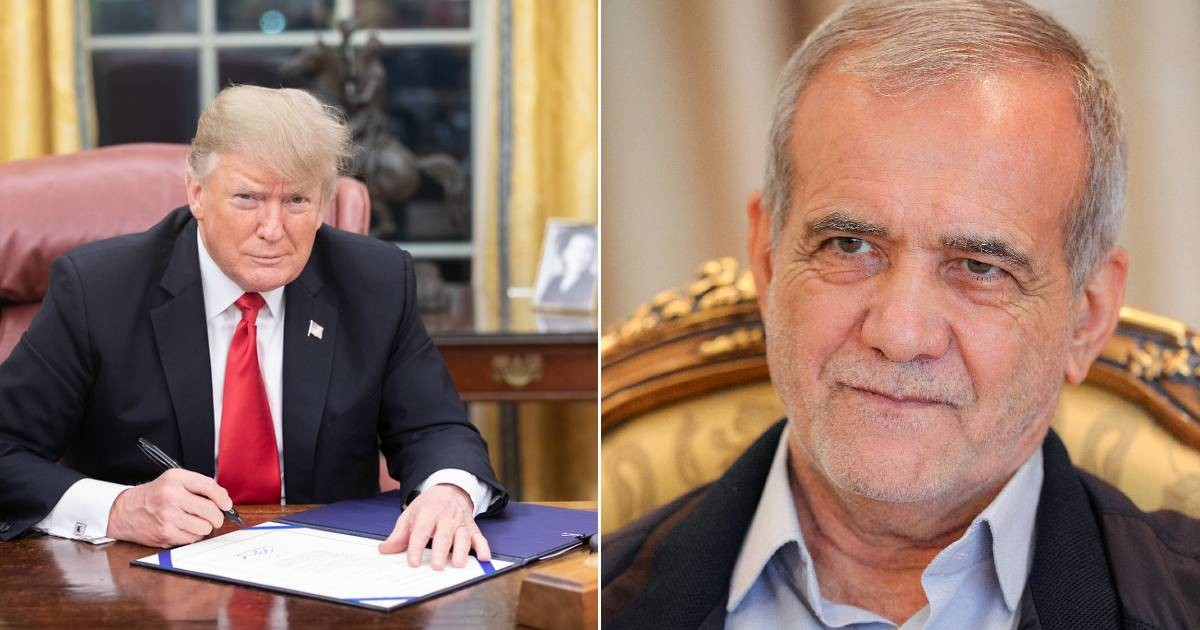
The administration of Donald Trump authorized this Thursday the Iranian delegation led by President Masud Pezeshkian to travel to New York to participate in the High-Level Week of the UN General Assembly, according to reported by EFE agency.
The decision was justified by a spokesperson for the State Department with a brief statement: "In fulfillment of our obligations as the host country, the main delegation of the Iranian regime will be able to attend the High-Level Week of the UN General Assembly."
It will be the first time that the Iranian leader sets foot on U.S. soil since the start of the war between the two countries.
The authorization is in response to the Headquarters Agreement signed between the UN and the US in 1947, which obliges Washington to facilitate the entry of accredited delegations to the United Nations, even when it involves nationals from countries with which it does not maintain diplomatic relations, or, in this case, with those it is at war with.
The trip had been shrouded in uncertainty: last Monday, Tehran publicly stated that Pezeshkian had not yet received his U.S. visa.
The Iranian delegation, which will also include Foreign Minister Abbas Araghchi, will arrive in New York with restrictions: it will be smaller than last year's delegation—when the U.S. had already denied visas to several members of the president's press team—and will be prohibited from purchasing luxury goods, in addition to having movement limits within the city.
The war context makes this visit a recent unprecedented event. The war between the U.S., Israel, and Iran broke out on February 28, 2026 with Operation Epic Fury, a coordinated and surprise airstrike against Iranian military targets.
Despite the massive bombings, the ayatollah regime was not overthrown, contrary to the declared objective of Washington.
In March, Trump stated that the war was "practically over", and in April the White House presented a ceasefire as a victory after 38 days of operation.
However, the conflict did not cease. In June, Trump canceled an attack and announced an agreement that he described as a "great agreement" to end the war, mediated by Pakistan with facilitation from Qatar.
The truce collapsed in July when Iran resumed attacks on commercial ships in the Strait of Hormuz, triggering new waves of U.S. bombings.
In August, Trump escalated the pressure with new economic sanctions against Iran and declared an "economic war" on Tehran. By September, the U.S. struck the Iranian oil fleet following a new attack on a vessel.
The restrictions imposed on Iran in 2026 have an illustrative precedent: during the soccer World Cup held this summer in the U.S., the Iranian national team had to train in Tijuana, Mexico, and cross the border solely to play their matches.
Pezeshkian is expected to deliver his speech before the General Assembly next Wednesday, September 23, marking the highest point of international visibility for the Iranian president since the beginning of hostilities.
Related videos:
Filed under: