
Related videos:
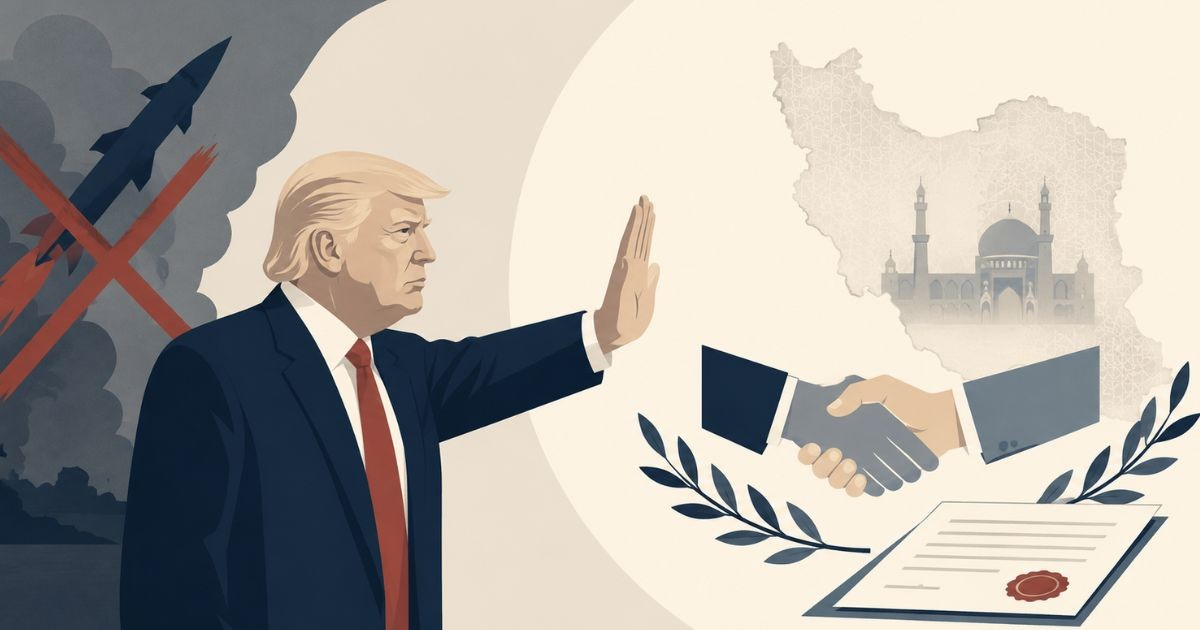
The president Donald Trump announced this Thursday the cancellation of the scheduled bombings against Iran for that night, stating that the negotiations had been raised to the highest level of Iranian leadership and approved by all parties involved.
In a message posted on Truth Social, Trump stated: "Since the talks with the Islamic Republic of Iran have been elevated to the highest level of Iranian leadership and approved, I have canceled, as president of the United States of America, the planned attacks and bombings against Iran for tonight."
The leader assured that the final points of the agreement had been approved "in principle and in great detail" by all parties, including the United States, Israel, Saudi Arabia, the United Arab Emirates, Qatar, Turkey, Pakistan, Bahrain, Kuwait, Jordan, and Egypt, among other countries.
However, Trump specified that the naval blockade on Iran will remain "in full effect" until the agreement is signed, and announced that the location and date of the signing would be announced soon.
The diplomatic shift occurred just hours after Trump himself threatened to hit Iran "very hard tonight" and confirmed in an interview with Fox News that the bombings would be "bigger, more powerful."
In that same interview, Trump also claimed that "Iran is dying to make a deal" and warned that if no agreement is reached, the United States would take control of the island of Jark, which manages approximately 90% of Iran's crude oil exports.
Iran, for its part, did not publicly confirm the agreement announced by Trump. According to Euronews, Tehran denied that a peace pre-agreement existed and stated that the document was still under review.
The Iranian foreign ministry declared this Thursday that the ceasefire in effect since April 8 was "practically irrelevant" following the recent attacks, calling them "illegal and criminal."
The announcement comes after two consecutive days of military escalation: on Wednesday, the U.S. Central Command launched a second wave of bombings against Iranian targets, to which Iran responded by attacking 18 targets at U.S. military bases in Bahrain and Kuwait, launching drones against the Fifth Fleet and announcing the complete closure of the Strait of Hormuz.
The commander of the Aerospace Force of the Revolutionary Guard, Majid Mousavi, warned: "Do you think you can turn the sacred Strait of Hormuz into an unsafe place? We will turn the whole region into a hell for you."
The conflict originated from "Operation Midnight Hammer" on February 28, 2026, a joint surprise attack by the U.S. and Israel against Iran's nuclear facilities in Fordow, Natanz, and Isfahan.
Since then, the negotiation process has gone through multiple phases, including a fragile ceasefire since April 8, extended on April 21 at the request of Pakistan as a mediator, and the de facto breakdown of the truce on June 1, when Iran suspended the negotiations citing Israeli attacks in Lebanon as a violation of the agreed terms.
Wood Mackenzie analysts project that the price of Brent could reach between 150 and 200 dollars per barrel if the closure of the Strait of Hormuz —through which more than 20% of the world's oil passes— continues for an extended period.
Filed under: