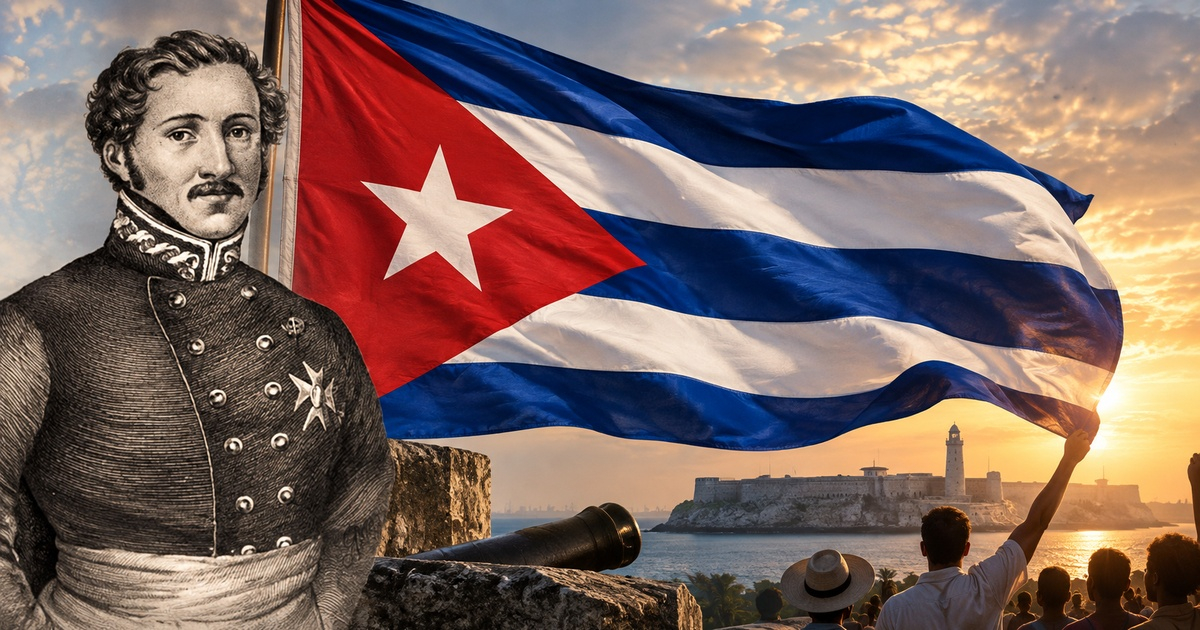
The history of Cuba is filled with figures who are difficult to categorize into a single category. Narciso López is one of them. Was he a patriot? An adventurer? A filibuster? An annexationist? Probably, the historical answer requires something more complex than choosing just one word.
Born in Caracas in 1797, López initially developed his military career within the Spanish army. His trajectory would change radically when he came into contact with Cuban sectors opposed to Spanish colonial rule. In 1848, he left Cuba after a conspiracy in which he was involved was uncovered, and he moved to the United States. There, he began organizing the project that would definitively mark his name in Cuban history.
But here appears the first major contradiction. López wanted to expel Spain from Cuba, but his project was not simply to create an independent Cuban republic. His goal was linked to the annexation of the island to the United States.
This does not mean, however, that we can reduce his figure to merely calling him an "American agent." His own proclamations reveal a language of national liberation. In 1850, he addressed the Cubans, urging them to conquer a free and independent homeland and spoke of the need to destroy Spanish tyranny. He also proclaimed the creation of a provisional government and a future constitutional assembly.
There lies a significant part of the historical problem. López spoke of freedom for Cuba while envisioning that Cuba within an annexationist project.
In May 1850, he landed in Cárdenas at the head of an expedition from the United States. He briefly occupied the city, but the Spanish reaction forced his men to retreat. The failure did not put an end to his plans.
The following year, he embarked on a second expedition. This time, the adventure ended in tragedy. Spanish forces defeated the expedition members, and López was captured. Transferred to Havana, he was executed by garrote on September 1, 1851.
His death turned him into an even more complex figure. And here begins a controversy that deserves to be known. The interpretation of Narciso López has not been uniform among Cuban historians. Manuel Sanguily, a military man, writer, politician, and also a scholar of Cuban history, directly addressed the issue in his 1894 work, "On the Purposes of General Narciso López." Sanguily argued that, although certain moments in López's trajectory could be debated, by 1850 his annexationist orientation was clear.
Decades later, Herminio Portell Vilá questioned that interpretation and defended a different view of López, emphasizing his separatist character and his struggle against Spanish colonial rule. This raised one of the central issues in the historiography concerning this figure: Was López fundamentally an annexationist who used the language of independence, or a separatist whose project ultimately became associated with annexationism?
The discussion is important because it shows that the figure of Narciso López cannot be reduced to a single interpretation. Even before the revolutionary historiography of post-1959, Cuban historians were already debating his true political intentions.
Subsequent historiography also incorporated another fundamental element: the relationship between annexationism, American territorial expansionism, and slavery. In the 1850s, expansionist sectors in the United States considered the possibility of incorporating Cuba, while certain Cuban economic groups viewed annexation as an alternative in light of their fear of the abolition of slavery. Therefore, López's project must be studied within that international and social context.
But it would also be incorrect to use that context to erase the contradictions in his thinking. López fought against Spanish colonial power and mobilized men under a banner of liberation, but at the same time, he defended a political project that contemplated the incorporation of Cuba into the United States. It is precisely that contradiction that has kept the discussion open among historians.
For some, he was a forerunner of the fight against Spanish colonialism. For others, he was a filibuster who intended to incorporate Cuba into the United States. Moreover, there is a third dimension that cannot be overlooked: the issue of slavery.
In the 1850s, significant expansionist sectors in the United States viewed Cuba as a potential territorial acquisition to benefit the expansion of the slave system. Some Cuban landowners were also concerned that Spain, pressured by Britain, would move towards the abolition of slavery. This context helps explain why the annexationist project found support among certain economic and political sectors.
Therefore, referring to Narciso López simply as a "patriot" would be insufficient. However, calling him merely an "adventurer" would also be an oversimplification.
He was a Venezuelan military man turned Cuban conspirator, an annexationist leader, and ultimately the chief of filibustering expeditions against Spanish rule. In his figure coexisted the desire to end colonial power, political ambition, annexationism, and the circumstances of an era marked by American territorial expansion and slavery.
And perhaps there lies the true historical significance of Narciso López.
We do not need to turn him into a hero to acknowledge that he defied Spanish power. Nor do we need to make him a villain to recognize that his vision did not align with the ideal of a fully independent Cuba.
Narciso López sought to free Cuba from Spain, but the Cuba he envisioned was not necessarily the independent Cuba that other revolutionaries would defend decades later.
History, when examined without legends, allows for the simultaneous existence of those two truths.
That's why the question remains open: Patriot, annexationist, filibuster, or adventurer?
Perhaps it was a bit of everything. And that is exactly why it deserves to be studied.
Related videos:
Filed under:
Opinion article: Las declaraciones y opiniones expresadas en este artículo son de exclusiva responsabilidad de su autor y no representan necesariamente el punto de vista de CiberCuba.