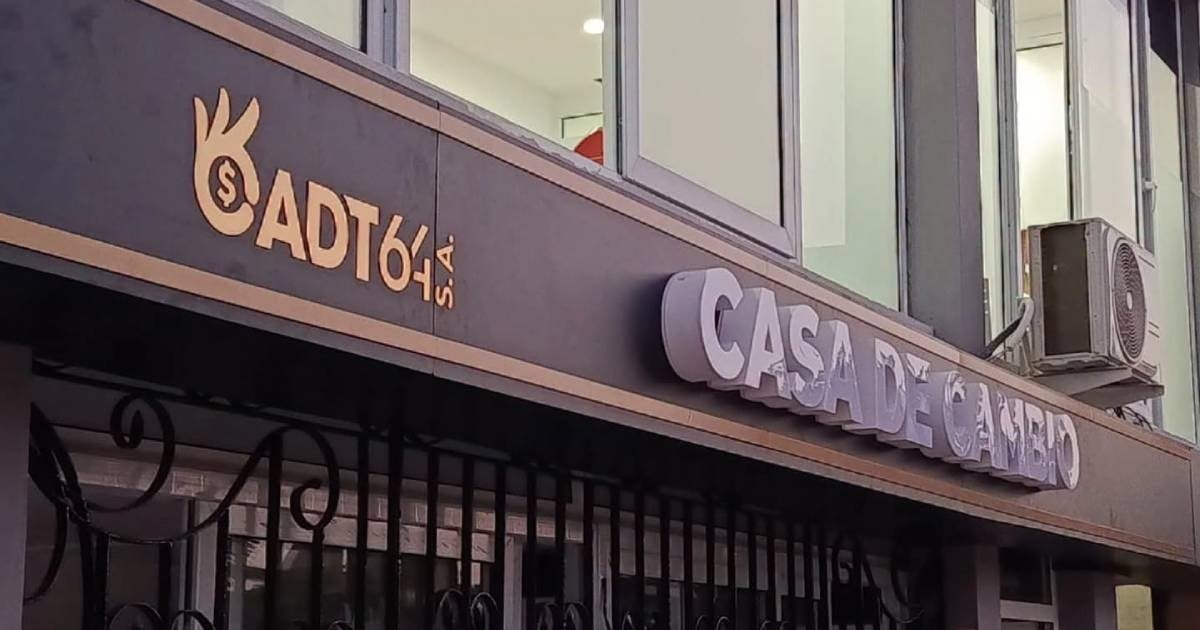
Economist Pedro Monreal scrutinized the launch of the first private currency exchange in Cuba and warned that its initial rates are sending a significant signal: the formal market that is beginning to emerge is setting prices much closer to the informal market than to the official rate of Segment III.
In an , Monreal examined the operation of ADT 64 in Santa Clara, focusing his inquiries on two issues: the rates at which it began to operate and the lack of detailed public information regarding the procedure used by the Central Bank of Cuba (BCC) to grant this type of licenses.
The first known prices support this comparison: on Tuesday, the ADT 64 screen showed the dollar at 710 CUP for buying and 730 CUP for selling, while the informal market was around 700 CUP and the official rate of Segment III was around 655 CUP per dollar.
The comparison requires, however, some precision: people who went to the establishment stated at that time that ADT 64 was buying foreign currency, but still was not selling it, even though the screen displayed a selling rate of 730 CUP.
For Monreal, the initial behavior of the establishment also challenges the expectation that the entry of private operators into the formal market could automatically lead to a cheaper dollar.
"The new business was not established to lower the dollar's value, but to quote it at a level that allows for maintaining availability of that currency," he noted.
The economist believes that this places the BCC in a dilemma: if the actual operations of the new exchange houses begin to approach the prices of the informal market, the rate of Segment III could be pushed toward those levels.
If, on the contrary, the Central Bank maintains a managed exchange rate that deviates from the data produced by its own experiment, the pilot would lose part of the utility that the authorities have attributed to it.
"On one hand, the rate of segment III could end up coming closer to the 'street' rate and lose its current anchor," wrote Monreal.
"On the other hand, if the central bank ignores the pilot’s initial data and maintains the managed rate, the experiment would end up being a costly showcase that is inconsistent with the exchange rate published by the state itself."
The function of ADT 64 goes precisely beyond just buying and selling currency: the BCC confirmed this week that operations conducted by the exchange house are being used as a source of information to substantiate the official rate of Segment III.
Ian Pedro Carbonell Karell, director of the payment system at the Central Bank, explained that the data comes from "actual, settled, and confirmed currency transactions" and not from announcements posted on social media or mere intentions to buy or sell.
Monreal, however, distinguishes between a pilot designed to verify whether the new model operates effectively and another that is capable of generating sufficiently representative statistical information to establish a national rate.
A single house —or a limited number— could serve, according to their analysis, to test matters such as cash handling, record-keeping systems, security, reporting to the BCC, or detecting counterfeit bills.
But using those transactions to establish a national exchange reference would require a much broader and more diverse sample.
As a hypothetical example, he suggested that a minimum sample might require at least 10 exchange houses distributed across no fewer than five provinces, including Havana, while a more robust scheme could necessitate between 20 and 25 establishments with a presence in the capital, several cities in the interior, an airport, and a tourist area.
It was also noted that both purchase and sale operations should be considered, as well as the volume mobilized, the number of transactions, and a sufficiently long period to assess how the rate responds to changes in remittances, seasonality, or cash availability.
"Without an effective sale of dollars, the pilot does not assess the value of the peso for those who need foreign currency; it only measures how much a buyer pays for foreign currency notes," he warned.
But Monreal's questioning is not limited to the rates. The economist described the model as a “pilot with opaque access” because, as he pointed out, there is already at least one authorized operator without any publicly known specific and detailed regulations explaining how another interested party can obtain a similar license.
"A operator is legalized, but it is not explained how the next one can enter," he summarized.
Monreal recalled that Cuba has general regulations for the financial system and the foreign exchange market, including Decree-Law 362 of 2018 and resolutions 127 and 128 of 2025 from the BCC.
These last ones established the foundations of the new exchange rate policy and the Foreign Exchange Market Regulations.
However, he maintained that a specific provision detailing the minimum capital required for private exchange houses, eligibility criteria, source of funds, necessary documentation, response times, authorized currencies, cash limits, reporting obligations, or grounds for denying or canceling a license has not yet been published in the Official Gazette.
For the economist, this lack of publicly known rules currently turns the authorization into an essentially discretionary power of the BCC, rather than a procedure that any interested party can aspire to under previously established conditions.
For Monreal, it is still too early to determine the true scope of the experiment: whether it is intended solely to test the functioning of private exchange houses or if it aims to create, based on them, a statistical reference capable of decisively influencing the official rate.
"Until that is clarified, doubt remains: either they are testing whether the business can work, or they aim to gauge the system with a statistically insufficient number of counters," he concluded.
The lack of information has also accompanied the project since its presentation.
When it was officially confirmed that the first private exchange house was already operating in Santa Clara, the authorities initially did not disclose its name, owners, address, hours of operation, currencies supported, fees, or transaction limits.
Subsequently, it was revealed that it was ADT 64 and that it had started operations on September 14, with its first public quotes even surpassing the values observed at that time in the informal market.
Related videos:
Filed under: