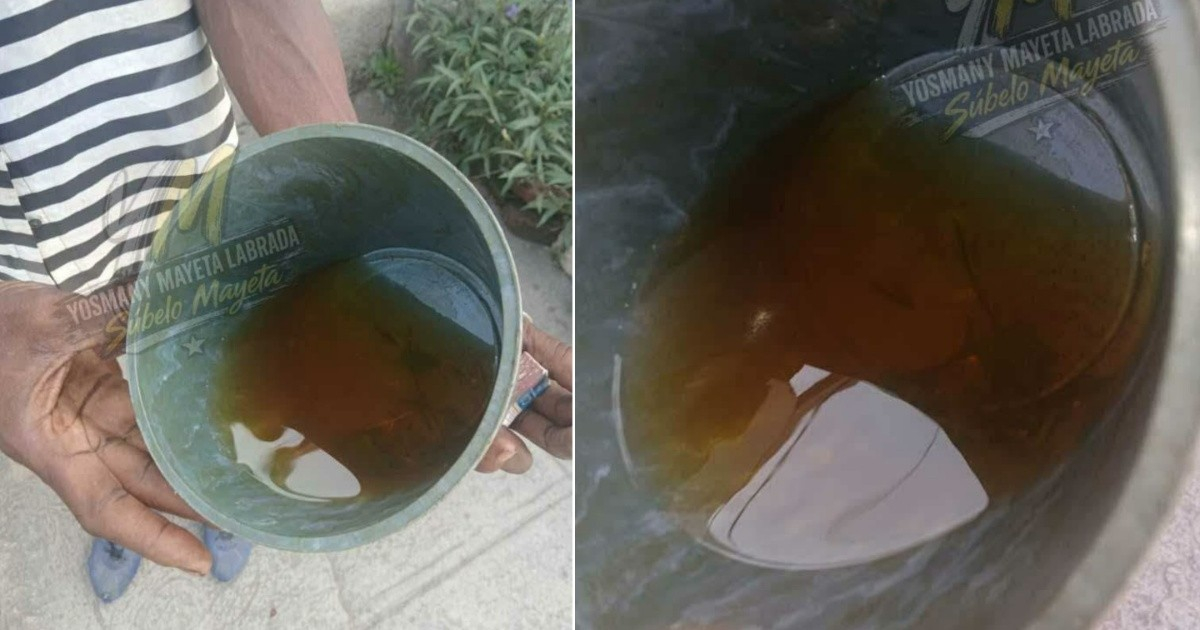
Images disseminated this Sunday on Facebook show what an anonymous source described as the "soup" served to elderly people and social cases in the dining hall of the Family Care System (SAF) located at what used to be the Cremería del Paseo de Martí, in Santiago de Cuba: a dark and murky liquid in a green bucket, with no solid food visible.
The citizen journalist Yosmany Mayeta Labrada published the complaint along with the photographs, attributing the description to the person who sent him the images: "a broth of cilantro and chopped garlic; they say it's soup."
Leeks and cilantro are common ingredients in Cuban cuisine used to enhance the flavor of broths. Their mention in the complaint highlights the lack of substance in the served liquid, which, according to the cited testimony, barely contained any chopped cilantro and leeks.
The complaint is not an isolated incident. In May of this year, a state-sponsored report on the SAF gathered the testimony of a beneficiary from another dining facility on Martí Avenue, also in Santiago, who noted the poor quality of the food and warned that some elderly individuals ended up searching for food in churches or with humanitarian individuals.
Months later, in June, another report acknowledged insufficient rations and supply issues in establishments where the food received may constitute the only daily intake for many elderly individuals.
The pattern is repeated in other provinces. In Holguín, in August 2025, only four of the 9.2 tons of peas assigned to the SAF arrived, which forced them to serve only white rice on some occasions. In Havana, a dining hall that served 84 elderly adults relied on donations from the World Food Program and support from a private company to sustain itself.
The vulnerability context of elderly Cubans exacerbates the situation. The minimum pension has remained at 4,000 Cuban pesos per month since September of last year, equivalent to less than 10 dollars in the informal market, compared to a basic basket estimated between 12,000 and 30,000 pesos.
Due to the state's inability to maintain the system, the regime opened the management of SAF dining halls to non-state actors through a public bidding process in August, backed by Agreement 10418 of the Council of Ministers and Resolution 14/2026 of the Ministry of Domestic Trade. The regulation requires two daily meals, food safety, and home delivery for those who cannot travel, but the gap between what is mandated on paper and what ends up on the plate is evident.
In Santiago de Cuba, this gap was also filled for a time by the opposition organization UNPACU, led by José Daniel Ferrer, whose headquarters in Altamira managed to distribute up to 330 meals daily to vulnerable individuals in 2025, until authorities began to harass the beneficiaries who came to the site.
Mayeta Labrada demanded a public response from the responsible institutions: "Commerce, Labor and Social Security, and the authorities of Santiago de Cuba should respond."
His conclusion summarizes the human dimension of the complaint: "The problem is how far the precariousness of a system has come that claims to protect its elderly while some end up looking at the bottom of a bowl searching for food that is barely there."
Related videos:
Filed under: