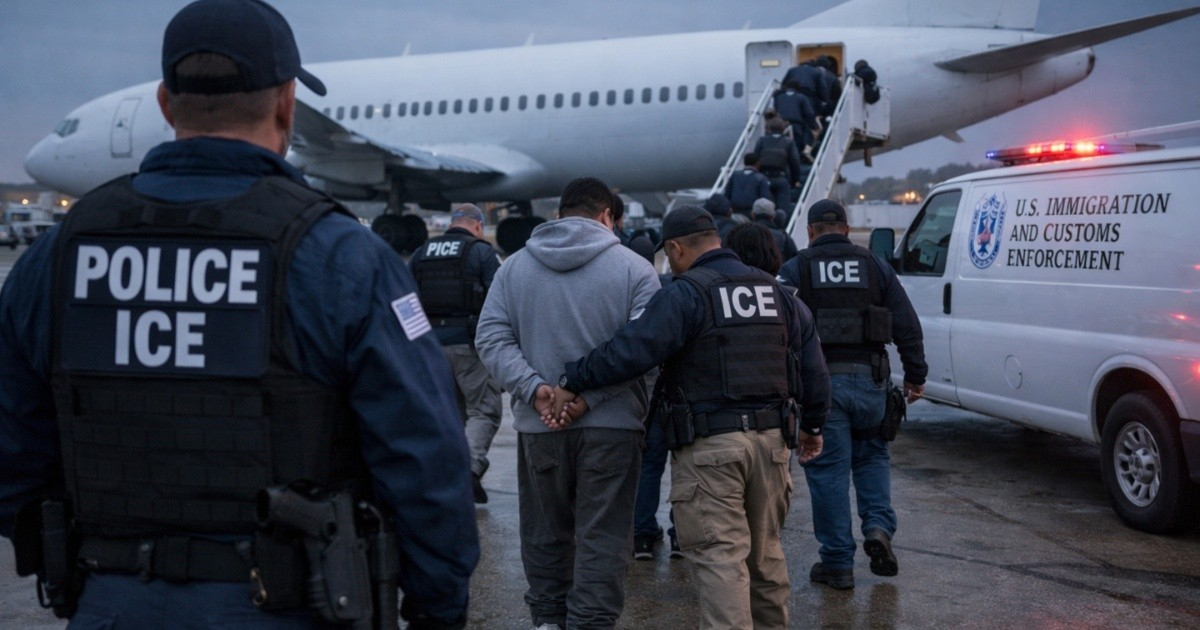
The Immigration and Customs Enforcement (ICE) has stopped showing thousands of detainees with final deportation orders in its public online locator system, a decision that has made it significantly harder for lawyers and family members to know where their clients and loved ones are located, as reported this Monday by The Associated Press (AP) based on testimonies from three current and former agency officials.
The change was implemented on September 15, without prior notice or public communication. The American Immigration Lawyers Association alerted its members a few days later, and several attorneys confirmed to AP that their clients had disappeared from the system that same week.
The measure affects those who have received final deportation orders from an immigration court. In July, nearly 16,000 people arrested and placed in ICE detention centers had final deportation orders, accounting for more than a third of the total admissions recorded that month, according to data from ICE obtained by the Deportation Data Project at UC Berkeley and UCLA.
Las acciones de ICE y sus consecuencias para miles de detenidos y sus familias forman parte de un panorama migratorio en constante cambio. Sigue los últimos desarrollos en nuestra sección de
At the beginning of July, ICE detention centers were housing more than 65,000 people in total. About 30% of them likely had final deportation orders, estimated Michelle Mendez, legal director of the National Immigration Project.
The exclusion does not apply to detainees at the Adelanto center in California, nor at temporary facilities in Minneapolis, New York, and the suburbs of Chicago, where judges have ordered ICE to keep them visible in the locator as part of ongoing litigation.
ICE neither confirmed nor denied the measure in its statement to the AP. The agency merely indicated that it prioritized the deportation of individuals with final orders, even in light of what it described as a "historic number of precautionary measures issued by courts" that halt individual expulsions.
Immigration lawyers warn that the disappearance of the locator could hasten deportations by hindering last-minute legal recourses, such as requesting the reopening of a case or filing a habeas corpus petition before a federal judge. Judges have issued thousands of rulings ordering releases or bail hearings in similar cases.
Atenas Burrola Estrada, deputy director of programs at the Amica Center for Immigrant Rights, confirmed that "each of our clients who has a final order has disappeared from the locator," including 17 counted as of this Monday.
Among those affected are eight Somali men detained at the military base of Guantánamo, Cuba. Their lawyer, My Khanh Ngo, from the American Civil Liberties Union (ACLU), warned that the change could make it "almost impossible" to challenge their deportations in some cases: "If you can't find your client, you don't know what's happening to him, you can't bring that information to court to stop his deportation."
Greg Chen, senior director of government relations at the American Immigration Lawyers Association, described the human impact of the measure: "Families are in panic because they believe the person has been deported and do not know where they might be. From the lawyers' perspective, this has serious implications for their ability to contact their clients."
The online location system was created in 2010 so that family members, lawyers, and the public could search for detainees without having to call regional offices or individual facilities. Since then, it has been criticized for updating slowly and containing incomplete information, but the exclusion of those with final orders appears to be unprecedented, according to several specialized lawyers.
The Trump administration set records for detentions this summer, with nearly 50,925 arrests in August. Detentions of Cubans increased by 463% between the end of 2024 and the beginning of 2026.
"For me, it's just another way of making people disappear," Mendez concluded. "Why would we do that in the United States of America? It's something we would hear about happening in another country and we would be concerned about individual rights and due process."
Related videos:
Filed under: