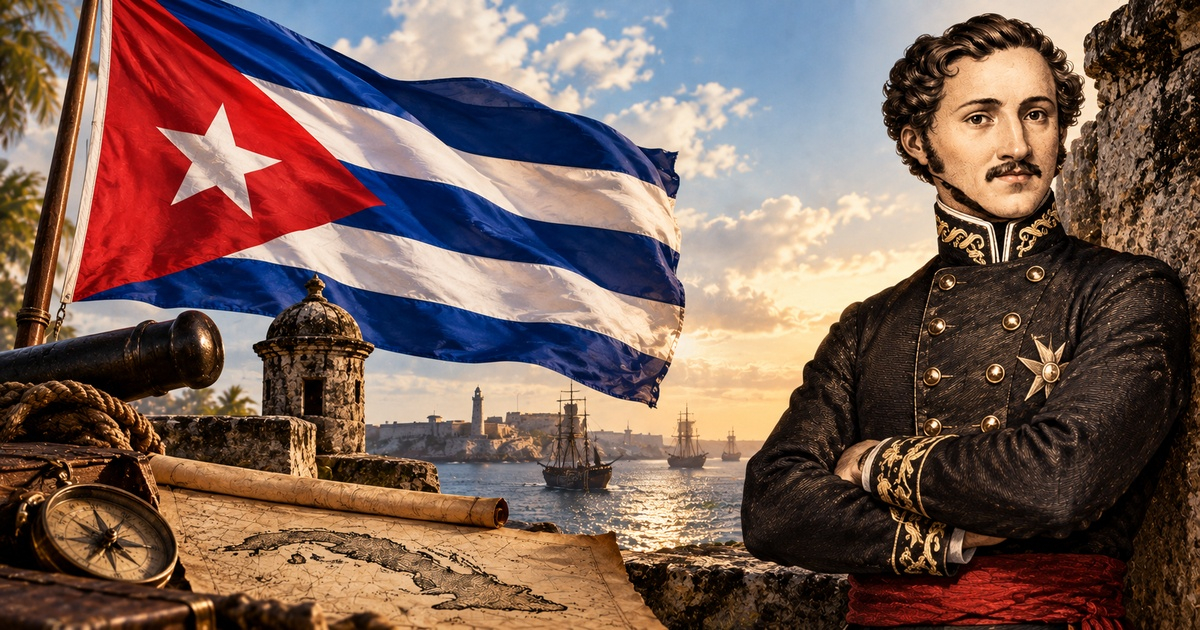
Narciso López holds a unique place in the history of Cuba. He fought against Spain, organized military expeditions, landed on Cuban territory, promoted a political project linked to annexation, and was executed in Havana in 1851. The flag he carried in his expedition would later become the national flag of Cuba.
And that's precisely where the problem begins. How should a man associated with annexationism be remembered when the symbol that accompanied his expedition ended up representing an independent Republic? This is no trivial question.
For over a century, Cuban historiography has provided varying responses. Some authors regarded López as a precursor to the Cuban revolution; others emphasized his annexationist stance; while still others sought to explain that annexationism through the economic and social structures of enslaved Cuba.
For this reason, rather than trying to place Narciso López immediately within a category—hero, annexationist, filibuster, precursor, or defender of slaveholding interests—it is essential to first study how historians have interpreted him.
The story of Narciso López thus has two narratives. The first is that of the man who conspired, fought, and died. The second is the image that historians later constructed of him. And these two do not always align.
José Antonio Saco and the Early Rejection of Annexation
Among the first Cuban intellectuals to be considered when studying the issue of annexation, is José Antonio Saco.
Saco was not a professional historian in the modern sense of the term, but his thought is essential for understanding the Cuban intellectual environment of the 19th century. His position was unequivocally opposed to the incorporation of Cuba into the United States.
For Saco, the issue was not merely about replacing one sovereignty with another. The existence of a distinct Cuban nationality was at stake. His thoughts represent one of the earliest significant intellectual challenges to the annexationist project.
But Saco also allows us to understand a fundamental issue: annexationism was not synonymous with every movement against Spain. There were Cubans who wanted to break away from Spanish colonial rule and, at the same time, rejected the incorporation of Cuba into the United States. This distinction will be crucial when, decades later, historiography has to confront the figure of Narciso López.
José Martí: between personal sacrifice and the political project
With José Martí, a new dimension emerges. Martí was deeply anti-annexationist and made absolute independence for Cuba one of the cornerstones of his political thought. However, his evaluation of the figures from the past cannot be reduced to a mechanical classification.
Martí understood that history is made up of concrete individuals, with their virtues, their mistakes, their contradictions, and their circumstances. In that context, Narciso López could be remembered for his fight against Spanish colonialism without implying an endorsement of his political project.
This distinction is essential. One thing is to value a man's sacrifice, and another is to wholly accept his political program. Subsequent historiography would inherit precisely that problem.
What should weigh more in the historical judgment of López: his political project or the fact that he fought against Spain and died for his actions? The answer will largely depend on the era from which each historian views the figure.
Vidal Morales and the Early Historians of the Republic
With the Republic begins a new stage. Cuban historiography needs to construct a genealogy of the nation and its struggles for freedom. In this context, the work of Vidal Morales y Morales emerges, particularly "Iniciadores y primeros mártires de la revolución cubana," published in 1901.
López begins to be incorporated into the narrative of the early revolutionary efforts. However, the issue of annexationism does not disappear. The new Republic needs to acknowledge those who fought against Spain, but it also needs to explain why some of those men supported different visions of absolute independence.
Here begins to develop a characteristic that will accompany Cuban historiography for decades: López will be remembered, but never in a completely peaceful manner. His place in the national memory will be conditioned by an open question: Was he a precursor of Cuban independence or a leader of an annexationist project?
Manuel Sanguily: the documentary accusation
The discussion becomes particularly intense with Manuel Sanguily. In "Purposes of General Narciso López," published in 1894, Sanguily develops a notably important interpretation: he argues that López was committed to the annexationist project. The significance of Sanguily does not lie solely in his conclusion. It resides in his method.
Sanguily attempts to demonstrate his thesis through documents, statements, and testimonies related to López's political activities. For him, it was not merely about López seeking foreign aid to liberate Cuba. There was a political orientation towards annexation. The difference is monumental.
Seeking external support for a war of independence does not necessarily mean wanting to incorporate the liberated territory into the country that provides that support. Sanguily understood that this distinction needed to be established in writing. His interpretation would have a considerable influence. However, the controversy was far from over.
Herminio Portell Vilá: the response to Sanguily
Decades later, Herminio Portell Vilá would turn Narciso López into the subject of a much more extensive investigation. His work "Narciso López y su época," published in three volumes between 1930 and 1958, constitutes one of the major historiographical efforts dedicated to the figure.
Portell Vilá did not simply accept Sanguily's interpretation. His aim was to review documentation, reconstruct the context, and challenge certain conclusions drawn from specific documents. The significance of Portell also lies in his archival work.
During his research, he consulted U.S. documentation related to López's activities and his expeditions. His investigation in U.S. archives during the 1930s significantly expanded the available documentary resources for studying the figure.
And here a methodological issue of great importance arises: an authentic document does not necessarily mean that the interpretation made of it is correct. The document must be read within its context. One must ask when it was written, who wrote it, to whom it was addressed, what its purpose was, and what other documents may confirm or contradict it.
Portell Vilá believed that Sanguily had placed excessive weight on certain evidence and argued for a more favorable interpretation of López as a precursor of the Cuban revolution. This established one of the major controversies in Cuban historiography: Sanguily versus Portell Vilá.
And the debate was not only about Narciso López. It was also about how history should be made.
Ramiro Guerra: from man to social structures
With Ramiro Guerra, the perspective changes once again. The question shifts from being exclusively: What did Narciso López want? to: What social forces made Cuban annexation possible? Guerra examines colonial society within its economic and social structures.
Nineteenth-century Cuba was a society deeply shaped by the sugar economy and slavery. The fear of an insurrection similar to that which occurred in Haiti loomed over the Cuban elites. The growth of sugar production, the concentration of wealth, and the defense of the slave system were all part of the context in which various political movements emerged.
From this perspective, annexationism could be studied as an alternative related to certain sectors of Cuban society. However, we must establish a fundamental distinction here: that a political movement aligns with the interests of specific social groups does not automatically demonstrate that all its leaders were merely instruments of those interests.
One thing is to study the social structure that favored a project. Another is to document the personal motivations of each protagonist. This distinction is particularly important in the case of López.
José Luciano Franco and Marxist Reading
After 1959, Cuban historiography underwent a profound transformation. The new official historiography needed to reinterpret the past through categories related to class struggle, imperialism, slavery, and economic interests. In this context, José Luciano Franco stands out. The question shifts once again. It is no longer sufficient to ask who López was. Now it is important to determine: Who benefited from the political project he led?
Annexationism begins to be studied in close relation to the interests of slaveholding sectors of Cuban society and with U.S. territorial expansion. The Haitian Revolution and the fear of Cuban elites of a large slave rebellion take on special significance in this interpretation. Thus, the issue of slavery becomes central to the explanation.
From this perspective, annexationism could be understood as a political option linked to certain economic and social interests. However, it is essential to avoid simplification again. Connecting a political project to a structure of interests does not alone prove that Narciso López lacked his own convictions or that he was merely an instrument of a particular class. History must substantiate this assertion with documents, not through pre-established categories.
The Revolutionary Historiography and the Problem of Memory
There is also a problem that cannot be overlooked. After 1959, the construction of a new national narrative needed to establish a revolutionary genealogy. The history prior to 1959 had to be reinterpreted from the new political perspective. Narciso López posed a particular challenge. He had fought against Spain. He had organized military expeditions. He had been executed. The flag he carried would ultimately become the national flag.
However, at the same time, his relationship with annexationism was incompatible with a straightforward interpretation of national independence. For this reason, López needed to be explained. He could not simply vanish from history. But he also could not be presented without nuance. Revolutionary historiography tended to emphasize the economic, social, and international conditions that surrounded his project. The issue of slavery gained considerable weight. The individual character was partially subordinated to the historical structure.
Torres-Cuevas and Loyola Vega: a contemporary synthesis
A later stage can be found in Eduardo Torres-Cuevas and Oscar Loyola Vega, authors of "Historia de Cuba 1492-1898: Formación y liberación de la nación," published in 2001. Here, there is an attempt to place the issue of Narciso López within a much broader historical process: the formation of the Cuban nation.
This perspective allows for a partial overcoming of the old opposition between two labels. López can be studied within the annexationist phenomenon without reducing his entire journey to a single word. This is because annexationism was not a completely homogeneous movement. There were different sectors, interests, and conceptions. Some may have viewed annexation as a political solution to Spain. Others might have seen it as an economic guarantee. Some could relate it to the preservation of the slave system. And others could understand it as a stage within a different political process. For this reason, historians must avoid automatically attributing the same motivations to all participants.
The flag and the paradox of Narciso López
Few things illustrate the complexity of the character better than the flag. The flag used by Narciso López in 1850 would eventually become the Cuban national flag. However, the meaning that a symbol acquires over time does not necessarily coincide with its original significance. This point is fundamental.
The flag may have originally been used within a specific political project and later acquired a completely different national meaning. The independent Cuban nation transformed it into its symbol.
Therefore, it would not be correct to use the flag as automatic proof that López defended exactly the same national project later supported by the independence movements of 1868 and 1895.
But it would also be incorrect to ignore that their expedition helped introduce that symbol into Cuba's political history. The paradox remains: the symbol survived the political project within which it was born.
Let's return to the documents
After over a century of historiography, the decisive moment arrives. We must return to the documents. Because a historical investigation cannot simply end by choosing between Sanguily and Portell, between Ramiro Guerra and José Luciano Franco, or between one nationalist interpretation and another Marxist one.
We must return to the sources. The documentation related to López allows us to reconstruct his political and military activities between 1848 and 1851. His correspondence, proclamations, relationships with American groups, preparations for expeditions, and political declarations constitute the material upon which any serious interpretation should be built.
And here an important conclusion arises: Narciso López's connection to annexationism cannot be erased. It is part of his historical trajectory. However, it is also not sufficient to turn that reality into a total explanation of the character. The documents must be studied chronologically. It is necessary to determine what López was saying at each moment, what his political relationships were, who financed or supported his expeditions, what objectives his proclamations expressed, and what differences existed between him and other participants in the movement.
The question should not be: “How can we prove that López was this or that?” The right question is: “What do the sources really allow us to demonstrate?” That distinction separates historical research from the creation of a legend.
The Last Journey
In 1850, López landed in Cuba at the head of an expedition. The venture failed. The following year, he organized a new expedition. That also failed. Captured after the defeat, he was taken to Havana and executed on September 1, 1851. He was then 39 years old. His death turned him into a martyr for certain sectors of Cuban memory.
But even here we must maintain a distance between memory and history. Dying while fighting against Spain does not automatically turn an annexationist into an independentist. Likewise, having defended annexation does not automatically make a man who fought against Spain a mere mercenary.
The two statements are too simplistic to explain a complex historical trajectory.
Narciso López before the tribunal of history
After exploring the various interpretations, we can observe something that may be more significant than any label. Each generation found a different Narciso López. For some, he was a conspirator against Spain. For others, an annexationist. For others, a forerunner. For others, an expression of the interests of the slaveholding society. And for still others, a figure within the process of the formation of the Cuban nation.
And for national memory, he was also linked to a flag that would ultimately come to represent an independent Republic. This raises an even deeper question: Who really built Narciso López: the man or the historians? The answer is: both.
The man produced documents, made decisions, organized expeditions, and died for them. Historians selected those documents, interpreted them, and incorporated them into various narratives about Cuba. This is why Narciso López is not just a historical figure; he is also an extraordinary case study on how national memory is constructed.
Conclusion: neither a manufactured hero nor a convenient villain
After reviewing this long historiographic controversy, I believe that a responsible response does not involve creating another Narciso López. We do not need to turn him into an absolute hero. Nor do we need to reduce him to a villain. Historical research must embrace complexity.
Narciso López was connected to annexationism. The context of slavery and the economic interests of certain sectors is essential for understanding the phenomenon of annexationism. The relationships between Cuban annexationism and American expansionism are part of the historical documentation.
But López's personal motivations must be established through a joint analysis of the sources and not through subsequent labels.
There is another fundamental teaching. The Cuban flag that we know today cannot be used to erase López's original political project. However, it cannot be ignored that that symbol outlived its creator and ultimately became part of the identity of an independent nation.
History, when studied seriously, does not always provide comfortable answers. Sometimes it presents contradictions. And those contradictions should not be hidden; they must be explained. Because the historian's mission is not to defend the dead.
It is also about not condemning them. It is about understanding them. Therefore, after exploring the various interpretations of Saco, Martí, Vidal Morales, Sanguily, Portell Vilá, Ramiro Guerra, José Luciano Franco, and Torres-Cuevas and Loyola, we can return to our initial question: Who was Narciso López really?
Perhaps the most honest answer is that we must continue to interrogate the documents. Because history cannot be resolved by simply choosing the historian we like the most. History is constructed by subjecting all interpretations to the same tribunal: the sources. Narciso López will continue to be an uncomfortable figure. And perhaps precisely for that reason, he deserves to be studied further. Because when a character does not fit comfortably within a label, the problem is not always with the character. Sometimes, it lies in our need to label him.
Related videos:
Filed under:
Opinion article: Las declaraciones y opiniones expresadas en este artículo son de exclusiva responsabilidad de su autor y no representan necesariamente el punto de vista de CiberCuba.