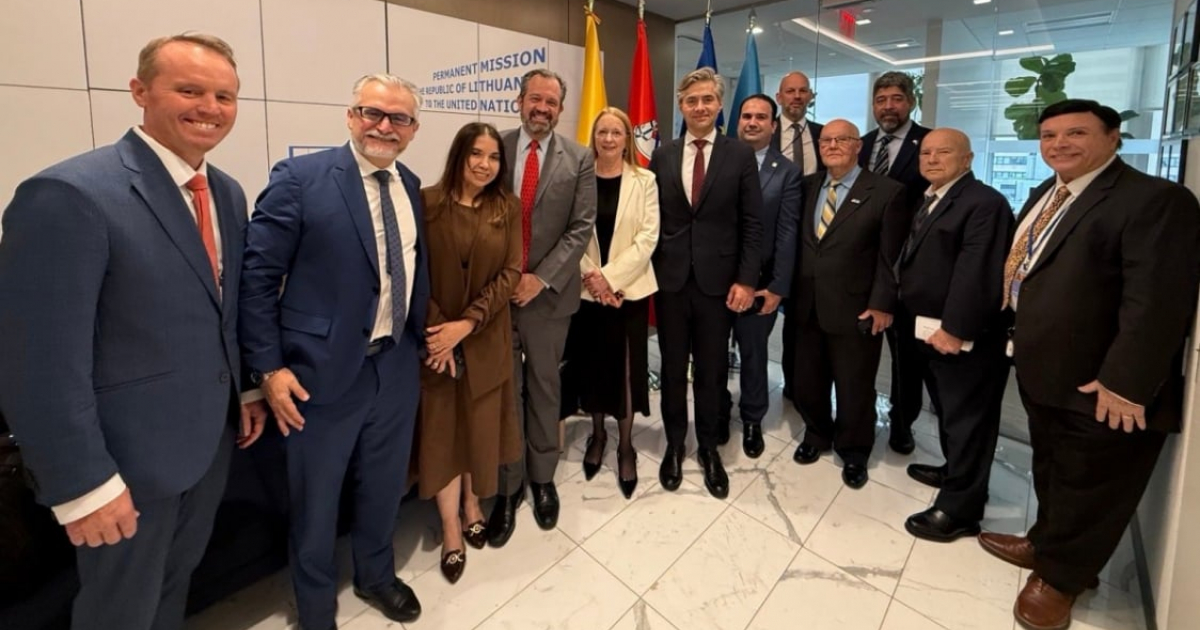
Opposition representatives from the Cuban exile community met on Tuesday with Lithuanian Foreign Minister Kęstutis Budrys and diplomats from Costa Rica and the United States to lay the groundwork for an international coalition of democratic nations committed to the transition in Cuba, according to a report by Martí Noticias.
The meeting took place at the Permanent Mission of Lithuania to the United Nations in New York, in parallel with the speech by President Donald Trump at the 81st UN General Assembly, where he described Cuba as an "absolutely failed state" and predicted that the regime "will fall." The Cuban regime's diplomatic delegationleft the plenary in protest as Trump made those remarks.
Executives and members of the Assembly of the Cuban Resistance (ARC), a platform that brings together more than 30 opposition organizations, played a leading role in the meeting at the Lithuanian headquarters alongside human rights activists.
The general coordinator of the ARC, Orlando Gutiérrez-Boronat, described the meeting as a "seed meeting" and emphasized its unprecedented nature: "This meeting is historic because for the first time a group of democratic nations is coming together to discuss how to support the Cuban people."
Gutiérrez-Boronat also emphasized the paradigm shift represented by this multilateral approach: "The Castro regime can no longer speak of a confrontation with the United States, but rather of a community of nations that demand the people of Cuba have their natural rights and historical rights to self-determine."
The three delegations —from Lithuania, Costa Rica, and the United States— welcomed the proposal to formalize this international coalition aimed at actively supporting the democratic transition and human rights on the Island.
The chancellor Budrys himself confirmed the meeting on his X account, where he stated that Lithuania "stands firmly with the Cuban people" in their pursuit of freedom and democracy, condemned the repression of the regime and its support for Russia's war against Ukraine, and announced that the Baltic country will continue to support Cuban civil society and human rights defenders.
Mexican lawyer René Bolio, one of the participants, highlighted Lithuania's experience as a strategic asset: "Lithuania has a lot of experience in transitioning from communism to freedom and wants to share that knowledge, in addition to documenting what is happening today in Cuba. It was a great success because it was agreed to create a support group for the transition and liberation of Cuba. It is the beginning of an international union to support the Cuban people."
A central point on the agenda was the role that Lithuania will assume by holding the rotating presidency of the Council of the European Union in the first half of 2027. Participants formally requested the Lithuanian government to advocate from that position for the permanent freeze of European funds to the Cuban regime, arguing that a government responsible for crimes against humanity and that sends mercenaries to fight alongside Russia in Ukraine does not deserve funding from the bloc.
That argument gains additional weight in light of the terrorism charges that the Lithuanian prosecutor’s office opened in January 2026 against three Cuban citizens accused of sabotage linked to the Russian GRU against military equipment intended for Ukraine.
The former Cuban political prisoner Luis Zúñiga praised the reception of the proposal: "Lithuania's role will be essential. The idea of creating a group of nations for a free Cuba has been warmly welcomed; they loved the initiative. We explained the immense support this cause has already generated throughout Latin America, where our secretary general has been received by most of the presidents in the region."
Costa Rica, which broke diplomatic relations with Cuba in March 2026 and whose Foreign Minister Manuel Tovar recently reaffirmed that the break is "complete," actively participated in the meeting as part of that emerging democratic front.
The academic Daniel Pedreira explained to the Lithuanian chancellor the role of the ARC in planning the transition through the "National Salvation Plan," a roadmap for the first 24 months following a political change in Cuba that includes governance, a market economy, transitional justice, and free elections.
Related videos:
Filed under: