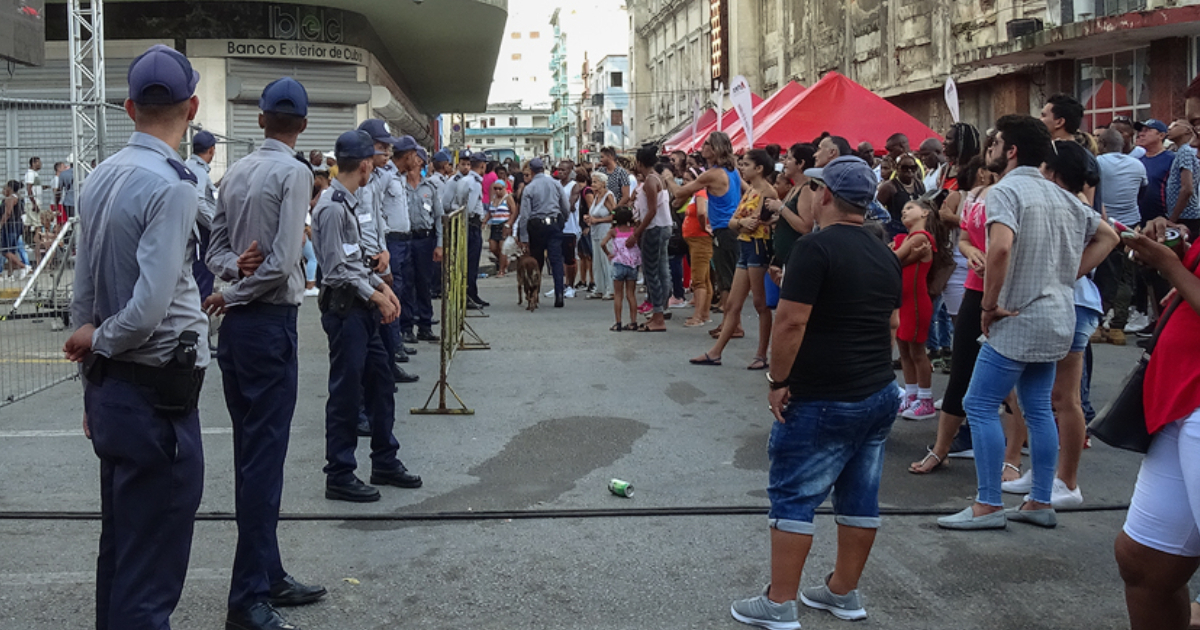
A new international report places Cuba at the bottom of the democratic rankings on the continent. The study The Global State of Democracy 2026: Democracy in an Age of Conflict, prepared by the International Institute for Democracy and Electoral Assistance (International IDEA), positions the island in the low range across the four dimensions measured by the index: representation, rights, rule of law, and participation.
The analysis encompasses data from 2025 and compares 173 countries using a scale from zero to one, where results below 0.4 are considered low. Cuba does not exceed this threshold in any of the four categories, and together with Venezuela, it is the only territory in the Americas that simultaneously shows this level of deterioration across all dimensions.
The worst result for the island corresponds to civic and electoral participation, where it scored only 0.212 points and ranked 166th among the 173 countries assessed. International IDEA evaluates in this category the involvement of citizens in public life, organizations, and electoral processes—areas that the Cuban regime systematically controls or suppresses.
In representation, Cuba scored 0.245 points and ranks 147th worldwide, a dimension that includes the existence of credible elections, inclusive voting, and effective parliaments. In rights, it achieved 0.273 points —also in 147th place—, falling two positions compared to the previous record, in a category that measures civil liberties, political equality, and access to justice.
The Rule of Law indicator scored the lowest of all: 0.174 points, ranking 157th in the global ranking. Although this position represents an improvement of one place compared to the previous year, the island remains firmly in the low range. The report warns that the rule of law is "one of the areas most exposed to deterioration on a global scale," with declines in judicial independence, anti-corruption institutions, and legal enforcement mechanisms as a widespread trend.
The document identifies Cuba, Nicaragua, and Venezuela as the three most prominent cases of authoritarian consolidation in Latin America, in a global context that also does not offer encouraging signs: 2025 marked the eleventh consecutive year in which more countries experienced net democratic backsliding than progress, and 98 out of 173 nations —57%— showed declines in at least one democratic factor between 2020 and 2025.
The results of the IDEA report add to a series of international evaluations that portray Cuba as one of the most closed systems on the planet. Freedom House rates the island as "Not Free" with just nine out of 100 points and zero in political rights. Reporters Without Borders placed it in 160th out of 180 in press freedom this year, the second worst in the Americas after Nicaragua. And the Heritage Foundation ranked it 175th out of 176 in economic freedom, within the category of "repressed" economies.
The pattern is not new. International IDEA already documented in 2019 that Cuba was the only democratic exception in Latin America, having not experienced any transition in four decades, and since 2018 it has ranked among the 25% of the most dictatorial countries in the world with issues on 12 of its 16 indicators.
The IDEA 2026 report is published days after the magazine Foreign Affairs warned that Cuba is approaching a point of no return in its structural crisis, and after a group of researchers from Harvard presented a formal proposal for democratic transition for the island.
Related videos:
Filed under: