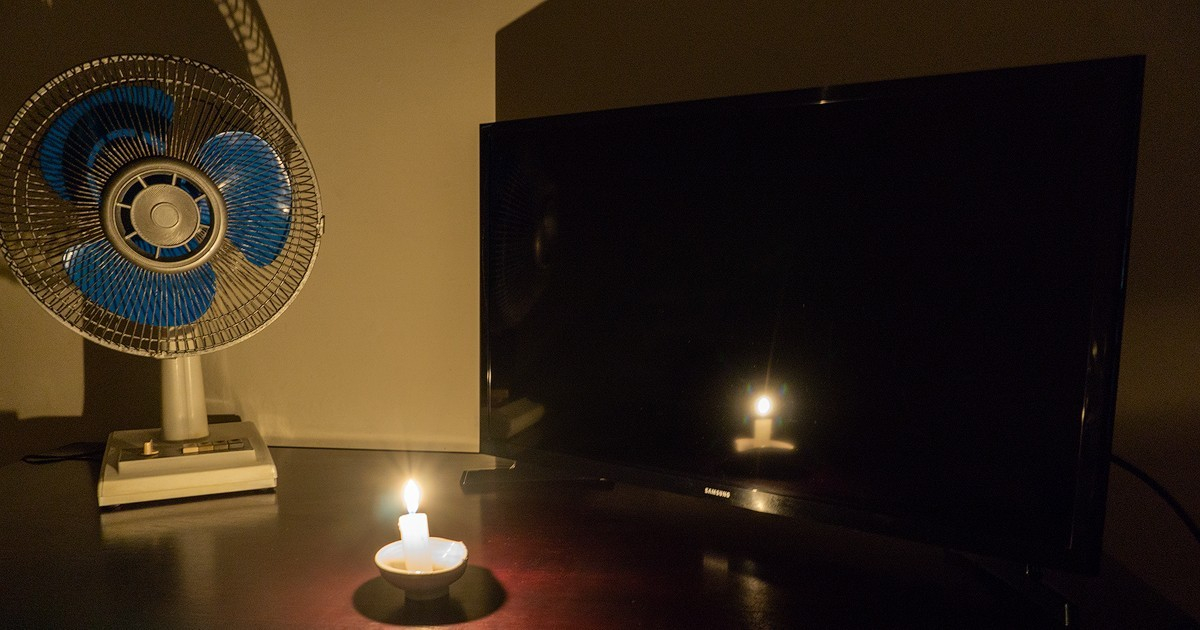
Cuba woke up this Thursday immersed in a new day of extreme blackouts. According to the official report from the Unión Eléctrica (UNE), at six in the morning, the National Electroenergetic System (SEN) had only 837 MW available against a demand of 2,524 MW, leaving 1,701 MW uncovered.
Wednesday was even more severe: the electricity service was interrupted for a full 24 hours, without any period of normalcy, not even in the early morning. The worst reading of the day was recorded at 8:20 PM, when the deficit reached 2,170 MW.
For the peak hours this Thursday, the UNE forecasts an availability of 897 MW against a maximum demand of 3,000 MW, resulting in a deficit of 2,103 MW and an anticipated impact of 2,133 MW. At noon, the estimated impact is 1,660 MW.
The only addition announced for the nighttime peak is the completion of unit 4 of the CMC thermoelectric plant (CTE) at 60 MW, a marginal figure compared to the magnitude of the deficit.
The report from the state entity details a breakdown of outages that explains much of the collapse: the unit 8 of the CTE Mariel is out of service, the unit of the CTE Guiteras —the largest thermoelectric plant in the country—, the unit 6 of the CTE Nuevitas, the unit 2 of the CTE Felton, and the unit 6 of the CTE Renté. Under maintenance are the unit 3 of the CTE Santa Cruz, the unit 5 of the CTE Nuevitas, and the unit 5 of the CTE Renté.
To this situation, we must add a detail that highlights the fuel crisis: unit 3 of the CTE Cienfuegos is "offline due to low fuel levels at the plant." The limitations in thermal generation total 467 MW.
The CTE Guiteras has faced a series of setbacks that worsen the situation. The power plant suffered damage to its boiler during the eighth nationwide blackout of the year, which occurred on September 18, when failures in the 220 kV transmission lines Matanzas-Cienfuegos and Matanzas-Santa Clara left more than nine million people without electricity for approximately 32 hours. On Wednesday, the plant experienced another setback during the hydraulic test of the economizer, further prolonging its repairs.
The solar photovoltaic generation provides partial relief and is exclusively diurnal: on Wednesday, solar parks produced 3,343 MWh, with a maximum power of 520 MW at noon. However, this capacity does not compensate for the failures of the thermal system nor does it cover nighttime demand, which is when blackouts become more intense.
The situation this Thursday is part of a prolonged energy crisis throughout September, with deficits exceeding 2,000 MW on multiple occasions and at least eight nationwide blackouts recorded so far in 2026.
The accumulated deterioration of thermoelectric plants that have been in operation for over four decades, the chronic shortage of fuel, and the lack of foreign currency to purchase it on the international market are creating a structural crisis with no signs of relief in the short term.
Related videos:
Filed under: