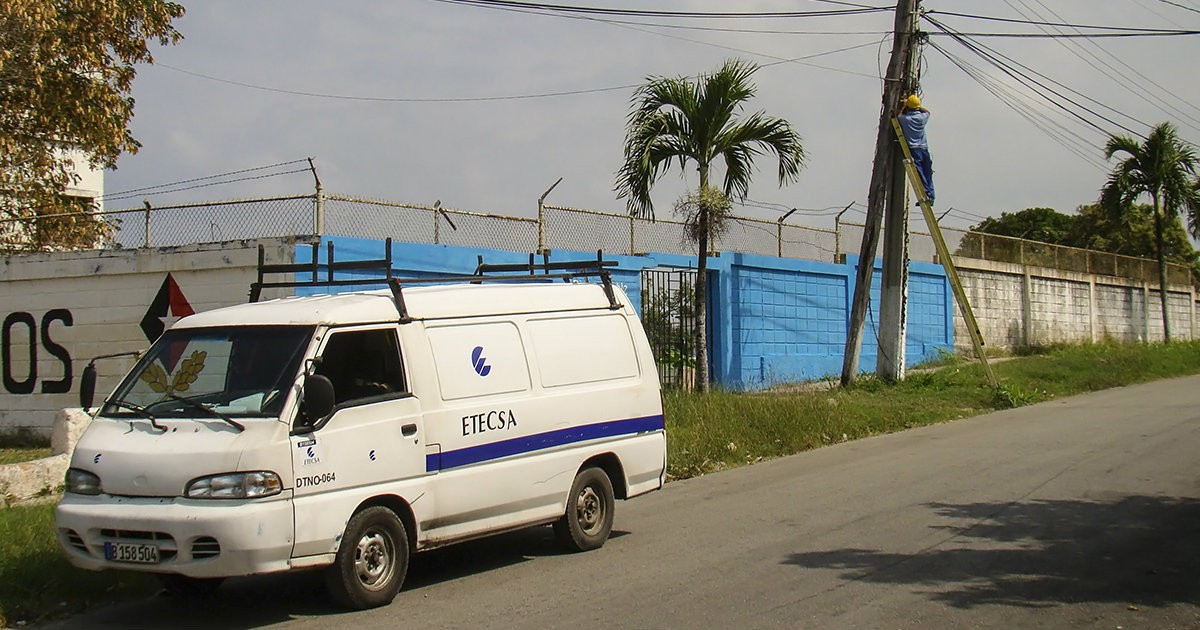
The electricity crisis shaking Cuba in 2026 has led to a partial collapse of telecommunications across the island. ETECSA, the state monopoly of the sector, acknowledged this Thursday in an institutional statement that prolonged blackouts leave entire communities without signal, disrupt internet connectivity, and overwhelm the few radio bases that manage to stay powered.
The most serious incident occurred on September 18, when the complete failure of the National Electric Power System (SEN) —the eighth nationwide blackout of 2026— left more than 80% of the radio base stations and nearly 70% of the telecommunications cabinets out of service. Internet traffic losses reached 58% compared to similar periods, as acknowledged by the company itself.
The situation this Thursday remained critical. The Electric Union (UNE) reported at 06:00 hours a capacity of only 837 MW against a demand of 2,524 MW, with 1,701 MW affected. For peak hours, a deficit of 2,103 MW was forecasted. Multiple thermoelectric units remain out of service —including those at the Mariel, Guiteras, Nuevitas, Felton, and Renté plants— while unit three of the CTE Cienfuegos is offline due to a lack of fuel.
"During the past few months, the availability of mobile and fixed services has decreased, causing increasing inconvenience for the population. This is largely due to many technological sites shutting down due to a lack of electrical power," ETECSA stated in its announcement.
The company has accumulated around 77,000 reports of interrupted fixed services, often due to a lack of resources and the cost of maintaining outdated infrastructure. Fixed telephony does not cover its own operational expenses, which is why ETECSA has to subsidize it with the revenues from mobile telephony, a balance that the energy crisis has disrupted.
Given this situation, the company made a significant decision: it halted the expansion of its access network —base stations, cabinets, and WiFi points— to focus resources on the transition to photovoltaic energy. "It is not feasible to continue investing to expand the access network if there is no capacity to support the telecommunications infrastructure energetically," the company justified.
Until the release of the statement, 64 municipal capitals had their main centers equipped with solar panels, with the most progress in Pinar del Río, Villa Clara, Matanzas, and Granma. However, the installed capacity does not always ensure service around the clock.
To support the most extensive national and provincial sites, ETECSA relies on generators that have, at times, operated for more than 20 continuous hours, causing discomfort to the neighbors. The company acknowledged that their supply and daily maintenance are priorities but insufficient given the scale of the outages.
Structural failures are compounded by vandalism: in recent weeks, there have been reports of theft and destruction of solar panels installed by ETECSA in Santiago de Cuba, further exacerbating the precariousness of the system.
Citizen discontent is intensifying due to the contrast with the fare increases implemented in May 2025, when ETECSA limited top-ups in Cuban pesos to 360 per month and raised the prices of data packages, a measure that the company itself acknowledged would affect nearly half of its customers. "Was that why they raised prices last year?" asked a user on social media, encapsulating the widespread sentiment.
The question remains unanswered officially: ETECSA did not announce compensations or provide a date for the normalization of the service.
Related videos:
Filed under: