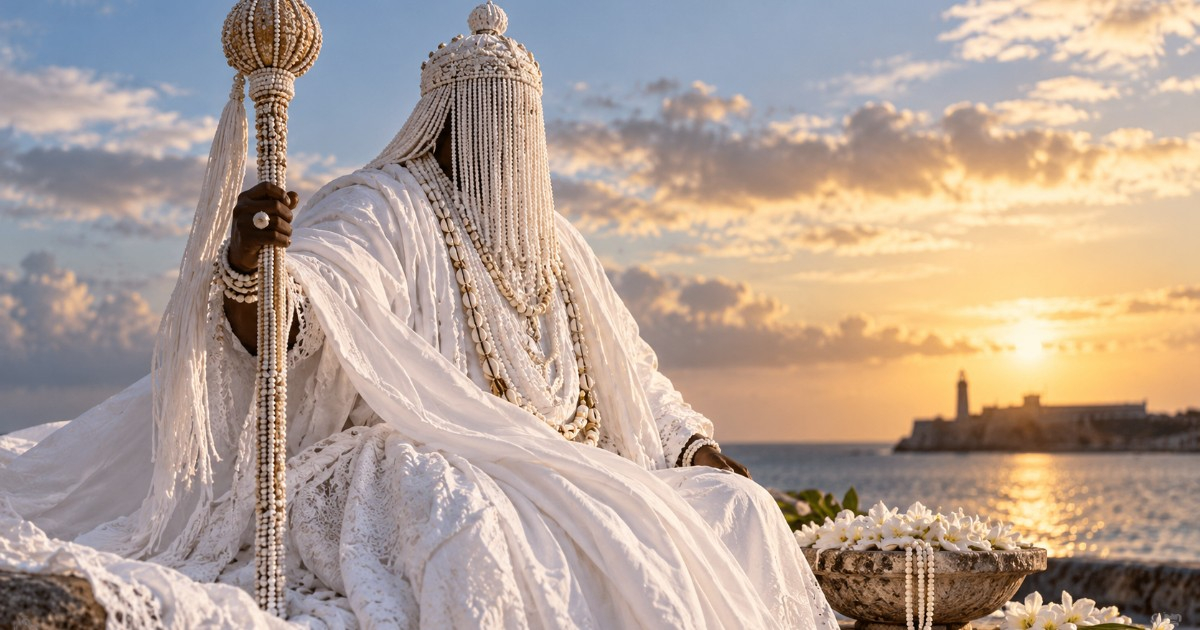
On September 24, many Cuban followers of the Yoruba religion celebrate Obbatalá, one of the most important orishas. This deity is associated with peace, purity, intelligence, and the quest for truth.
According to Yoruba tradition, Obbatalá was sent by Oloddumare to create human beings. He is regarded as the father of humanity and the protector of his children, which is why he rejects fighting and violence. He represents balance and harmony.
Also, Obbatalá is known as the owner of heads. Believers attribute to him the mastery over thoughts, dreams, and intelligence.
This orisha has different paths or manifestations, both masculine and feminine. White is its characteristic color and symbolizes spiritual cleanliness and purity.
In Cuba, centuries of coexistence between African religious traditions and Catholicism led to the syncretism of Obbatalá with Our Lady of Mercedes, an invocation of the Virgin Mary also known as the Virgin of Mercy.
The Virgin of Mercy has a close historical relationship with prisoners and captives. Her devotion dates back to the 13th century and the establishment of the Order of Our Lady of Mercy, originally dedicated to securing the freedom of captive Christians. Hence, in her iconography, chains and shackles sometimes appear as symbols of captivity and liberation.
In Cuba, every September 24th, numerous faithful, usually dressed in white, gather at the Church of Our Lady of Mercy in Havana to bring flowers, make requests, and pray specifically for imprisoned individuals and their families.
This is a special day for many believers. It is a time to draw closer to faith and, above all, to pray for peace in the world, for Cuba, and for Cubans, no matter where they are.
Related videos:
Filed under: