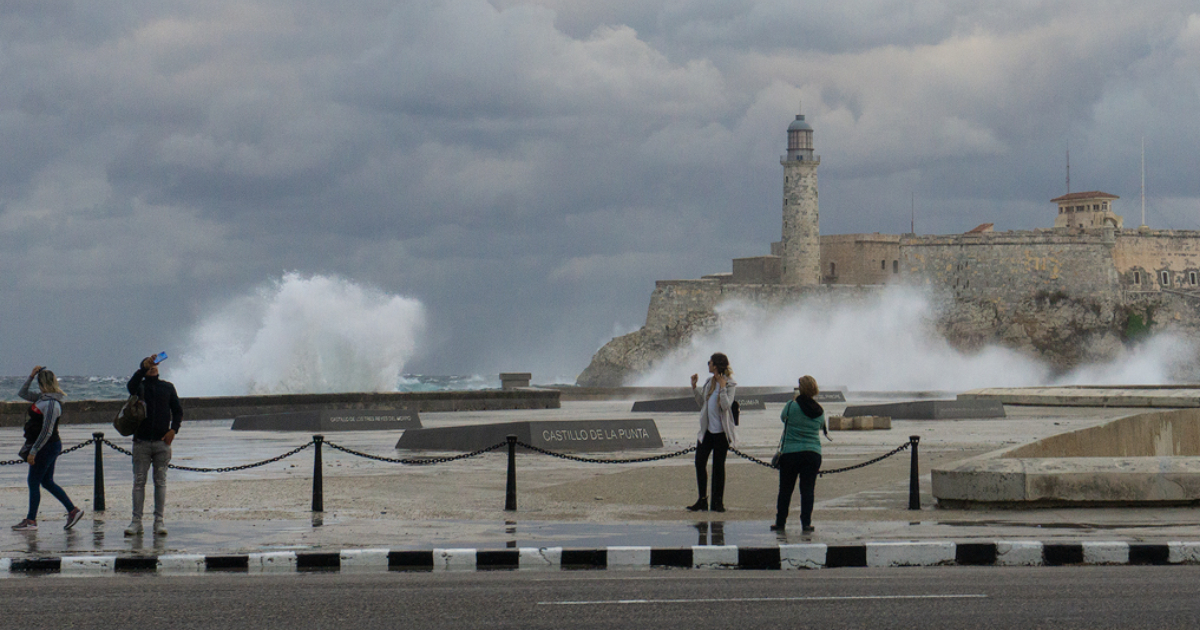
The Cuban Institute of Meteorology (INSMET) warned this Wednesday that a frontal trough will affect the western part of the country for at least three consecutive days, with showers and rains expected to start on Friday.
According to the post by the agency on Facebook, it refers to "the remnants of a dissipating front," an extratropical low over the western Atlantic that will slowly move down the Florida peninsula on Thursday and Friday, positioning itself near the northern coast of Cuba on Saturday.
INSMET was clear in dispelling confusion: "It is not a cold front, but it can bring rain. Stay tuned for official reports."
Temperatures will not experience a significant drop. The agency specified that "they will continue to be warm, although slightly lower due to areas of cloudiness and rain."
The notice comes at a particularly delicate time for Havana and western Cuba, where the drainage infrastructure has suffered severe deterioration, turning every heavy rainfall into an emergency.
This Wednesday, just an hour of rain was enough to flood several streets in Centro Habana. Residents described the scene starkly: “They are rivers, they are flooded rivers”, while a tractor was used to transport people between flooded areas in the Santa Ana neighborhood.
The structural cause is pointed out repeatedly by the residents themselves: "When it rains a lot here in Havana, everything gets flooded. Since all the drains and everything are clogged, the water has nowhere to go."
The episode this Wednesday adds to a series of similar events throughout September. On the 11th of that month, the José Martí International Airport recorded 71.8 millimeters of rain in just one hour.
Two days later, rainfall exceeding 300 millimeters in 24 hours in some areas of the capital resulted in 26 homes completely collapsed, 122 with partial collapses, and over 250,000 customers without electricity.
On that occasion, 148 people had to be housed in state centers, while another 762 self-evacuated with family or friends.
September is historically one of the rainiest months in Cuba, with average precipitation of 174 millimeters in the west, according to data from the Cuban News Agency, and it coincides with the peak of the Atlantic hurricane season.
The situation could worsen in the coming days: meteorological sources indicate that starting Saturday, the atmospheric configuration could favor the formation of a low-pressure center with potential cyclonic development, with a higher risk in low-lying areas, poorly drained regions, and near rivers and channels in western Cuba.
Related videos:
Filed under: