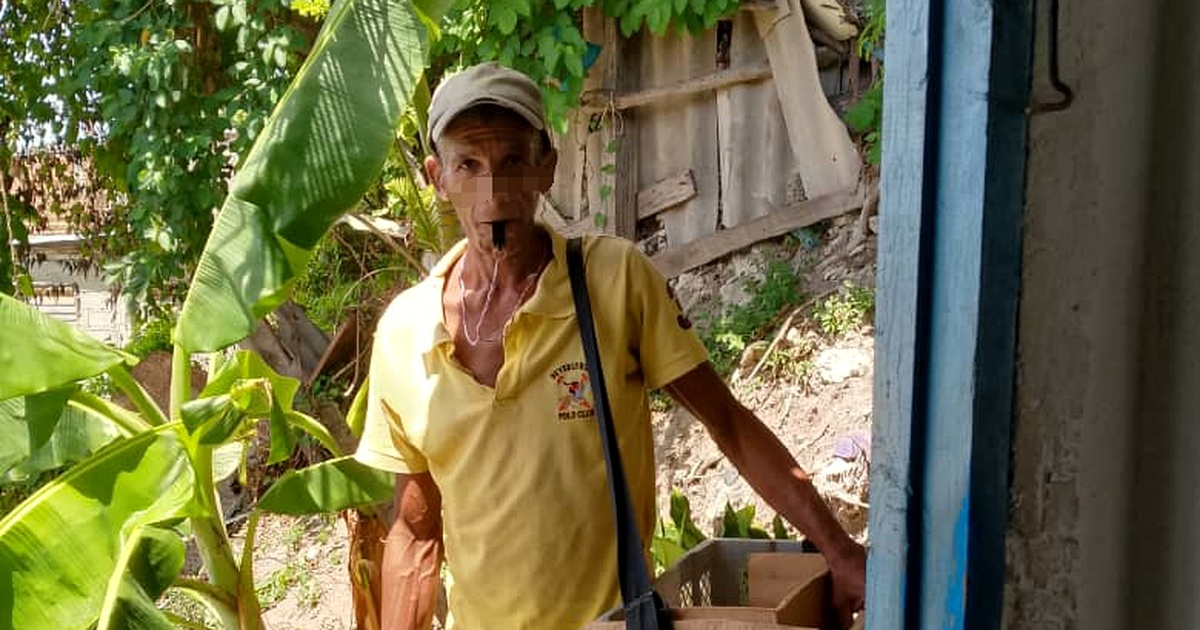
The sound does not come from a worn throat, but from a plastic whistle pressed between the lips. In the hills of Santiago de Cuba, the traditional call has given way to an auditory signal of distress: the sharp whistle that alerts neighbors that bread has arrived at the door. On the other side of the strap crossing his chest, holding a plastic net cage with his left hand, Felo, a man in his mid-fifties, distinctly thin and with a face aged beyond his years from the relentless eastern sun and decades of survival, walks through the city step by step.
He is neither a government employee nor the owner of the flour. He is the last link in the informal distribution chain: the street vendor.
From Monday to Friday, he carries on his shoulders up to 180 "balls" of bread, those small round rolls made from wheat flour that the state bakery has stopped providing regularly. On weekends, the quota drops to 150. The entire day, from the first light until the last piece disappears from the plastic crate, goes by on foot.
The mathematics of their survival is exact but relentless. The supplying bakery delivers each round piece for between 26 and 27 Cuban pesos (CUP). On the street, where scarcity drives up prices, bread is sold for between 35 and 40 CUP. For each unit sold, they make a profit of about 8 or 9 pesos. On a good day of selling 180 loaves, their gross income hovers around 1,400 CUP.
In Cuba, where state salaries are low, earning more than a thousand pesos a day may seem like a substantial amount. However, in an economy marked by continuous devaluation, those 1,400 CUP represent barely two dollars on the informal market. The amount doesn't even cover the cost of a bottle of oil, which ranges between 3,500 and 4,500 CUP, nor a dozen eggs, which easily exceeds 2,000 pesos. With the daily earnings from 180 breads, Felo can hardly hope to buy a single pound of pork to put something on the table.
To earn that basic livelihood, their legs must cover between 10 and 15 kilometers each day. In the topography of Santiago de Cuba, this distance is not measured in flat meters, but rather in the angle of steep slopes, broken sidewalks, and worn-out steps, all under temperatures that approach 35 degrees in the shade.
The physical wear and tear after over five decades of life is cumulative. Therefore, his immediate aspiration is not to change professions, but to gather 3,000 pesos, the equivalent of two full days of work, to buy a used car for transporting children. "Sales are bad," he admits with the resignation of someone who sees his clients’ wallets tightening, just as his own has. Adapting children's car wheels to his plastic cart is not a commercial whim; it’s a biomechanical necessity to save his knees and spine as he walks. - "I need to sell more to get by," says the seller.
Its story reveals the true nature of the Cuban economic crisis, compelled to open up to the private sector. It has brought processed flour back to the streets, but the distribution logistics do not depend on trucks; instead, they rely on the vulnerabilities of those most affected. The bakery supplies the raw material and the oven; the informal worker contributes their sweat, the soles of their shoes, and their joints.
Behind him, amid the banana plants and the unpainted facades of the neighborhood, the sound of the whistle booms again. Felo resumes his climb. While the official economy grapples with figures and speeches, the table of many families in Santiago still has only a piece of bread, reliant on the efforts of a man navigating the crisis, uphill.
Related videos:
Filed under: