The Cuban Elizabeth González Aznar directed a new public message to Miguel Díaz-Canel in which she questioned the ruler's claim to speak on behalf of the population and asked him on what basis he asserts that he has the support of the Cubans to continue the construction of socialism.
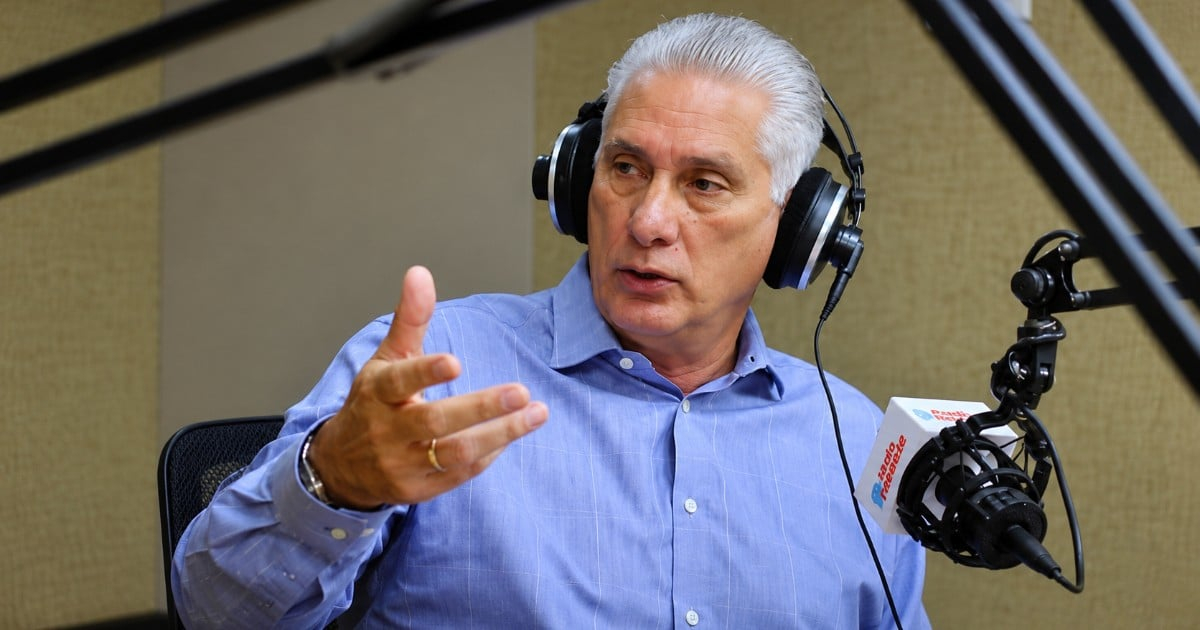
In a , González reacted to the premiere of the radio program Criterio Compartido, hosted by Díaz-Canel on Radio Rebelde, and focused his questions on the results of the government's management, economic inequalities, and the official assertion that the country will continue on the socialist path.
The radial space began this Wednesday, and its first broadcast was dedicated to the 176 economic and social transformations approved in June.
During the program, Díaz-Canel reiterated that these measures represent an "updating" of Cuban socialism and "not a turn towards capitalism".
González questioned whether the new measures will produce results different from those achieved so far.
In his text, he framed his criticism within what he described as eight years of Díaz-Canel's leadership, during which, according to his assessment, measures, laws, projects, and adjustments have been announced without the majority of workers and retirees experiencing any improvement.
Today the people survive and resist, but do not live, he wrote.
He also questioned the growth of the private sector and argued that some entrepreneurs, small and medium-sized enterprises, and self-employed workers have achieved very different economic conditions compared to those who depend on salaries and state pensions.
González also attributed the high prices to the decline in the purchasing power of the population.
The 176 economic measures approved by Cuban authorities cover areas such as investment, financial system, foreign trade, property, energy, and business operations, and include greater participation of the private sector in various economic activities.
Another key point of the message was Díaz-Canel's insistence that the economic transformations do not mean abandoning socialism.
González responded that, in his view, the growing economic disparities among Cubans contradict principles that the authorities themselves present as characteristics of that system.
"It's not about saying it, it's about doing it, it's about living it", he stated, after comparing the conditions of certain private actors with those of doctors, scientists, teachers, engineers, and other state workers.
The most direct questioning came when González doubted that the government could assume that the permanence and resilience of the population necessarily equate to political support.
"You assume that the people resist out of ideology, political conviction, and support for you and your government, but you cannot claim that. Have you ever asked the people?", he wrote.
The Cuban suggested that a response regarding the true support for the continuity of the model should be obtained through a consultation with the entire population and not through selected groups.
“Why do you claim that you have the support of the people and that the people support your government?”, he asked.
González stated that, in his case, resisting the current conditions does not necessarily reflect an ideological stance. "Many of us resist out of a lack of options, because we have no other choice," he pointed out.
The idea aligns with another question that had been directed at Díaz-Canel in August, when he rejected the authorities' attribution of the everyday resilience of Cubans to the leadership of the Communist Party, stating then: “This people resist because we have no other choice.”
González concluded his latest publication with a reference to the electrical issues that daily affect the population: «I hope to have electricity and a charged mobile phone for the next edition of the program».
In recent months, González has repeatedly directed public inquiries at the Cuban authorities.
In mid-September, she reported that residents of San Agustín, in La Lisa, had been without water for more than a week and asked the leaders, "Why do we have to live like this?".
A day later, he returned to the issue to report leaks that, he claimed, had been wasting water for years while many homes experienced service interruptions.
"The one that spills runs like a river," he pointed out then.
At the beginning of September, he had directly questioned Díaz-Canel about the social and economic disparities that, in his opinion, have deepened in Cuba, stating that "never before has this country had such social differences."
On August 28, in another open letter, she challenged the leader about food prices, power outages, and the economic situation, and ended by asking him: "How long, Mr. President?"
Related videos:
Filed under: