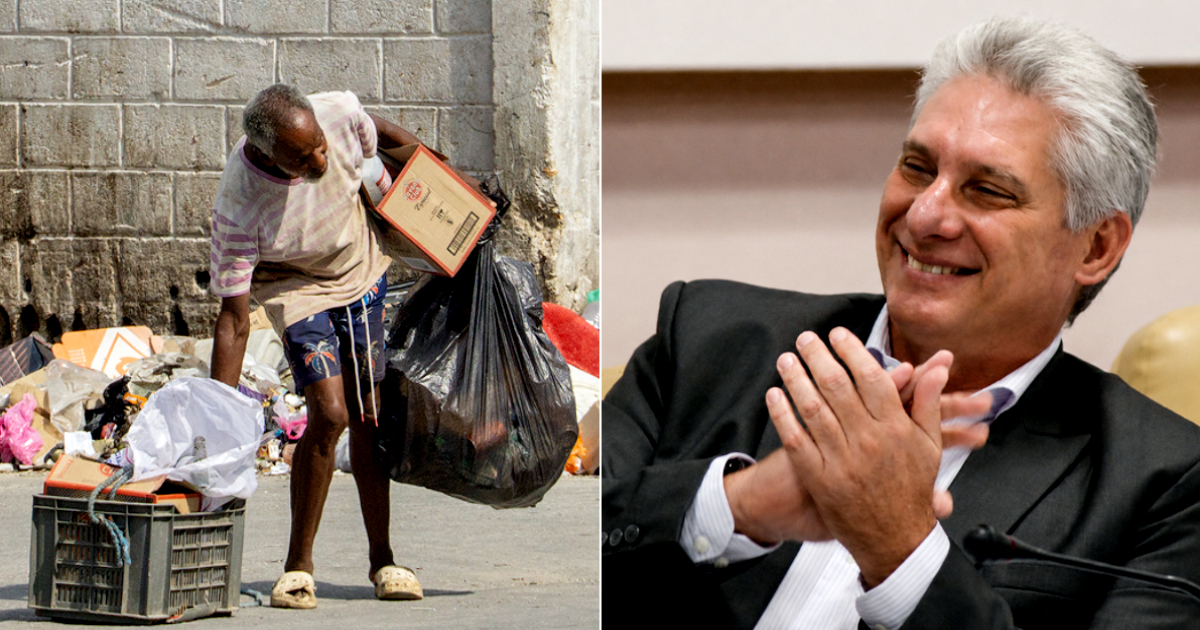
The Cuban Elizabeth González Aznar once again directed a strong message to Miguel Díaz-Canel, this time to challenge the ruler's insistence on defending socialism while, as she claims, economic inequalities, privileges, and social disparities become increasingly visible in Cuba.
In a post shared this Tuesday on Facebook, González Aznar once again wrote directly to the leader and made it clear from the outset that she will continue to voice her discontent with the state of the country and his way of governing it.
"Dear President Miguel Díaz-Canel, I am writing to you once again, although I have never been sure that you read what I write, but well, the CIE does, so I presume something gets through," he began.
The Cuban also invoked José Martí to explain why she insists on making her criticisms public: “Like Martí, I truly believe in the power of words.”
"I consider myself a revolutionary Cuban, but not the type from now, the type from before, which are really very different. Therefore, I will not tire of expressing my dissatisfactions regarding my country and its way and method of leading it; I have, like all Cubans, that right," she stated.
His message particularly questions the defense that Díaz-Canel has made of the socialist model.
In June, when the Government announced a broad package of economic reforms, the leader insisted that "we are not renouncing socialism" and defended the construction of a "Cuban-style socialism," despite the incorporation of market mechanisms and greater openness to the private sector.
González recalled the interviews given by Díaz-Canel to foreign journalists and his speeches over the past year, noting that he was particularly struck by the fervor with which he insists that his government has not "given in for a second" in the construction of socialism.
The Cuban woman sarcastically remarked on a system that, as she pointed out, "has been under construction for over half a century and is still not realized", and asserted that the "foolishness," in the sense she herself deemed most appropriate, of refusing to give up socialism is personally concerning and contradictory to her.
"A socialist system has guidelines and premises without which one cannot speak of a socialist system, and I sincerely do not see them in today's Cuba. Moreover, not only do I not see them, but we have also witnessed how the ones that existed have gradually been lost," he stated.
"Then, Mr. President, how can we believe? How can we trust? How can we understand?" he asked.
González contrasted that discourse with what he observes in the daily lives of Cubans.
"You speak of irrevocable socialism in Cuba, but never before has this country had so many social differences, so many economic inequalities, it is the closest thing to social classes of capitalism," he wrote.
He also stated that Cuba is "further away" than ever from the Martian principle of "for everyone and for the good of all" and the maxim of "to each according to his work."
"So, how can we believe you, Mr. President?" he questioned again.
It also ensured that there is a growing distance between the authorities' words and the reality faced by the population.
"You can say many things, express with beautiful and even poetic words many ideas, but the reality that is lived is completely different," he noted. "Words and wishes are one thing, but actions, the tangible and lived reality, are another."
To illustrate the importance he attributes to the distance between discourse and reality, González even referred to an extreme historical example.
He mentioned Adolf Hitler and pointed out that, despite being "a fascist who nearly brought about the end of the world," he believed he was doing good for humanity through the supposed "purification" of the race.
The Cuban explicitly clarified that she was not comparing Díaz-Canel to Hitler, but using the example to warn about "the importance of a divorce between what is said and thought and what is done."
Among the examples he used are the blackouts and the way the scarce available electricity is distributed.
González questioned why some circuits experience outages of more than 24 hours while others, as reported, remain powered for extended periods or are not disconnected.
"How is it that in a socialist system, the little that the SEN generates, for all the well-known reasons, cannot be distributed among everyone without priorities or servitude, so that we can all enjoy a bit of what little there is?" he asked.
According to what was stated, the population was first divided into blocks and now into circuits. It was assured that some areas have been without service for more than 24 hours, while others do not experience outages, and questioned the lack of information regarding the reasons why certain zones are given priority.
"These last ones are prioritized, but we don't even know which ones they are because they don't inform us clearly as they did with those that are turned off, nor do we understand why they are prioritized," he stated.
González pointed out that some explanations suggest the existence of "coupled services," other circuits identified as DAF, and other cases regarding which, according to her, there is "no idea why," although she stated that among the population it is discussed that it could be due to the people living in them.
"The truth is that this division does not represent a socialist system at all because while some live with electricity 24/7, others survive without electricity for more than 24 hours, and that is not social justice; it benefits some over others," he stated.
The Cuban also stated that there are differences even among the areas experiencing blackouts. According to her complaint, some circuits can receive up to eight hours of electricity, while others barely get two and, at times, not even that much due to "automatic cutoffs from instability."
González argued that, in those cases, the Electric Company’s response is to disconnect them, which, in his words, "balances one deficit with another."
Why does this happen? No one explains, he questioned.
He also accused the Electric Company of Havana of issuing reports that do not correspond to the actual situation of certain circuits.
"The Electric Company of Havana issues false reports about circuits that, according to them, are turned off due to shortages, when in reality they have been active for up to 10 hours, and the people are witnessing this; they want to report it, but there is nowhere to do so," he stated.
His claims about supposed privileges, the reasons for prioritizing certain circuits, and the alleged false reports from the Electric Company of Havana pertain to his complaint and have not been independently verified.
From that situation, González launched one of the most forceful criticisms of his message against the official insistence on presenting the country as a socialist society.
"Then you speak very enthusiastically about socialism and announce that you will not renounce it, but in practice, what is done is closer to a genocidal capitalism than to the construction of socialism," he stated.
The Cuban also denounced what she considers “corruption” and “servility” surrounding the electricity problem and stated that the authorities do not want to hear the complaints of those who are directly suffering from the crisis.
"Around this problem, there is corruption and servility, but no one wants to listen to the people; they don't care because they do not experience it," he wrote.
He also accused the leaders of living a reality very different from that of the majority of the population and stated that this gap is evident even in their appearance and the way they present themselves in public.
"And this is another example of how distant socialism looks in Cuba, the life of the leaders compared to the people. It is something so evident, it evokes indignation. It reflects in the way they speak, dress, in their faces, in their bodies," he wrote.
You live while the people survive, and it's easy to talk about sacrifice that way, he added.
González also mentioned access to gas, water, and dollarization as other examples of policies and shortcomings that, in his view, deepen the divides among Cubans.
In the closing part of his message, he emphasized that he had never seen the Cuban people so divided and argued that this fragmentation results in a lack of "ideological unity." He also suggested that such division could ultimately serve as a guarantee for those in power.
This is not the first time that Elizabeth González Aznar has publicly questioned Díaz-Canel.
At the beginning of July, he directly asked why Cubans should trust him and his Government, after pointing out the deterioration of basic services and the existence of an elite that, in his opinion, lives under very different conditions than the rest of the country.
In August, she responded to the leader again after he attributed the resilience of the Cuban people to the Communist Party. She then rejected that interpretation and stated that "this people resist because we have no other choice".
Related videos:
Filed under: