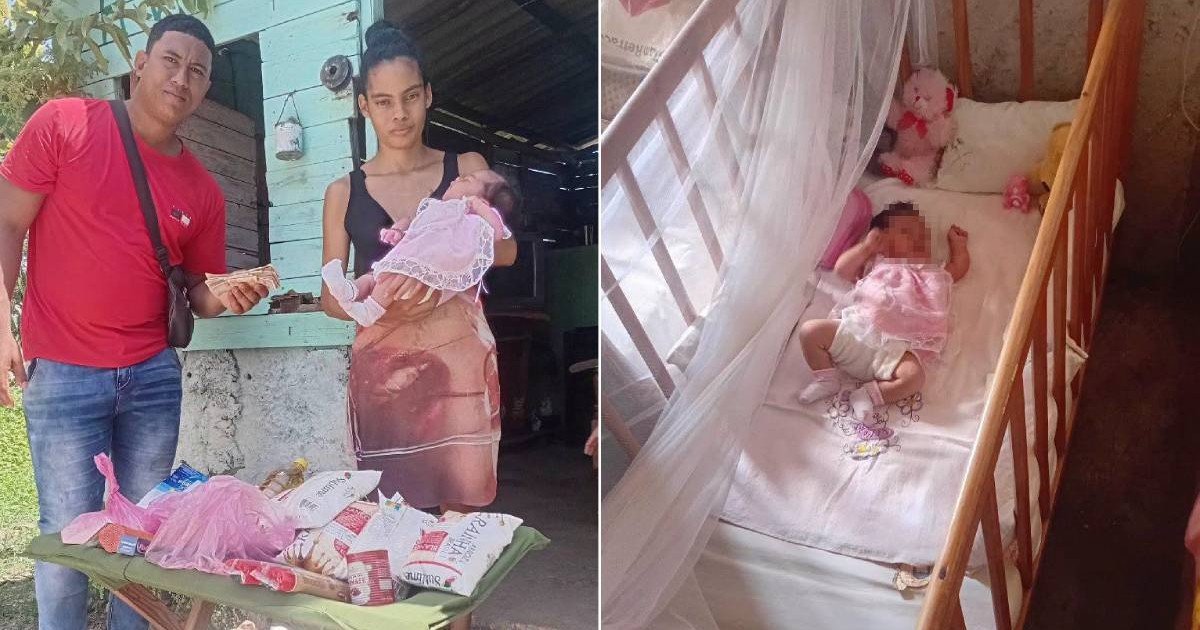
A Cuban resident in the United States responded to the call for solidarity from the Santiago activist Nairobis Sánchez and donated to a family in a situation of extreme vulnerability a crib, a mattress, a mosquito net, hygiene products, food, and 17,000 Cuban pesos.
Sánchez published on his Facebook account that the affected family had previously endured a robbery, an incident that had been shared in a previous post to request assistance.
The donation arrived at a critical moment: the family’s baby, just a few months old, suffers from severe scabies and does not stop crying due to the itching, while there are no medications available in the hospital to treat this condition.
"I had to travel about 7 kilometers to reach them, but when it comes to helping, tiredness takes a back seat," wrote Sánchez, who personally delivered the donated items to the family living in a modest wooden house.
The images that accompany the post show the little one in the newly received crib, with a white mosquito net and clean bedding, as well as the characteristic skin lesions of scabies spread across her torso.
Sánchez clarified that the baby still needs specific products for treatment and called on those who can help to contact him at +53 63687051. "Any help, no matter how small, can make a difference," he stated.
The case is set against a pharmaceutical crisis unprecedented in Cuba: the Ministry of Public Health admitted in July 2026 that only between 30% and 32% of the essential medication list was available in the country, with 461 out of 651 drugs missing nationwide.
BioCubaFarma acknowledged in June that it could not guarantee about 300 of the 395 medications committed to the national health system.
Scabies, caused by the mite Sarcoptes scabiei, requires treatments such as permethrin, benzyl benzoate, or ivermectin, medications whose availability in Cuban pharmacies is extremely limited.
In infants, the condition is usually more widespread and severe than in adults, and without proper treatment, the itching is intense and continuous. Outlets like El Toque and Diario Las Américas have documented outbreaks of scabies that particularly affect infants and families living in overcrowded and impoverished conditions on the island.
This is not the first time that Sánchez has mobilized the solidarity of the diaspora in response to urgent cases in Santiago de Cuba.
In mid-September, the case of a single mother with a baby who has Down syndrome and a heart murmur was highlighted, living in extreme poverty. Just days earlier, help was sought for a seven-month-old baby whose mother had passed away and who was hospitalized at the Dr. Juan de la Cruz Martínez Maceira Children's Hospital.
On Wednesday, a similar case shook social media: a baby in Yaguajay, Sancti Spíritus, with bullous epidermolysis also required urgent help with medications and supplies, highlighting the Cuban state's inability to ensure basic care for the most vulnerable.
"Share this post so that more people can see the heart of Cubans and the solidarity that exists when we unite," concluded Sánchez, whose work on social media has become one of the few effective channels of support for families that the healthcare system has left vulnerable.
Related videos:
Filed under: