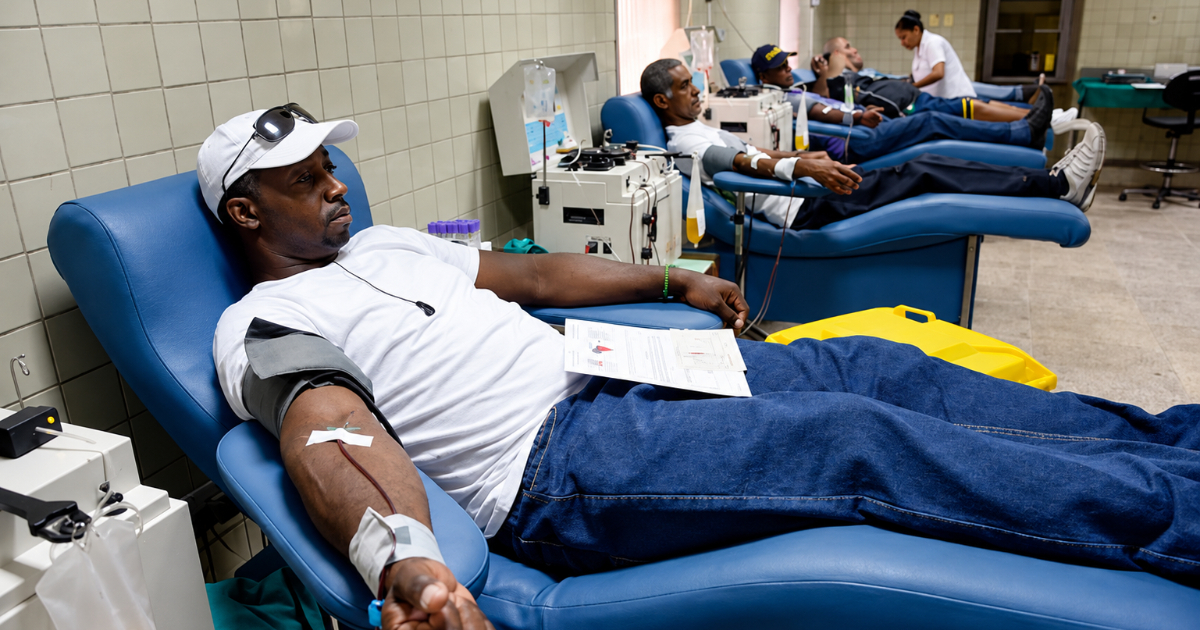
About to turn 66 years old, the Committees for the Defense of the Revolution (CDR) continue to request blood.
Information published this Wednesday by Granma regarding the activities of the organization in Holguín states that «blood donations are also being encouraged» and emphasizes the response of the community members to the calls to go to the blood banks.
It is quite significant that blood appears in the same article alongside another of the historical missions of the CDR: the so-called "revolutionary popular vigilance".
Both tasks have accompanied the organization since its inception. Much has been written about the role of the CDR in neighborhood surveillance, the preparation of reports on residents, or collaboration with security agencies.
Less known is her involvement for over six decades in the systematic collection of blood from the population.
An activity always presented as voluntary and altruistic, but also organized through plans, goals, commitments, and emulation.
From surveillance to blood collection
The CDR were created by the dictator Fidel Castro on September 28, 1960. Just a few months later, they were already involved in donation campaigns.
A historical reconstruction places that activity starting in January 1961, and when the Cuban transfusion medicine program began organizing in 1962, the Committees took on a central role in promoting and recruiting donors.
During the Missile Crisis of October that year, the mobilization enabled approximately 8,000 extractions in Havana in just 72 hours.
Another decisive moment came after the earthquake in Peru in 1970. Cuba sent part of its plasma reserves, and Fidel Castro launched a campaign to replenish them and assist the victims. In just ten days, 104,594 donations were made.
A testimony later collected by the researcher Marta Harnecker shows how that mobilization operated. A Cuban who was then the deputy director of a school recalled that at his center “we were assigned the task of collecting blood donations”.
What initially could respond to emergencies ended up being incorporated into the regular activities of the CDR.
In the report presented at the First Congress of the Communist Party of Cuba in 1975, 1,181,000 blood donations were attributed to the organization during its first 15 years of existence.
Blood had become yet another "revolutionary task".
Voluntary donations... with a plan to fulfill
Over the years, a peculiar characteristic has solidified that still persists: donations are officially voluntary, but their collection is organized through specific figures that territories and structures must reach.
In 2006, for example, the CDR of Granma celebrated reaching 35,000 extractions and being the first in the country to complete the amount they had "committed" to during that "emulative year."
The very title of the information summarized the contradiction: “The Committees for the Defense of the Revolution in Granma fulfill the annual plan for voluntary blood donations”.
In 2017, Granma celebrated 50 consecutive months of compliance with the Voluntary Blood Donation Plan. Provinces and municipalities had specific targets assigned: Pinar del Río needed to achieve 1,833 monthly donations and Cienfuegos, 1,125.
The goals extended even to the health structures of the communities. In 2020, the polyclinic in Esmeralda, Camagüey, was assigned a quarterly plan of 68 donations and the Municipal Directorate of the CDR participated in the calls from the districts.
That a health system plans the blood reserves it needs does not mean that citizens are compelled to donate. The Cuban specificity lies elsewhere: for decades, a mass political organization established in every neighborhood has taken on the responsibility of mobilizing donors and ensuring certain outcomes.
Thus, concepts such as "voluntary," "plan," "commitment," "compliance," and "emulation" ended up coexisting within the same system.
When the patient has to seek the blood
There is another, less institutional side to this story.
For years, many Cubans have reported that before certain surgeries, the patient needed to find a family member, friend, or third party to donate blood.
The practice continues to appear in recent testimonies.
In June 2025, the official media outlet Escambray documented that in Sancti Spíritus, as in other Cuban provinces, blood transfusions increasingly relied on luck or the financial means of the family.
Earlier, in April of that year, the independent outlet 14ymedio warned that the shortage in blood banks had even led to an informal market that extended even to social networks: individuals offering to donate in exchange for between 5,000 and 7,000 Cuban pesos.
The requirement for a donor is not officially listed as a general prerequisite for a surgical intervention, which is why it is important to differentiate those testimonies and hospital practices from explicit state regulations.
But the shortage is real. Cuba went from 690,450 donations in 1990 to 254,845 in 2023, according to figures collected in the health yearbooks.
The enormous machinery of social mobilization that for decades achieved hundreds of thousands of bags annually no longer produces the same results.
Blood, plasma, and industry
There is also an economic aspect that adds another dimension to the story.
An official document from the Ministry of Public Health for the period 2021-2025 outlined two distinct indicators: the “annual blood donation plan” and the “annual plasma donation plan for industry”. To receive a favorable evaluation, both needed to reach 100%.
Cuba has developed a plasma fractionation industry and the production of blood-derived products for decades.
Archivo Cuba, an organization led by researcher María Werlau, estimated based on international trade statistics that between 1995 and 2019, Cuba exported 1.323 billion dollars in a category that includes blood, plasma, blood components, and derived medicinal products.
The information requires important precision: this commercial classification is broad and does not allow for the assertion that those revenues came directly from funds provided by Cuban donors. There is also no public evidence that allows tracking a donation collected by a CDR to a product subsequently exported.
What is documented is the State's economic interest in plasma. In 2025, BioCubaFarma sought foreign investment to build a plasmapheresis center aimed at obtaining and marketing plasma, the sale of which would allow for the recovery of the investment.
The contrast is hard to ignore: for decades, the State has mobilized the population to provide a biological material for free, which also fuels an industry with economic value.
66 years later, there are still obligations to fulfill
The story has come down to the present almost intact.
In July 2026, a neighborhood in Holguín aimed to achieve 100 blood donations as a "commitment to Fidel" in honor of the centenary of his birth. Local media even tracked how many more were needed to "meet the goal."
Now, just a few days before the 66th anniversary of the CDR, Granma once again emphasizes that in Holguín, donations are being encouraged and cederistas are invited to come to the withdrawal banks.
And in Pinar del Río, La Palma has just been recognized as a Vanguard of the CDR after achieving, among other indicators, 102% of its blood donation plan.
More than six decades have passed since the first campaigns. Cuba has changed, the CDRs have aged and lost much of the mobilization capacity they had in the past, while the country faces a severe decline in donations.
But the mechanism retains something essential from its origins: engaging donors, mobilizing the neighborhood, setting a goal, and achieving it.
Related videos:
Filed under: