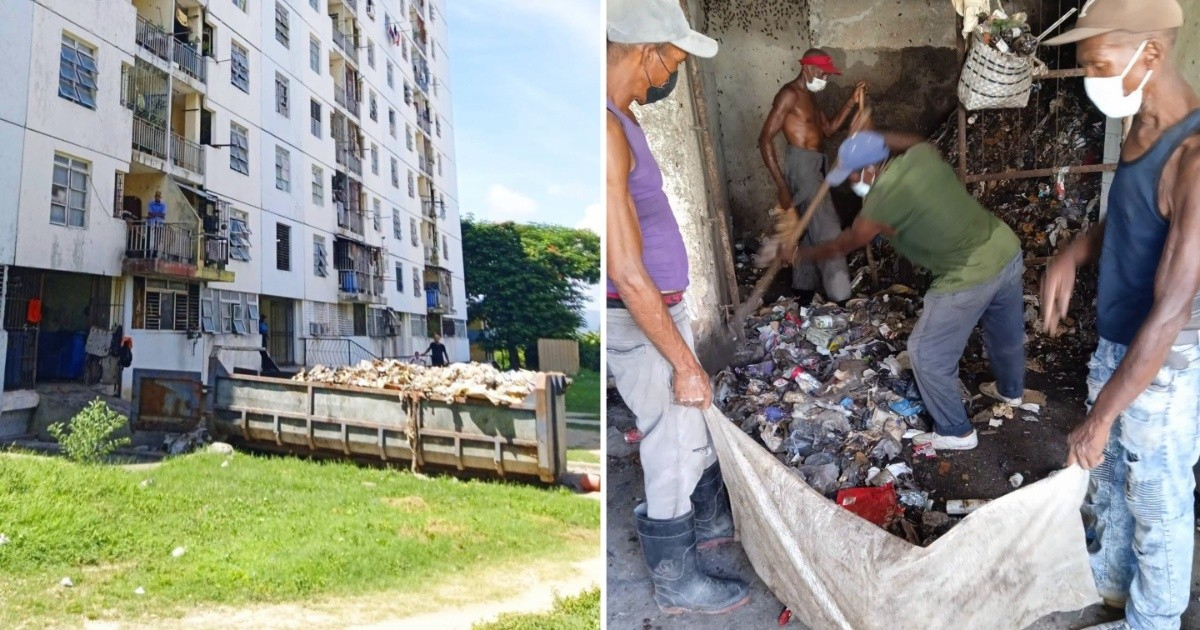
A report published on Facebook on Wednesday night achieved what months of neighborhood complaints had not: that the authorities of Santiago de Cuba intervened in the 12-story building in the Antonio Maceo district, where hundreds of families were living in critically unsanitary conditions without stable access to drinking water or electricity.
Since early Thursday morning, a multidisciplinary team made up of housing agencies, community organizations, electrical line workers, municipal authorities, district 3 representatives, and residents of the building itself began to work on-site.
Thus, he documented on his Facebook profile Aris Arias Batalla, provincial chief of Operations and Relief of the Red Cross in Santiago de Cuba, who the previous night had published what he himself referred to as "10 mg of reflection" on the situation of the building.
Among the actions taken that day were the collection of solid waste accumulated in the building's chute — the plastic containers had been buried in garbage for months, reaching up to the ceiling — the removal of the electrical transformer for inspection, maintenance, and oil replenishment, and the reorganization of the Neighborhood Board, which had ceased to function due to internal conflicts among residents.
Once the electricity is restored through the reconnection of the transformer, residents will be able to access the pump and switches of the turbine for pumping drinking water to the upper floors.
Arias Batalla acknowledged in his follow-up post that the situation did not reach that point by chance: "There was indeed negligence, administrative and governmental shortcomings on the part of all the executives of the aforementioned organizations, but let's wipe the slate clean."
At the same time, he called for a shared responsibility between institutions and residents: "The community as a whole has, and must, ensure its contribution to the hygiene and beautification of the building and its surrounding environment. Each person must do their part and contribute a little effort to reverse the current situation and context."
The comments from citizens on the post reflect a widespread perception that the authorities only respond to pressure from social media.
"Apparently, if it’s not reported on social media, problems don’t get resolved," wrote one user. Another was more direct: "Was it necessary to report it online for the residents' concerns to be taken seriously? Must we wait for a complaint to do what should have been done?"
A third commentator praised the intervention but warned that other properties in similar situations are still neglected: "I wish the situation of the 8-story building at Jota had the same visibility and that solutions were provided to the many problems here, which the Electric Company of Santiago de Cuba, the secretary, and the governor have known about since May, and yet, nothing, absolutely nothing gets resolved here."
"Let's hope that the vital signs improve with the passing days, so that Building 12 becomes comfortable, beautiful, and hygienic like it was in years past," wrote Arias Batalla, whose complaint achieved in one night what institutional channels had not resolved in months.
The case is part of a documented pattern of deterioration of multifamily buildings in the city. In the same month, residents of the 18-story buildings in Garzón reported nearly 40 hours without electricity, which paralyzed elevators and water pumps, while in San Pedrito, residents have been reporting an apartment full of garbage for six years with rats and cockroaches, without authorities providing a solution.
The national housing deficit exceeds 929,000 homes and nearly 35% of the Cuban housing stock is in fair or poor condition, according to data from 2026. In 2025, only 5,493 homes were built across the country, a 26% decrease from the previous year, according to figures from the National Office of Statistics and Information cited by IPS.
Related videos:
Filed under: