The Venezuelan journalist and political analyst Luz Mely Reyes, co-founder and director of Efecto Cocuyo, published a powerful opinion column on Venezuela this Thursday in El País titled "Venezuela has no one to write for it", in which she dismantles the narrative of both sides of the Venezuelan political spectrum and concludes that, amid geopolitical pragmatism and major oil agreements, "what was ultimately broken was the entire country."
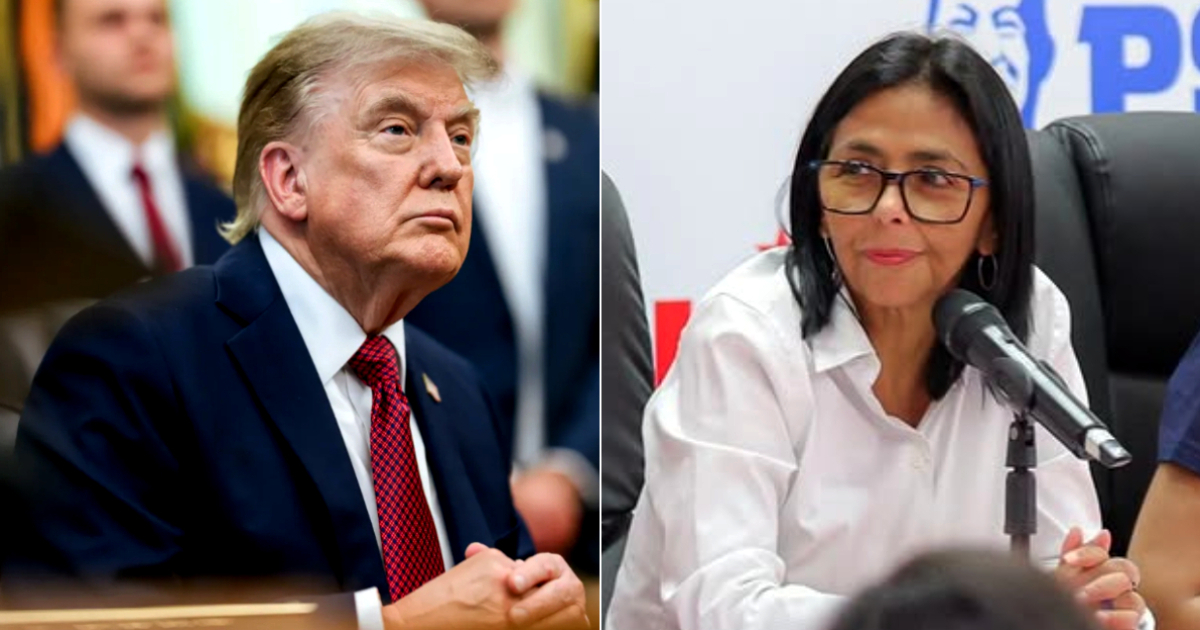
The text takes as its starting point what occurred the previous day in New York, when Delcy Rodríguez met with Donald Trump on the sidelines of the UN General Assembly — the first in-person contact between the leaders of both countries in over eleven years — while, at the same time, the Nobel Peace Prize winner María Corina Machado confirmed her seventh failed attempt to return to Venezuela so far this year.
Reyes describes Venezuelan politics in recent months as a sort of reality show where "almost everything we see on screen is due to special effects, while beneath the surface and behind the scenes, the real political and economic interests are at play."
The focal point of these interests, the columnist notes, is the control of Venezuela's energy resources. Before the General Assembly, Trump stated it plainly: "The armed forces of the United States carried out a massive operation in Venezuela. We arrested a criminal, Nicolás Maduro. Since that day, hundreds of Venezuelan political prisoners have been released. [...] Last month we signed the largest oil agreement in history, covering 65 billion barrels of oil [...] To the victor belongs the spoils," the columnist quotes.
Reyes describes the attitude of all actors as a collective self-deception. The collaborating opposition seeks to justify its actions "to avoid admitting that it has been relegated to a supporting role," while the leadership of Chavismo reassures itself with the maxim "bend to avoid breaking." Rodríguez promised at the UN that there will be elections in Venezuela, but without setting a date or specific timeline, and did not mention Maduro even once during her nearly 19-minute speech.
What is foreseen, the columnist warns, is not a democratic opening but "the formal dismantling of what remains of Petróleos de Venezuela." The agreement, she points out, is so opaque that "there is still no certainty whether the South American nation has signed a 100-year concession for the exploitation of its oil fields."
This is compounded by the reform of the Hydrocarbons Law and the Mining Law approved in January 2026 to open the sector to foreign capital. For Reyes, this represents “the most radical paradigm shift in the last 60 years: the transition from a rentier state to a low-cost extractive factory.”
The analysis by Reyes holds particular significance for Cuba. For over two decades, Venezuela supported the island with subsidized oil—estimated in thousands of barrels daily—in exchange for political cooperation and other services. Since the capture of Maduro on January 3, 2026, that flow has been interrupted or drastically reduced, worsening the already critical energy crisis in Cuba.
The new Venezuelan oil scheme, aimed at the U.S. and international markets, makes the restoration of that historic subsidy practically impossible.
Likewise, the expectations generated in many sectors and spaces regarding the possible overthrow of the Cuban dictatorship through a U.S. military operation similar to the one that led to Maduro's capture, have been contingent on the unfolding events in that South American nation. The Trump-Rodríguez alliance, most recently highlighted during the UN meeting, and the ongoing difficult situation faced by the Venezuelan people call into question many of those expectations.
With the García Márquez irony that titles his column, Reyes depicts Trump and Rodríguez celebrating their alliance while "there is a real country observing rusted seesaws and has towns in ruins." He concludes with an image that captures the exhaustion of a generation: like the colonel who awaited a pension every Friday that the State would never pay him, Venezuelans have been waiting for years for a democratic promise that, judging by the events of this week in New York, still has no expected arrival date.
Related videos:
Filed under: