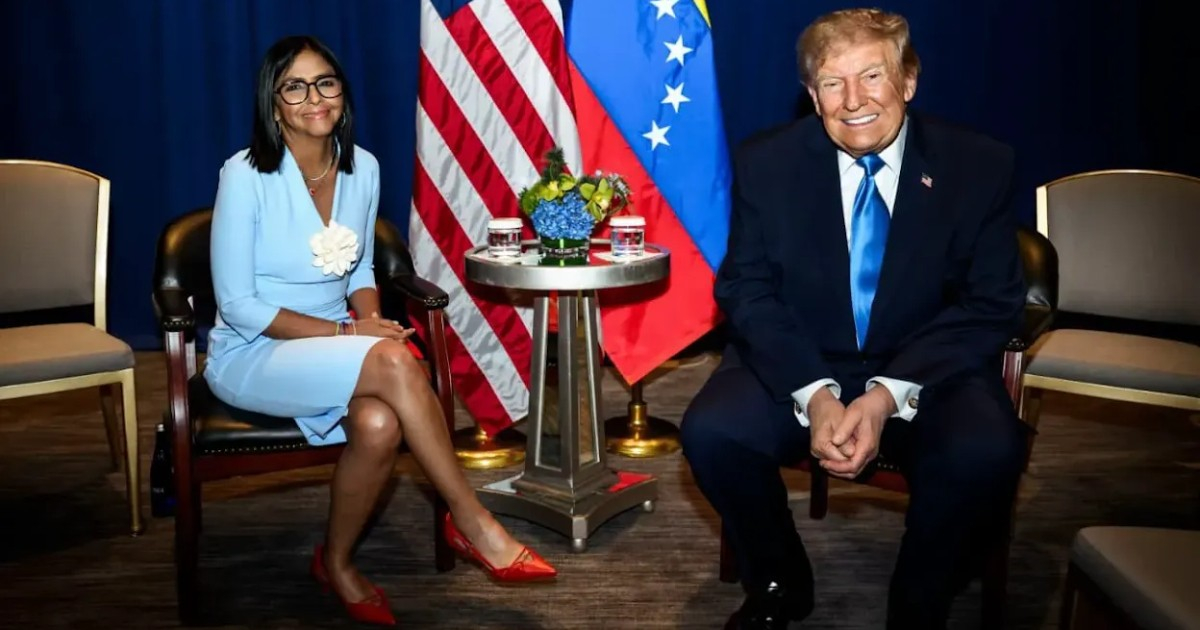
Donald Trump met this Wednesday with the acting president of Venezuela, Delcy Rodríguez, on the sidelines of the UN General Assembly in New York, marking the first in-person contact between a U.S. leader and a Venezuelan official in over eleven years, according to Axios, citing sources from the White House.
The meeting, lasting about 15 minutes at the Lotte New York Palace Hotel in Manhattan, was described by those sources as "warm, friendly, but also direct." Trump was accompanied by Secretary of State Marco Rubio, Treasury Secretary Scott Bessent, Chief of Staff Susie Wiles, and Deputy Chief of Staff Stephen Miller.
The central theme was the necessity of holding elections in Venezuela, although Trump did not set a specific date. “At the end of the day, there must be elections,” the president told Rodríguez, according to one of the sources present at the meeting.
Rodríguez, for his part, acknowledged the importance of the process: «She acknowledged it. She said she also wants elections», the same source noted.
Later, before the General Assembly, Rodríguez promised that there would be elections in Venezuela and stated that the Venezuelan government had "opened a dialogue" in that regard.
«There will be elections in Venezuela and in that direction, we have initiated a political dialogue with sectors of the opposition aimed at leading a process on equal terms for everyone,» he declared.
The night before, Rodríguez described the meeting as "historic" on her X account, highlighting that they discussed "strengthening the bilateral relationship and a cooperation agenda in strategic areas such as energy, mining, and security." The post included a photo of her making the "V" for Venezuela as Trump poses with his trademark thumbs up.
The image sparked outrage among the Venezuelan diaspora in the United States, which demands concrete electoral commitments and not just trade agreements.
On the same day as the meeting, allies of opposition leader María Corina Machado —Nobel Peace Prize winner— reported that Venezuela denied her entry for the third time in 24 hours, marking at least the seventh time since late June that the Chavista regime has prevented her from returning to the country.
The relationship between Washington and Caracas has taken a radical turn since the capture of Nicolás Maduro by U.S. forces on January 3, 2026. The Trump administration signed in August what Trump called the largest oil deal in history, which involves 17 strategic fields and approximately 65 billion barrels of proven reserves. Rubio's plan for the democratic transition includes three phases:
After Maduro's capture, Rubio stated that Washington was working on a "three-phase" plan for Venezuela: stabilization, recovery, and transition. In this regard, the Secretary of State has emphasized the importance of reforming the Supreme Court so that the opposition can nominate judges, reforming the National Electoral Council to prevent a repeat of the 2024 fraud — when victory was stolen from Edmundo González Urrutia — and, finally, announcing an election date.
But it is precisely that last step that is generating the greatest alarm among Venezuelan civil society and the international community, especially the countries in the region.
Internal sources of the administration, according to the transition plan explained by Rubio, suggest that an election in the summer or fall of 2028 would make more sense, given that Venezuela needs time to restructure a sovereign debt that the White House estimates at around 300 billion dollars, exceeding the country's own GDP.
The country cannot thrive until that is resolved, warned a Axios source from the White House.
On his part, Senator Bernie Moreno (R-Ohio) has proposed July 24, 2027, as the election date, but the Trump administration considers it premature.
"If it could be on the 27th, that would be great. We would like that", a government official told the mentioned outlet, although he clarified that Venezuela must first resolve its debt issue.
"If the deadline for meeting those conditions is 2027 or 2028, it is still up in the air. Of course, it cannot be extended indefinitely.", concluded the same source.
Related videos:
Filed under: