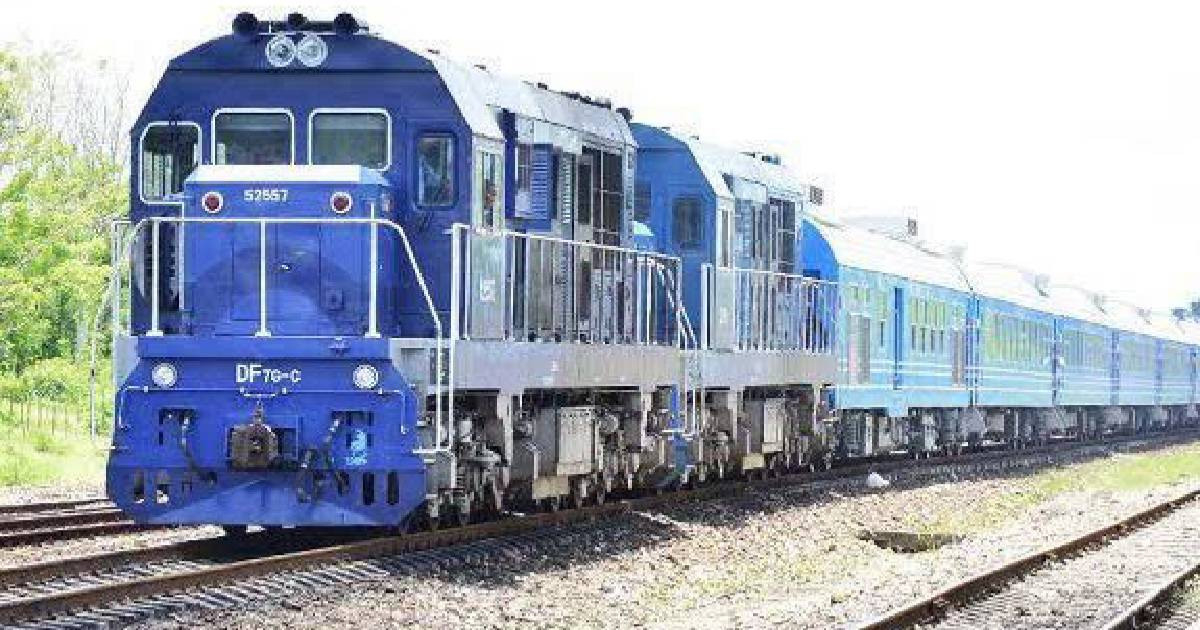
The Union of Railways of Cuba in Guantánamo announced changes to the railway service fares, although sector authorities admitted that they have not yet established the new prices for local trains or for interprovincial routes.
Pedro Durruti Martínez, deputy director of the entity in the province, explained that the calculation of the new rates is still underway and must receive approval from the Ministry of Finance and Prices before being made public.
"We are currently working on preparing the cost sheet and the calculations, essentially because the fare, the cost of the fare will be calculated based on man-kilometers traveled. It will not be based on a cost sheet. Why? Because when we started to prepare the cost sheet, it exceeded the prices that will be proposed for the operation of our trains," explained the executive, quoted this Saturday by the broadcaster Radio Guantánamo.
The chosen formula will allow for setting rates below the costs derived from traditional calculations. According to Durruti, the preparation of the cost sheet revealed figures that were "significantly higher" than the prices that authorities intend to establish for railway services.
The rate change is related to the introduction of the so-called "select operational card," a mechanism through which the purchase of fuel in foreign currency is financed for certain units in the transportation sector.
"The select card is used for purchasing fuel in foreign currency. That fuel has a quite high cost, but for the railway, what they charge us is only the equivalent in national currency, which is what is included in the ticket price," the official clarified.
He estimated that by the end of this week or early next week, approval from the Ministry of Finance and Prices could be obtained. Only after that approval will the new rates for motor vehicles, urban rail, and interprovincial trains be announced.
Among the mentioned services are the Caimanera-Guantánamo route and the routes to Santiago de Cuba, Cuneira, and Holguín. According to Durruti, these services are requested by the community, but they have not been able to enter into operation due to the fuel situation.
The deputy director of the Union of Railways of Cuba in Guantánamo confirmed that he will keep the public informed once the Ministry of Finance and Prices issues its approval, although he did not specify a definitive date.
The announcement of the new fares comes as the sector itself acknowledges that it still needs to determine how much it will cost to travel on railway services whose revival depends precisely on the availability of fuel.
Since February, the Ministry of Transport (Mitrans) has implemented a package of adjustments and suspensions in national and local transportation services due to the energy crisis.
In this regard, the number of trains to eastern Cuba has been drastically reduced, first to one departure every eight days and then, starting in June, to one every 16 days to Santiago de Cuba, Guantánamo, Holguín, and Bayamo-Manzanillo.
In July, it was revealed that the monthly operations of national trains fell by 74%, from 62 services to just 16 a month, and in August, Mitrans admitted that even those minimal frequencies could not always be guaranteed due to a lack of diesel.
Guantánamo, in particular, is experiencing a severe fuel shortage that has paralyzed public transport and has prevented the transfer of more than 140 tons of rice and 51 tons of beans from the port of Santiago de Cuba.
The debate over railway transportation prices is national. The Morón-Camagüey train was announced with a ticket price of 1,500 pesos, a figure that generated widespread citizen rejection as it was deemed unaffordable for salaried workers, retirees, and pensioners.
Related videos:
Filed under: