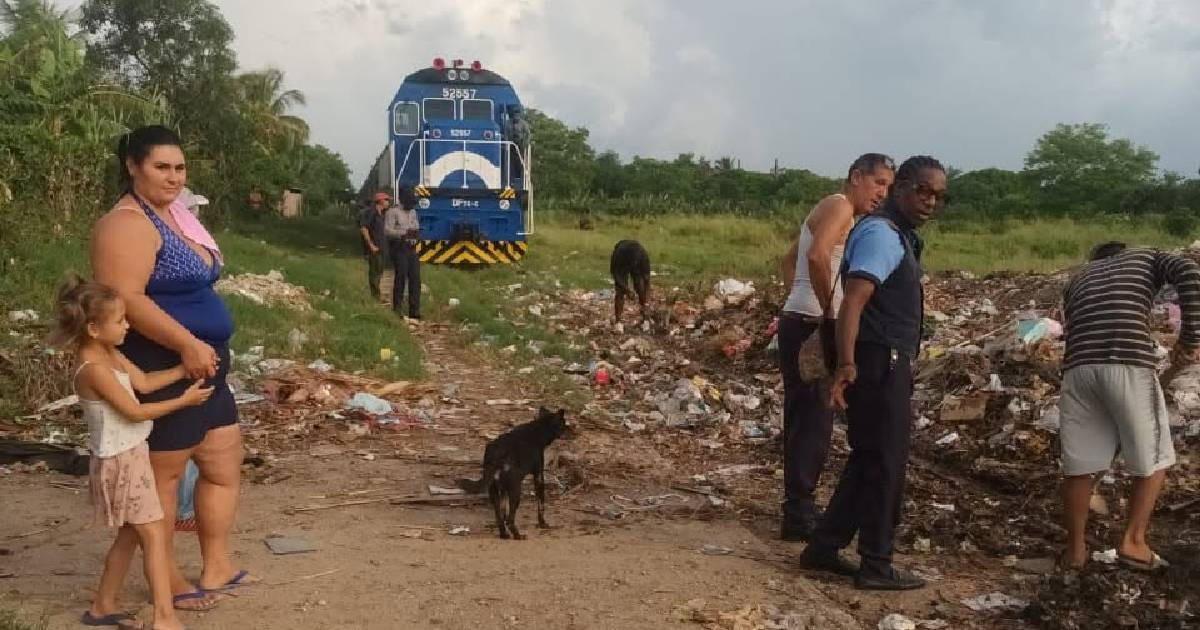
The Havana-Guantanamo train had to make an emergency stop this week in the Aguilera neighborhood of the city of Las Tunas due to the accumulation of waste on the railway track that blocked the passage of the train.
The incident was documented and published on Facebook by the artist and content creator from Tunera José Luis Alarcón, who described the scene with irony while not downplaying the seriousness of the issue.
According to Alarcón, the engineer spotted the obstacle as the convoy was approaching the area: "What at a distance looked like a Caribbean mountain range turned out to be a perfect combination of plastic bags, organic waste, and a couple of abandoned sacks." Faced with the risk of derailment, he activated the emergency brakes.
"The screech of the rails jolted half the passengers from their seats and brought the residents of Aguilera to their doorways," reported the content creator.
The images show locomotive 52557, model DF70-2, halted next to a plot covered in waste, cardboard, and debris, with passengers and neighbors gathered around. Several travelers got off with makeshift shovels to clear away the trash and clear the tracks, allowing the train to resume its journey.
A passenger, quoted by Alarcón, tried to find the silver lining in the situation: "Look on the bright side, at least there's a breeze here and we're not stuck in the sun in the middle of the woods."
"Will Aguilera stop become an official stop on the route? It will all depend on the next waste collection cycle," Alarcón quipped as he concluded his post, summarizing in a question the apathy of the authorities regarding a problem that not only impacts the quality of life for the residents of Tunero but also the safety of rail transport.
The episode is not an isolated incident, but rather the latest symptom of a chronic waste crisis that has taken hold of Las Tunas.
At the beginning of this year, the official press of the province acknowledged the existence of "hundreds of micro dumps" scattered throughout the capital city, with waste accumulating next to schools, clinics, and homes.
The causes are structural: the province needs 657 cart drivers for waste collection but only has 229 active, of which just over 60 operate in the provincial capital. In addition, there is a deficit of fuel for the collection vehicles, which reached zero in February 2026.
The waste has been affecting the railway infrastructure long before the recent incident in Las Tunas. In August 2025, the Railway Construction Company alerted about the uncontrolled increase of waste dumped on the railway tracks, warning that it shortens the lifespan of critical components and forces emergency cleanups that halt transit.
In April, garbage and debris blocked more than half of a railway crossing in Bayamo, on the line towards Havana, which the authorities themselves deemed a risk to human life.
Related videos:
Filed under: