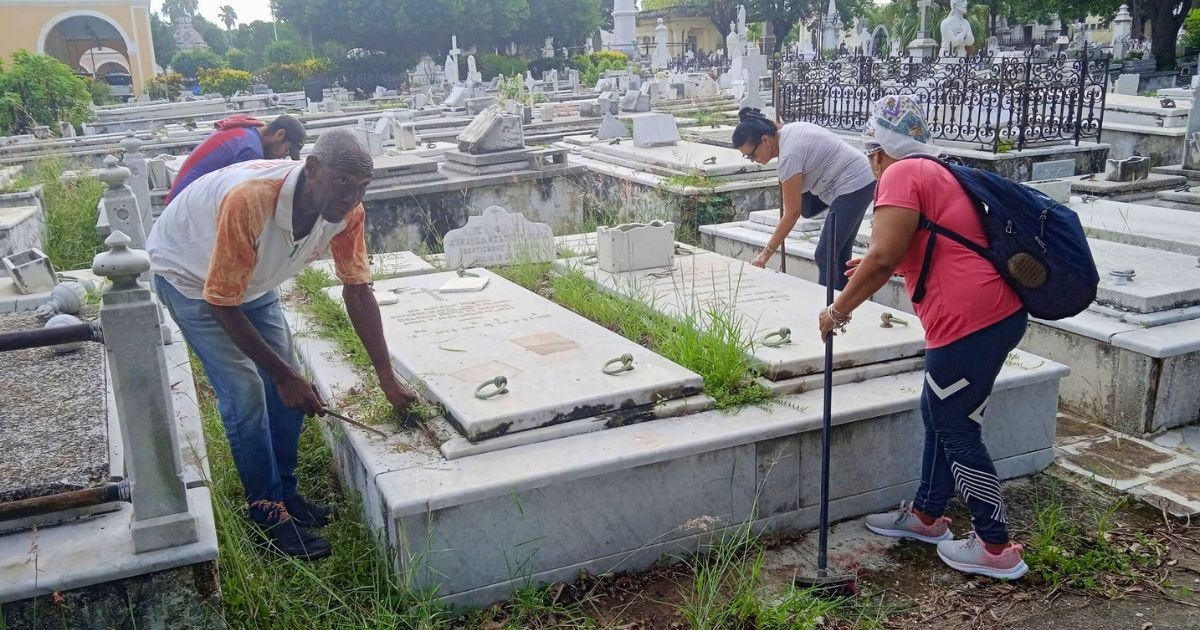
Workers from the Cuban Institute of Book (ICL) arrived this Friday at the Colón Cemetery in Havana to begin cleaning and maintenance efforts in the areas surrounding the graves of Cuban writers, in an initiative that will continue every Friday throughout September and October.
The post from the Cristóbal Colón Necropolis confirmed that the event was led by the Deputy Director of ICL, Niurka Eligio de la Fuente, and that the list of personalities to be honored includes 49 "writers of all genres, and Cuban poets" (sic). Could it be that poetry is not considered a genre of writing?
The first day covered the tombs of Laura Muestre Hevia, José Lezama Lima, Julián del Casal y de la Lastra, Dulce María Loynaz, Renée Méndez Capote, and Onelio Jorge Cardoso, with museologist Ricardo Rafael Díaz Murgas serving as the guide for the tour.
The Cuban state apparatus, always so attentive to its writers and artists, arrived with machetes and gloves—decades after having ignored, mistreated, censored, or directly persecuted them in life—to clear the grass from their graves. A form of reconciliation, undoubtedly, although the individuals concerned can no longer express their views on the matter.
Lezama Lima is perhaps the most eloquent case of the regime's posthumous generosity. His novel Paradiso, published in 1966, was withdrawn from Cuban bookstores shortly after its release, labeled as "pornographic" by the cultural bureaucracy. Since 1971, during the height of the Quinquenio Gris, he lived in official ostracism until his death in August 1976.
This year, marking half a century since his passing and six decades since the publication of Paradiso, Miami paid tribute with a full house screening the documentary "Lezama Lima: unleashing the tongue," by Ernesto Fundora, at the Coral Gables Museum. Havana, on its part, took measures to clear the area.
The case of Dulce María Loynaz is no less revealing. Isolated for decades by the regime, the Cervantes Prize she received in 1992 — the only Latin American writer to obtain it up to that moment — was not proposed by Cuba, but by Mexico, according to Cuban-Mexican academic Alejandro González Acosta in an interview, while the official Cuban proposal was Eliseo Diego.
González Acosta also recalled that during the Mariel exodus of 1980, Loynaz's house was the target of a repudiation act in which members or neighbors associated with the CDR threw stones and eggs at the home. Now, the state sends its officials to cut the grass for her.
The deterioration of the cemetery is no secret. In November 2024, images released by journalist Carlos Herrera Rodríguez revealed the neglected condition of the graves; in December of that same year, journalist Yasel Porto discovered vandalized tombs and exposed bones while visiting his grandmother's grave.
In April 2026, the cemetery had accumulated years of neglect with human remains mixed with debris, as reported by journalist Camila Acosta. However, months earlier, in November 2025, the regime had showcased another cleaning of the Colón Cemetery as a gesture for institutional image, with great fanfare and similarly fleeting results.
The ICL initiative is thus part of a well-established tradition: one-off cleaning events presented as grand gestures, rather than as a sustained maintenance effort for a space declared a national monument. The sessions will continue every Friday until the end of October, a sufficient amount of time for the grass, true to its nature, to start growing back again.
Related videos:
Filed under: