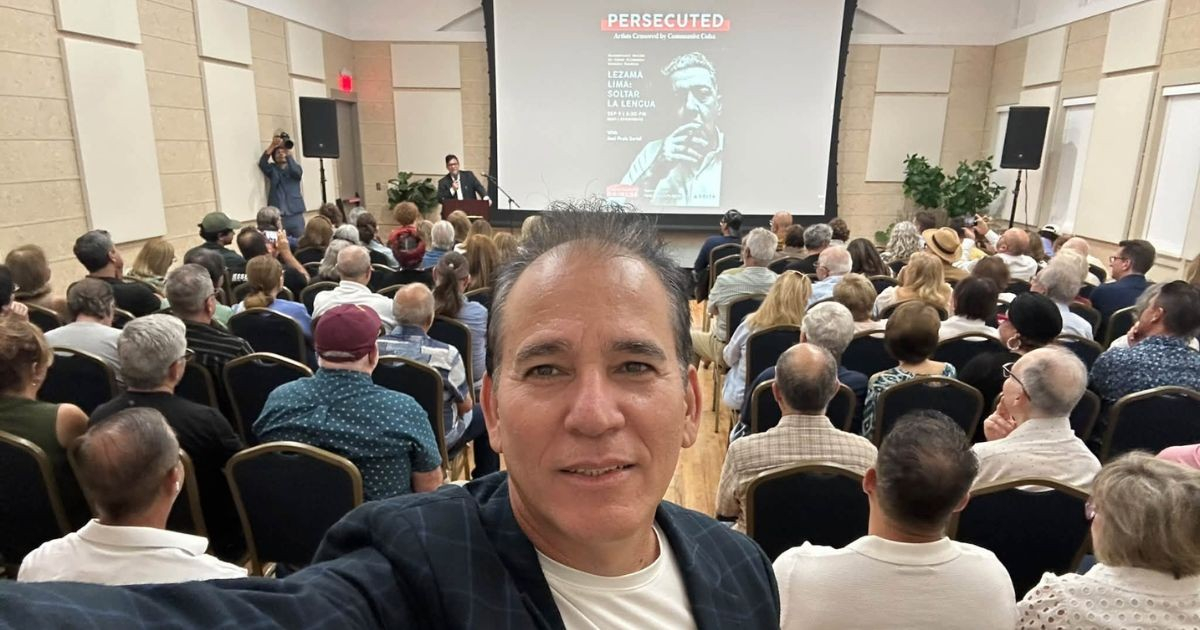
The documentary «Lezama Lima: letting the tongue loose», by Cuban filmmaker Ernesto Fundora, was screened this week to a full audience at the Coral Gables Museum in Florida, during an evening that brought together scholars, artists, and members of the Cuban diaspora to pay tribute to one of the greatest writers of 20th-century Latin American literature.
Fundora himself expressed his satisfaction on social media following the screening that took place on Wednesday the 9th: "Full house at the screening of the documentary 'Lezama Lima: Letting the Tongue Loose.' Thanks to the Museum of Coral Gables, to José Prats Sariol for his engaging talk, to Odalys Salina for her performance of a song featuring a verse by Lezama, to Mamushka, the great-niece of the poet, and to the entire top-tier audience that treated us with warmth and exquisite attention. Miami remembers Lezama. Congratulations."
The exhibition commemorated a double anniversary: the 50th anniversary of the death of José Lezama Lima —who passed away in Havana on August 9, 1976— and the 60th anniversary of the publication of his novel Paradiso, which was released in Cuba in 1966 and removed from Havana bookstores shortly thereafter, when the cultural bureaucracy of the regime labeled it "pornographic" due to its sexual content and homosexual references, particularly in Chapter VIII.
The event featured the participation of writer and literary critic José Prats Sariol, author of Lezama Lima or the Concurrent Chance (2010), who gave a talk about the poet; singer Odalys Salina, who performed a song with verses by Lezama; and Mamushka, great-niece of the writer, whose presence added a familial and emotional connection to the evening.
Feature film dedicated to the life of Lezama Lima, the film was produced between 2018 and 2019 by Video Vueltas Producciones SA de CV with support from TV UNAM, and includes interviews recorded in Miami, Havana, and other locations with figures such as Cintio Vitier, Fina García Marruz, César López, Anton Arrufat, and Silvio Rodríguez. The Coral Gables Museum describes it as a work that "explores the life, literary vision, and enduring legacy of Lezama," preserving "firsthand accounts from those who knew him personally."
The screening was part of the series "Persecuted: Artists Censored by Communist Cuba," in which the museum draws a connection between the censorship of the 1960s—embodied by Lezama, whose homosexuality, Catholicism, and defense of literary autonomy increasingly marginalized him in the context of the Grey Five Year Period and the Military Units to Aid Production (UMAP)—and contemporary repression.
The first installment of the series was the screening of the documentary “Luis Manuel Otero Alcántara: We Are Connected” on August 5, 2026, the anniversary of El Maleconazo of 1994, with Otero Alcántara himself —co-founder of the San Isidro Movement, arrested in July 2021 and sentenced to five years in prison— present at the museum.
Fundora, based in Mexico City and a graduate of the Instituto Superior de Arte (ISA) in Havana and the Escuela Internacional de Cine y Televisión (EICTV) in San Antonio de los Baños, has directed over 90 music videos and a dozen documentaries since founding Video Vueltas Producciones in 1996.
His recent trajectory has been marked by violence: in May 2026, Mexican Communist Party militants physically attacked him during a presentation of the documentary about Otero Alcántara in Coyoacán. The assailants shouted insults such as "Damn worms!" and slogans in favor of Fidel and Raúl Castro.
Fundora has harshly summarized the situation in Cuba: "We are held hostage by a group of satanists. The Cuban nation is held hostage by a group of satanists." The filled hall at the Coral Gables Museum last Tuesday was, in that sense, a cultural response to decades of censorship and repression: Miami remembered Lezama with the attention and affection that the Cuban regime denied him in life.
Related videos:
Filed under: