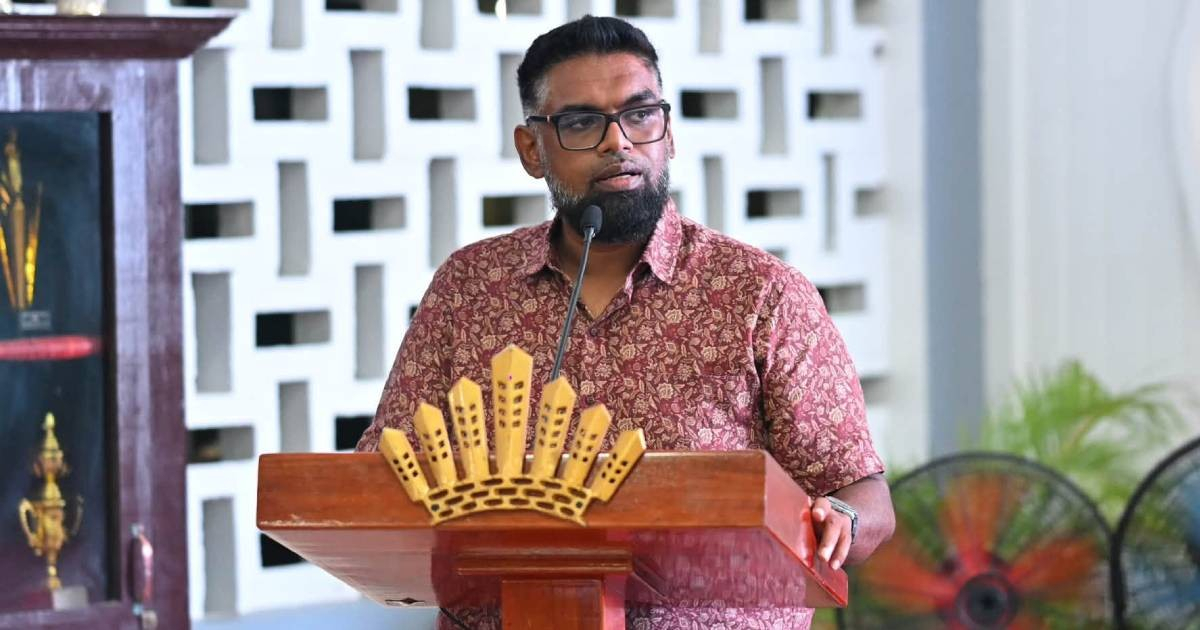
Guyana is preparing a new immigration policy to respond to the growing need for foreign workers that accompanies the rapid expansion of its economy, as President Irfaan Ali projects that by 2030 at least three million people will pass through the country for work, business, and tourism purposes.
The official explained that the Government is working on a migration framework that is "flexible, dynamic, and modern" during an interview about the economic relations between Guyana and Qatar, according to a report this Saturday by the Guyana Public Information Department (DPI).
Ali acknowledged that some sectors of the Guyanese economy are already dependent on foreign workers, particularly construction, and noted that that need will grow as new industrial projects come online.
"Can you imagine the construction sector without foreign workers now?" asked the president, who compared Guyana's situation to the experience of Qatar, a country that extensively relied on imported labor to support its economic transformation.
"Here in Guyana, we are far from major labor markets. But out of necessity, we are now importing labor," he explained.
The leader projected a significant increase in the movement of people to the country over the next few years. According to his estimate, by 2030 at least three million people will pass through the Guyanese economy to work, conduct business, or engage in leisure activities.
The figure does not mean that Guyana expects to reach a permanent population of three million inhabitants. Ali refers to the volume of people who could enter and circulate within the country's economy, a distinction that the president himself had already made in previous statements.
In 2024, during another discussion on economic growth, Ali explained that Guyana did not need to have three million residents, but rather to generate sufficient movement of people to sustain the new investments and services.
"You don't need three million people living in Guyana," he said then, according to reported Guyana Chronicle.
The new projection raises that aspiration. Guyana Chronicle reported this week that the Government expects a significant increase in workers, entrepreneurs, and visitors as projects in energy, infrastructure, agriculture, logistics, and tourism come online.
One of the central challenges will be to acquire the necessary human capital. Ali specifically mentioned plans to bring natural gas to shore and use it as a foundation for new industries, including a urea plant, an alumina plant, and large data centers.
"We need to have a flexible, dynamic, and modern migration policy to meet our future needs and requirements," the president affirmed.
The project does not start from scratch. In July 2025, the Government itself announced that the Attorney General was reviewing immigration, labor, and documentation laws from other countries with the aim of designing a modern framework that would facilitate the inclusion of foreign workers in the development process.
Ali then stated that a framework for future legislation had already been developed and summarized the reason for the changes bluntly: Guyana needed more people to sustain growth.
The need for labor has also been highlighted in evaluations cited by the Government. In February of this year, DPI reported that a study by the Centre for Local Business Development estimated a shortage of over 52,000 workers, while a projection attributed to the International Organization for Migration indicated that at least 100,000 additional workers might be needed for the country to fully develop its growth plans.
The policy being developed by Georgetown is also of particular interest to the growing Cuban community.
In August, Ali sent a direct message to Cubans interested in working in Guyana: they must enter and be employed through legal channels and will be subject to the same labor laws and conditions as domestic workers.
"Cubans who want to work here must do so through legal channels," the president noted at that time, amidst changes in the mechanism that had been used for years to hire healthcare professionals from the island.
News Room Guyana reported that the new scheme allows Cuban professionals to be hired directly within the framework of Guyanese labor laws, following the conclusion of the previous governmental mechanism for medical cooperation.
Ali also considers the Guyanese diaspora part of the strategy to meet the new needs of the country. The government assures that citizens living abroad are already returning to establish businesses and engage in projects related to economic expansion.
Related videos:
Filed under: