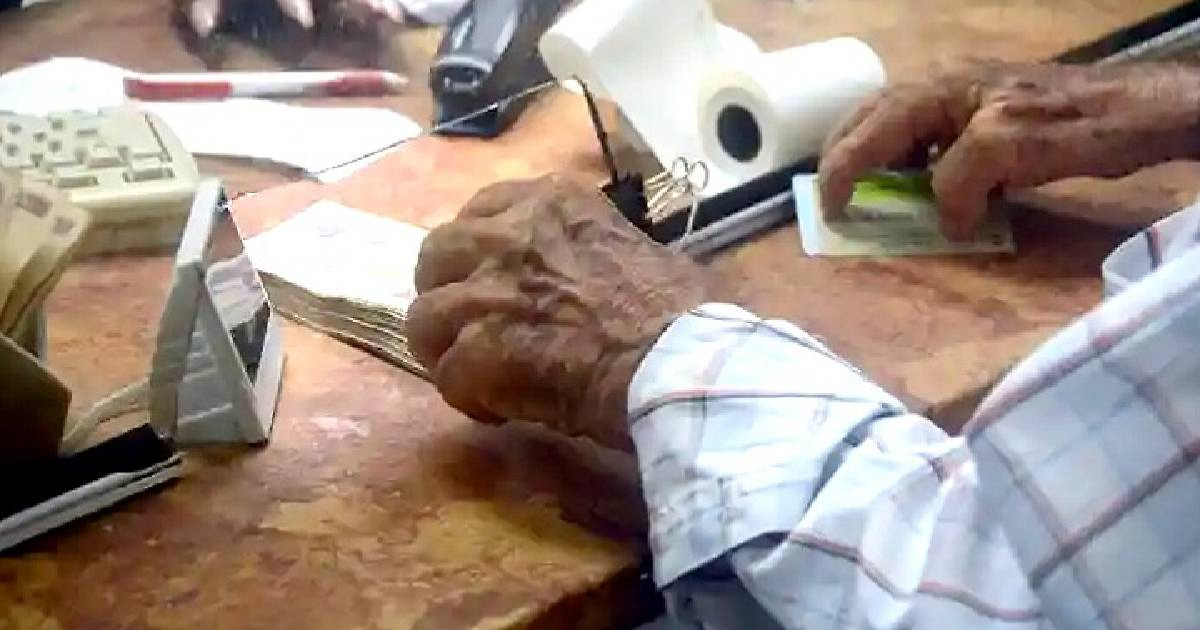
The government of Guantánamo has already signed 1,056 contracts with economic actors to disburse cash pensions to 18,344 retirees, which represents 37% of the pensioners in the province, confirmed the official newspaper Venceremos this Sunday.
The mechanism is part of axis number eight of the 176 economic and social transformations approved at the national level and was formalized through Resolution 74/2026 of the Central Bank of Cuba. Instead of going to a bank branch, retirees now receive their money from the assigned economic actor.
The scheme includes self-employed workers, micro, small and medium-sized enterprises, cooperatives, and state entities. These receive a payroll with the names of the beneficiaries and the corresponding amounts, make the payments, and have 72 hours to present the documentation to the bank and obtain reimbursement, the source detailed.
The average amount delivered to each retiree in Guantánamo is 3,256 pesos per month. This figure is below the national minimum of 4,000 pesos and, according to the provided data, is insufficient compared to the cost of the basic basket, which is estimated by several economists to be over 50,000 pesos.
The director of the Directorate of Labor and Social Security of Guantánamo, Oscar Mendoza Pérez, presented the transfer of this function as a benefit for pensioners, as it will help them avoid long waits at the banks.
Mendoza acknowledged that retirees will no longer have to "spend several hours in lines, in the sun, sometimes starting the night before, as has happened for years," in order to collect their pensions.
The highest-earning micro, small, and medium enterprises are the ones that have taken on the most payments, especially in the municipality of Guantánamo, where this method has been in place for two months at the initiative of the Central Bank.
In Imías, Niceto Pérez, Caimanera, and El Salvador, the greatest progress is noted, while the other municipalities show coverage levels between 11% and 36%, the news outlet pointed out.
The transfer of payments occurs alongside the liquidity difficulties faced by the Banco de Crédito y Comercio (Bandec) in Guantánamo. The institution needs to collect nearly 15 million pesos daily, but it barely receives just over 34% of that amount, a situation that, as Venceremos itself acknowledged in July, has ceased to be merely a banking issue and has transformed into a social problem.
However, three years after the banking system implementation, more than 31,000 retirees from Guantánamo, which is equivalent to 63% of the total (about 50,000), continue to rely on bank counters to receive their payments, while over 18,000 do so through postal agencies, a method that remains available even through postal agents in remote areas.
The Cuban economist Elías Amor warned about the risks of the model and described it as "madness," arguing that pension payments "are a state responsibility that cannot be shifted to the private sector," and that the scheme creates risks of liquidity, delays in reimbursements, and bureaucratic burdens for the participating businesses.
Related videos:
Filed under: